Brad White says Florida's defense must find its killer instinct
Brad White broke down Florida's defensive shortcomings against FAU, the need for greater awareness and what must improve before Campbell.
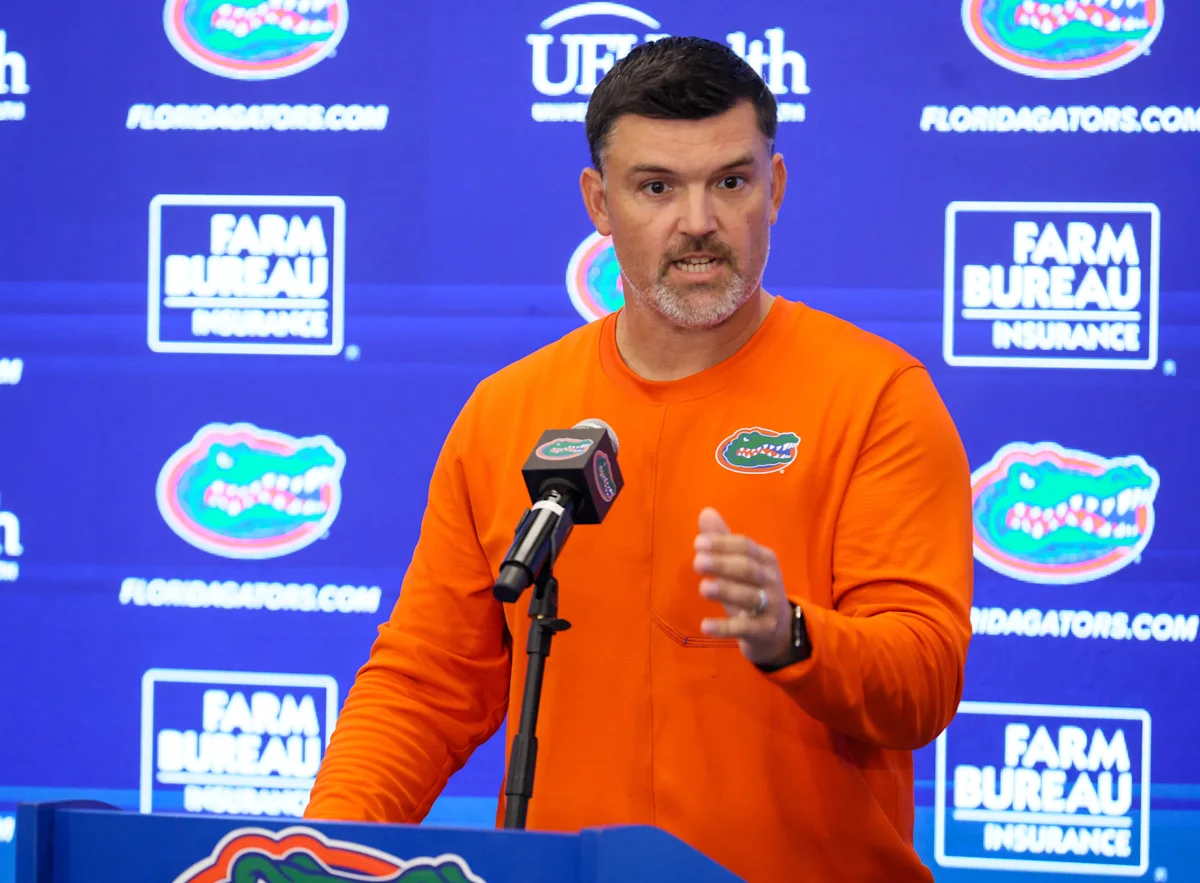
Allowing 21 points to Florida Atlantic left Brad White with a "pit in his stomach" after Florida 's defense failed to meet his standard in Week 1.
The Gators ' defensive coordinator credited the unit for forcing three turnovers and making several critical stops, but he didn't dance around the problems handling tempo, recognizing situations and maintaining proper pass-rush technique.
White also discussed DJ Coleman 's immediate emergence as a leader, Brendan Bett 's development, Alfonzo Allen Jr.'s versatility and the lessons Florida must carry into its Week 2 matchup against Campbell.
PHOTOS: Highlights from Florida's season-opening win vs FAU Owls
What was your assessment of Florida's defensive performance against FAU?
I think we all see it the same way. In every game, there's going to be good, and there's bad. In the moment, immediately after the game, you've got that pit in your stomach because you know we could have played way better.
That was not the standard or the bar that we want to set for how to play defense around here. Again, a lot of it, when you watch the tape, wasn't an effort thing. It was an awareness thing, understanding football and basic football IQ.
The No. 1 goal we talked about was embracing the tempo. We knew it was going to be high-paced. We knew it was going to be different than expected. I think for a significant portion of the game, we did not do a good enough job. We let it get to us and dictate how we played.
There was a little bit of survival mode. We talked about what you can't do against that is get into that mode where, "I've just got to survive this down. I've got to survive." You've got to have a killer instinct and empty it on every play.
It's a really good learning experience. Are you happy with it? No. We're really glad that we won the game. Obviously, the offense played really, really well and relieved some of that pressure for those guys on defense.
But we need to take a significant step forward in terms of our mentality, how we play and our awareness on the football field. When you play with football awareness and football IQ, you see the good things that happen.
You see DJ Coleman's pick. They're in condensed spacing. You've repped it. We've seen it. We repped it against that play call, and he knew it. He saw it, jumped it and, boom, DJ did a nice job on the tip.
There were good things, but Coach always talks about that word "strain" and what that means. We need to learn how to say, "Hey, listen, there's that effort where you feel like you're giving everything, but when you don't think you can go any further, push even more."
When you say, "My car is straining," like when your car is straining up a hill, what does that mean? It is pushing beyond its limit. It's not just working hard to get up. There are cars that work, but if it's straining to get up, you can tell by the sound and by the look.
That's what we need from some of our guys.
What were the positives from the season opener?
The takeaways were good. On first and second down, did they get some first downs? Yeah. But that was the first time I've ever been part of 22 third downs. Then you tack on another seven fourth downs. There were 29 times when it was third or fourth down, and a lot of those were short to medium.
Hats off to them. They were a team sort of built on explosives, and they said, "You know what? We're going to just try to methodically do this thing."
When a team does that, our guys have to be able to adjust. When we come to the sideline and make an adjustment — "Hey, we've got to jump down. We've got to get sticky. It's third-and-2. It's third-and-4. We've got to get the call and understand what the down and distance is. This is a time to challenge."
We have to learn from that. We'll get better from that. But by no means is everybody's head down and this thing is over. This is a building process. They've got to learn how I call a game. I've got to learn how they adjust on the sideline and how they take coaching. How literal are they sometimes when you talk and give coaching points? Can they read the tone, or is everything super literal? Every guy is a little bit different, and I'm still learning.
There are some calls in there that I would like back. There was a third down in the red zone when I was trying to take away one route, and then they ran the run play. By taking away the route, I took the safety out of the run fit, so he was going to be late.
I tried to muck it up, and we just missed the tackle inside. That's a call I'd love to have back, especially as much as they were starting to run the ball on third down. I should have just said, "Hey, we can play the route in a one-on-one situation without safety help." Those are things, again, for all of us. You've got to raise your hand and ask, "How do I get better from Week 1 to Week 2?"
How would you evaluate Florida's pass rush?
It never felt really clean. It didn't feel like we were getting a ton of clean wins. There were a couple of other times when we were at the top of the pocket where I think our top-of-the-pocket mechanics could be better — how we reach and how we strain at the top.
On the one third down when he scrambled down to the 1-yard line, we ended up jetting up the B gap with our three-technique, and he got really high. We needed that edge rusher to naturally turn it into a game. That three-technique also has to understand, "If I don't win the B-gap right now within three yards, I have to counter. I've got to push the play."
Some of the rush lanes got a little bit off. In the first game, all the technique went out the window a little bit — the things that they've been working on. They all came in Sunday and Monday with kind of long faces, like, "Man, Coach, all that bad technique showed up on film."
I was like, "Yeah, because you let the moment and the game get bigger than the training." But they've got to learn from that. This is why we say, "Do what we do."
We've talked in here about touching the stove. The reality is that most young men these days don't learn from other people touching the stove. You can tell them it's hot. They can watch their teammate touch it and say, "Man, that looked like it really hurt. Hey, let me just touch it to see if it really does or if you're joking with me."
The problem is that you've got 11 guys all trying to do that. It's like, "Guys, we've got to learn from that guy."
We're getting there. Do we need to get better? Yeah. But I'm never going to come up here — whether you like it or not — and say the sky is falling.
It's a game. We're going to pour into our guys, and we're going to be really demanding of them. They understand that. It was a really good Tuesday practice today in terms of what we're trying to demand of them and the growth that we expect from them and us as coaches.
But we're still going to enjoy it. We're going to enjoy it because that's how you have swagger. If it's a doldrum and you feel like you just have to beat them down to a pulp, then they're not going to play for you.
Were the defensive backs instructed to play off the receivers on third-and-short?
It goes down to feel. The best part about playing in The Swamp is being in The Swamp, and it's 90,000 people being loud on third down. At that point, you as a coach cannot communicate anymore. It goes back to having to be trained, and we have not done a good enough job of getting those guys to truly understand every down and every distance.
I have to not just get the call, but I have to know the situation. It's third-and-1 on the goal line. It's third-and-1 in a logo-zone shot area. It's third-and-1 backed up. What are their offensive tendencies in all of those moments?
It can't just be, "Man, I'm so tired. It's been eight plays. Please, just somebody make a play. I can't get beat deep, so I'm going to back up."
You've got to dig deep in those situations. But we have to continue to do a better job as coaches because, in practice, if you're out there and we tell you, "Get out and press," they hear you.
We can be yelling as loudly as we can on the sideline during a game, but they can't hear us. They have to be able to operate. The only player I can talk to is the inside linebacker.
How much has Brendan Bett grown, and what does he provide the defensive line?
He's on a defense that is young in areas. There are some older guys whom people lean into. It's him. It's the Bryce Thorntons. It's the Myles Grahams. It's the guys who have been around here for a while.
They've been in games and understand the environment, so guys can lean into them. He's that force. He's that guy whom I can talk to and say, "Hey, this is what we're trying to get done. Can you sort of help me along?" I lean into him.
But even he is still young in his football development. I think people forget how young we are from a pure snap perspective on defense. There's maturity that we have to go through, and there's a football maturity that we have to develop as a defense.
Even Bett, as a guy, understands that he's learning how to control the emotional aspect of football. He is emotional in a good way, but that still needs to be harnessed and controlled so he can play at his best and doesn't get down on himself if he's not making every play.
He wants to do right so badly. It's like, "Hey, man, it's not going to be perfect. But play with effort and play with strain."
Maybe my favorite play of the entire game was the fourth-down stop. Not for any reason other than it was the end of the game. Essentially, the game was in hand, but you want to talk about what strain looks like? That wasn't just effort. That was strain to finish the series and not let them in.
We came out of that timeout and said, "Guys, this is going to tell me something about our football character as a defense. Are we going to lay down? Are we just going to go through the motions and then sing the fight song afterward, or are you going to take this personally?"
When we say we defend every blade of grass, is that just words, or is that in action? You saw it from everybody, but you really saw it from No. 90 on that play.
What did you see in DJ Coleman before bringing him to Florida?
That's another one. You're talking about a senior guys trust and learn from. I referenced guys who have been here, but as quickly as DJ has been here, he has elevated himself into a leadership position on our team. So much of it is just through his work and how he goes about his business.
He's very much in that mold of being a pro's pro. He's here early and stays late. He's going to watch all the film. As much data as we can give him, he wants to take and absorb.
By no means was it perfect, but it was a really high-effort game. The interception and then the forced interception were really big plays. Obviously, you start the game with the pick. Then they had the two touchdown drives, and you're reeling a little bit. It was like, "OK, let's see how we're going to rebound."
Then, to have a pick at the plus-10 and give the offense a short field was big for us. It set up back-to-back drives when we stopped them on downs going into halftime.
That was a big momentum shift. We talk a lot about momentum in college football. Everybody talks about, "This is a key stat. This is a key stat." But if you look at the key indicators, they're all momentum plays.
If you win the explosive-play battle, what are explosive plays? They're big momentum swings. If you win the turnover battle, what is a turnover? It's momentum.
Especially when you're dealing with 18- to 22-year-olds, depending on what team you are, they might be older than that. Then you have the emotional roller coaster of it all.
How have Florida's four former Baylor defenders helped the unit?
I'm really impressed with the maturity level of those guys. I say it's not a surprise.
It's no different than when certain guys come from a certain high school and you know how they were raised and coached coming out of that program.
I know Coach Aranda really well and how he's developed from way back during his time at Wisconsin , LSU and before. We see things a lot of the same way in terms of how you develop a football player.
So much of it is awareness. That's why we harp so much on football IQ here. It's not about the X's and O's. The athleticism and strength are great. You need that, but smart, intelligent football players make football plays.
They do things that maybe super-athletic guys who aren't football-aware can't do. They play a step faster and read the formation. Where those guys came from would be why I think they've been such quality contributors.
What does Alfonzo Allen Jr. provide in the secondary?
He's a ball guy. He loves ball. He's super versatile in terms of being able to play at STAR or either safety position.
Again, we always say, "The more you can do," and he can do a lot for us. That's a huge skill set for us and allows us to have some flexibility in our rotations.
Certain defenses will call for certain guys. It's important as a play-caller that you try to highlight each player's skill set because his skill set is a little bit different than, say, Kanye's.
But you feel his physicality when he comes downhill and puts his hands on blockers. His block destruction is really good, and his tackling is firm and solid. He's been a really pleasant surprise for us.
What did you think of Kanye Clark's performance against FAU?
I thought there were some good things and some things that we need to work on. There were two different slot fades. One was obviously a really good play down there in the red zone. Then there was the one on third-and-long after the review and incomplete. We were bringing pressure. The quarterback saw it and just threw it up with Jaden Robinson barreling down on him. It was a good throw and catch.
If you're going to play Cover 1 at times, those are the hard ones. There's a reason that's the go-to shot when you know it's single-high or zero. You throw that all day long. You want to win more than you lose. He just happened to have two of those plays. It was a true 50-50.
When we accumulate it at the end of the season, you can ask me. If that thing looks like it's 65% or 70% in our favor, then he did a good job. If it stays 50-50, then we'll have a different discussion.
How do you teach the players to improve their situational awareness?
You try to find anything. You highlight it, but we talked about the touching-the-stove piece. You can talk until you're blue in the face, but a lot of these guys have to experience it.
The reality is that all of us tend to learn better when there's a consequence. Specifically, already this week, I'll stop a drill and say, "OK, what was the down and distance? What was the personnel?" I'll ask, and if they don't know everything about it, the whole defense is doing three up-downs. It's forcing them to think and forcing them to be overly aware in practice.
If they're not, it's not just them doing it. They're accountable to all their teammates. Trust me, when you start doing too many of them, everybody's going to be looking at you and telling you to make sure you know. Then it gets communicated across.
It's not just an individual issue. If I'm a safety and see my corner out there not pressed, I'm yelling at him to get down. It's not, "Well, I hope he gets down. That might be a minus on his play." Talk. Help each other. It's OK to help each other.
We're going to have some of those mechanics going forward. Again, that's on me. I probably should have been doing that more early. Sometimes you take some things for granted.
Topics in this story
Gathered from external sources. Rights to this text belong to whoever originally published it.