Kevin Danso and Sunderland: Why Pragmatism Can Be Progressive
Sunderland’s approach under Régis Le Bris may not always look ‘progressive’, but could Kevin Danso show why pragmatism is helping the Lads succeed?
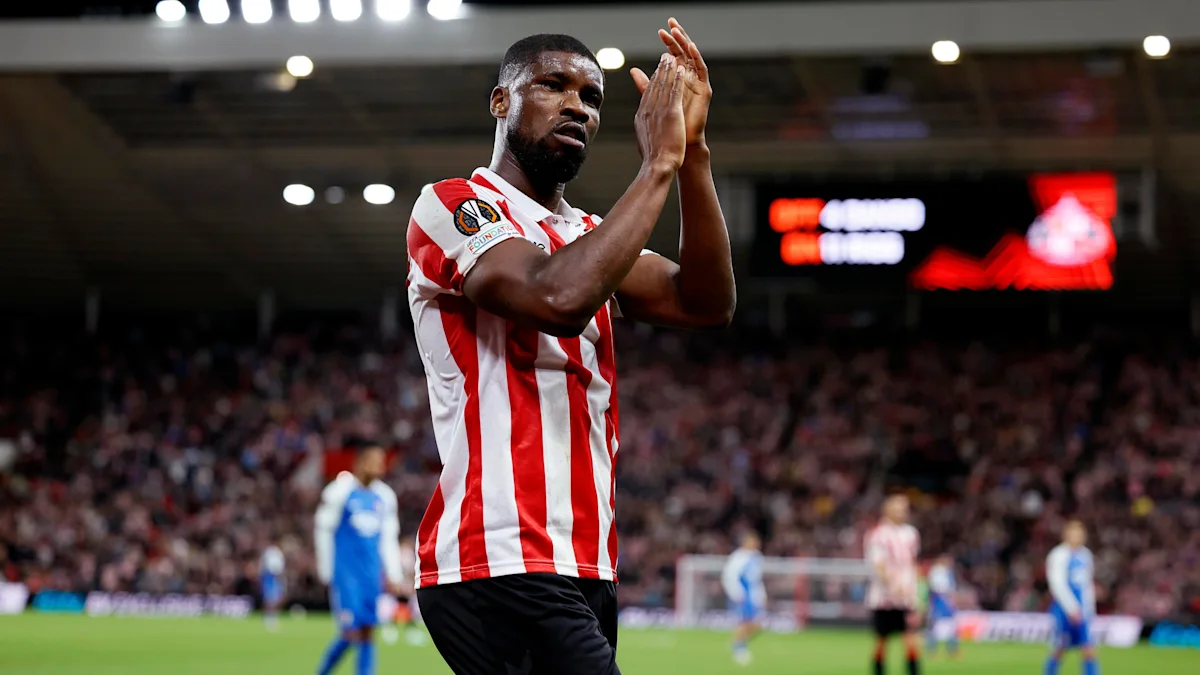
Terminology in football always tends to change. Closing-down became pressing, direct play evolved to vertical football, and having to defend is now referred to as suffering. When the elements of the game we all know are constantly redefined, you could be forgiven for forgetting that a knock-down from a long throw-in counts the same as a tap-in from 2 yards.
There is one particular adjective that is bandied around and continues to confuse me, because I don't know what a progressive manager is. According to the Oxford Dictionary, the word means " happening by degrees or favouring modern, forward-thinking reform ". Guardiola, Bielsa and Brighton 's Fabian Hürzeler have all had the term attached to them. But why?
Is Arteta's building of an incredibly physical squad to exploit set-pieces any more reformative than Guardiola bringing passing out from the back to English shores? How much added value has Vincent Kompany added to Bayern Munich after joining from a relegated Burnley ? Why is Antonio Conte seen as 'rigid' in his 3-4-3, yet Ruben Amorim and Xabi Alonso were seen as tactical pioneers?
Well, I'm not going to answer those questions for several reasons. One being that this is a Sunderland page, and another being that there's probably a book's worth of writing to be done there. But I do think there's a Wearside-centric conversation to be had here.
Régis Le Bris has not received enough credit for his work at Sunderland. The sound of his plaudits decays incredibly quickly the further away from the Stadium of Light you get. Whilst there was a vast quantity of money spent last summer, and figureheads like Granit Xhaka exponentially increased the quality of the squad, it was Le Bris who bonded that together.
Le Bris found the balance of his footballing principles, the foundations he had already laid in the Championship, and the humility against superior opposition to guide us to Europe last season. So why were we 4th favourites for relegation at the start of the season?
Well, before trying to answer that, there's another term worth introducing: pragmatic . Again, I'll look to Oxford, which defines the term as: "dealing with problems, decisions, or situations in a practical, sensible, and realistic way based on what actually works in real life, rather than following fixed theories, dogmas, or ideal rules".
Régis Le Bris is certainly seen as more of a pragmatic than a progressive figure in football, and should that be looked down upon as much as it feels?
I think Kevin Danso is the perfect vehicle to guide us through this conversation. The Austrian joined Spurs as competition to Cristian Romero and Micky van de Ven last February, with Ange Postecoglou stating, "Obviously we're a bit short at the back and have been for a while. He's experienced, a good one-on-one defender and new players give us energy."
Whilst not a glowing endorsement from the Australian, it was ultimately his fourth Tottenham Hotspur manager that saw Danso's exit, in Roberto De Zerbi. Romero also subsequently left the North London side this summer, but De Zerbi also saw the exit of promising youngster Luka Vušković, with replacements coming in the form of Jan Paul van Hecke , Marcos Senesi and Tosin Adarabioyo .
It is apparent that the keys to the Tottenham Hotspur Stadium have been given to the 47-year-old Italian, both with the quantity of money spent and in the places they have spent it. After a lengthy doping ban, Mykhailo Mudryk was reunited with the man he calls his " footballing father ". As already mentioned, Vušković departed, despite being named in the Bundesliga Team of the Season, and after aiding England to a World Cup semi-final, Djed Spence was allowed to leave for Italy .
Well, when you compare him to his apparent replacements in Senesi and van Hecke, it adds some context.
lbeit in fewer minutes than both Senesi and van Hecke, Danso's defensive numbers, for a poor Spurs side, last season dwarf both of his replacements. He was far more active in both aerial and ground duels, winning almost twice as many in the air as the Argentine did for Bournemouth . Danso was also a far more active defender, averaging almost 12 defensive contributions per 90.
Danso is clearly an adept and frequent defensive contributor to his sides; we've already seen that this season. But when you compare his work with the ball, you can begin to understand why he was allowed to leave North London.
van Hecke averaged around 60 passes per 90 last season, with Danso and Senesi averaging around 10 fewer. van Hecke and Senesi also managed over 20% of their passes to be line-breaking , meaning it was able to bypass a section of the opposition's defence, e.g. past a pressing front three or a midfield block. Danso only sat at around 13% of his passes for that metric. He also averaged fewer touches and accurate long balls than both of Spurs' new defenders.
De Zerbi has clearly made it clear that his defenders must be extremely comfortable on the ball, even if that means sacrificing both defensive actions and ability.
Of course, you can take these numbers with a pinch of salt. Both Bournemouth and Brighton fared better than Spurs last season. It's understandable that, as a central defender in a team that is fighting relegation, a simple shorter pass may be more favourable than a risky cross-field one.
Danso was never first-choice at Tottenham, but another thing Senesi and van Hecke had last season was the stability of playing under a single manager. It wouldn't have helped that he had to win favour with Thomas Frank, Igor Tudor and Roberto De Zerbi, even after the departure of the manager who brought him in.
Regardless, Danso's numbers show him as a centre-back who will frequently seek to break down or stop attacks, and at a relatively high success rate.
In his book ' How to Win the Premier League ', Ian Graham speaks of how it can be difficult to analyse the quality of defenders and uses Liam Ridgewell to convey this. At the end of the 2007/08 season, Ridgewell ranked amongst the best in Europe for his frequent number of blocks, clearances and last-ditch tackles. Graham goes on to mention that, without video analysis, it would've also been difficult to notice that he was also liable for a number of the chances Birmingham conceded that season.
Whilst he wasn't alone or a standout in that regard, it did provide context and an added dimension to what you would consider 'defensive responsibility' . The frequency of defensive actions doesn't indicate their quality or their cause. Danso is certainly not a calamity at the back, but it is worth considering.
So what does all this have to do with Sunderland? Well, the likelihood is that Danso will become a permanent member of the club next summer, and more pertinently, a significant fixture of our defence this season. But I think there's a few more ways you can look at this.
I don't think it's unfair to say Régis Le Bris has shown himself to be conservative in the Premier League so far; it's certainly not meant as an insult. His tactics have found ways to ensure the side have a solid, defensive foundation, whilst allowing the likes of Le Fée, Brobbey and Isidor to shine when the opportunity arises.
When I mentioned progressive managers before, I've recently grown to find Le Bris' use of Hume or Meunier really intelligent. Nordi Mukiele provides so much going forward as a right-back, and has the additional cover of those hybrid wingers/full-backs when Sunderland are out of possession. I think that is why Danso makes a lot of sense; he allows Mukiele to operate on the right and is athletic enough to cover the space left when he does roam upfield.
However, you'd like to think there would be a point where the metaphorical handbrake can be taken off. The Manchester City game certainly showed that we have the attacking quality and offensive movements to harm the best that England has to offer. I hope Le Bris does trust his side to play like this with two traditional wingers at points this season.
And that is why Danso is such a brilliant representation of where Sunderland are at. Many can consider prioritising a centre-back's defensive abilities somewhat archaic, but under Le Bris, it is pivotal that a solid base is there to allow our forwards to do their best work.
There may be a time when we seek more progression from deeper areas of the field, but what we've landed upon has brought us to European football. Whilst some may not consider our football sexy, and some may not think of Danso as a modern elite centre-back, the effectiveness of both cannot be questioned.
We're at a position where a move from one of the traditional 'big 6' to Sunderland for a peak-age player is not seen as a step down. It may even, and can perhaps even, provide a platform for players to shine and display their full arsenal of abilities. You'd hope that, as we grow with Le Bris, his confidence to play more expansively would grow with it.
We've seen glimpses in the Championship, and now in the Premier League, of how Le Bris can enable more offensive play. I'd argue if you want to measure it in the coming season, take a look at Kevin Danso.
Topics in this story
Gathered from external sources. Rights to this text belong to whoever originally published it.