Santos' historic debut in 1912
By Gabriel Pierin, from the Memory CenterThe historic clash brought together Santos Foot-ball Club and its namesake, Santos Athletic Club — today renowned as...
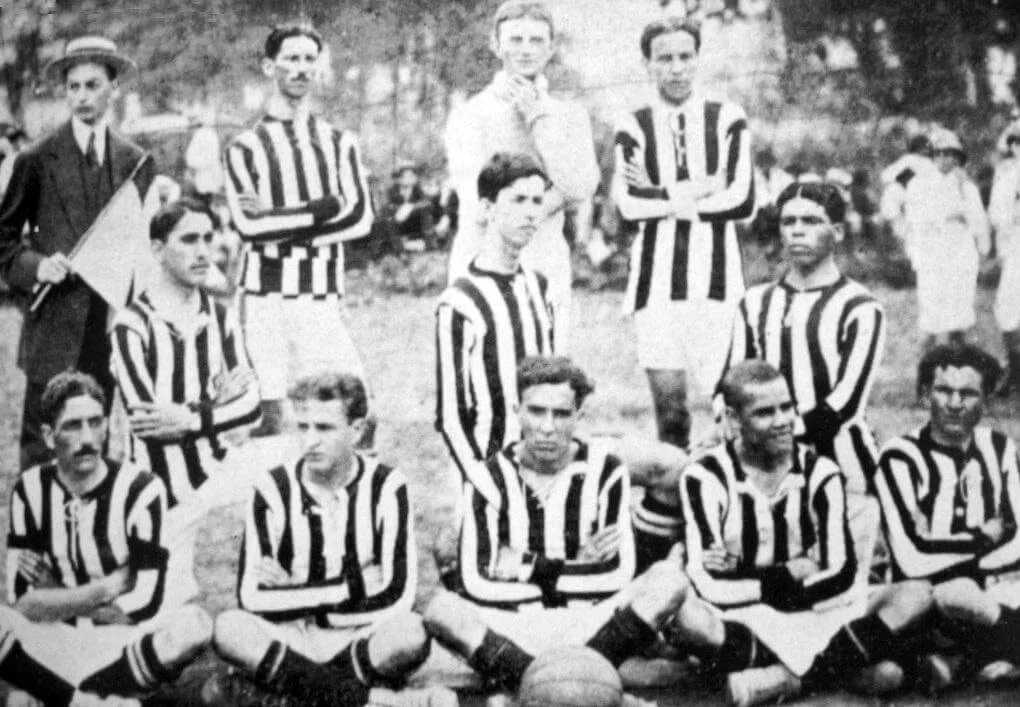
By Gabriel Pierin, from the Memory Center
The historic clash brought together Santos Foot-ball Club and its namesake, Santos Athletic Club — today renowned as the "Englishmen's Club" — at Velo Santista, the former ground of SC Internacional.
On that distant September 15 , 1912, under a radiant Sunday sun, the young left winger Arnaldo Silveira, "Miúdo," just 18 years old, scored the first goal for the fledgling team. The club, which at the time had its headquarters at Largo do Rosário, originally wore white and blue with gold trim.
That first official match of the squad led by Sizino Colatino Martins Patusca served as a prelude to the many decades of glory and major achievements the newly founded club would go on to enjoy.
Santos, which used to train in Villa Macuco, near the Santos docks, lined up for that pioneering match with French goalkeeper Julien Fauvel, Sidnei and Arantes; Ernani, Oscar and Montenegro; Adolpho Millon, Hugo, Nilo, Simon and Arnaldo Silveira.
On the other side, the team from the José Menino neighborhood featured Parsons, Kent and Deweck; Woodon, Seddon and Lee; Saul, De Saone, Allen, V. Cross and Harold Cross. Curiously, one of Santos Athletic's forwards was Harold Cross, one of Santos's own founders, who in the very next fixtures would join Santos's attacking line.
The inaugural encounter ended 3–2 to Santos FBC. The winning goals were scored by Arnaldo Silveira (2) and Adolpho Millon (1), while Lee scored twice for the British side.
On that same pitch, set on the charming and well-known Ana Costa Avenue, Santos played 14 matches, recording 11 wins and three draws, and also won the 1913 Campeonato Santista on that ground .
The press of the time immortalized the event with the following account:
"With a crowd the like of which we had not seen for some time, yesterday's match between the distinguished English Club and Santos Foot-Ball Club took place. Around the field stood the most distinguished English and Brazilian families. There was much discussion over who would win, some favoring the Brazilians, others the English. Once the contest began, at 2:30, the kick-off fell to the nationals, who soon lost the ball, though before long they struck back, putting the English goal in serious danger. After a hard-fought battle, the first half ended with the following result: Santos Athletic Club 1 goal. Santos Foot-Ball Club 1 goal.
In the second half the struggle became fiercer still, and then the fine play of Montenegro, Oscar and Belmarço was seen, increasing the score with 2 more goals for their team. The English, for their part, redoubled their efforts, managing another goal, scored by Lee. It is worth highlighting goalkeeper Fauvel, who played admirably, as well as Montenegro, Simon, Belmarço and Arantes. Among the English, their goalkeeper Person, Lee and Cross stood out. At 3:30 the game ended with the victory of Santos Foot-Ball Club by 3 goals to 2."
That afternoon, with the gates open to the public, Santos's players took the field wearing white long-sleeved dress shirts, with a blue ribbon on their arms.
Adolpho Millon Jr., son of captain Adolpho, and Arnaldo Silveira, nephew of president Sizino Patusca, emerged as the first two idols in the history of the Alvinegro Praiano. Both Meninos da Vila played a decisive role throughout the club's first decade.
The brilliance of the duo up front opened the way for them to be called up as starters for the first Brazilian National Team in history, which played in the 1914 Copa Roca in Argentina. Their partnership with the national team lasted until the 1919 South American Championship, when they became champions wearing Brazil's colors.
Right winger Millon wore Santos's black-and-white shirt until 1922, making 118 appearances and scoring 52 goals. Right winger Arnaldo Silveira, meanwhile, represented the Vila Belmiro eleven 132 times, finding the net on 74 occasions.
Both stand out among the select group of the 39 founders of the most famous black-and-white club in the world.
Topics in this story
Gathered from external sources. Rights to this text belong to whoever originally published it.