The good, the bad, the s—t that gets you beat from Patriots vs. Bears
Let’s use Mike Vrabel’s categorizations to break down the Patriots’ loss in Week 7.
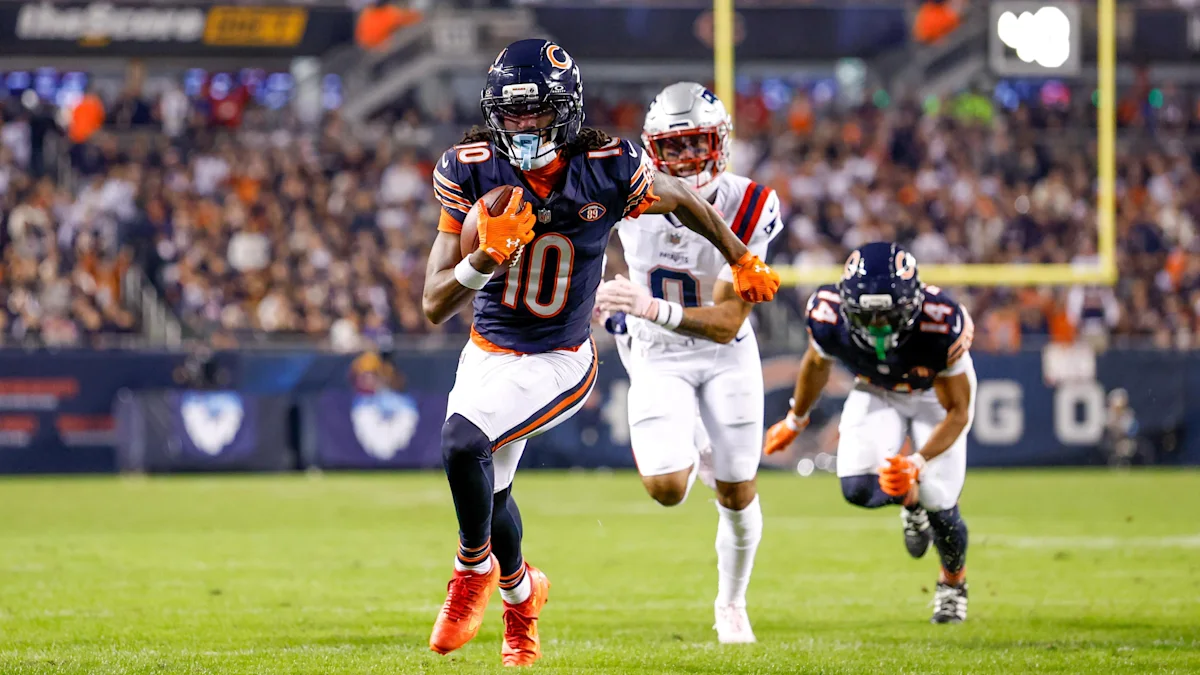
Ahead of his first training camp as Patriots head coach in 2025, Mike Vrabel explained that he was judging his team's performances by three distinct categories: the good, the bad, and the s—t that gets you beat. If Vrabel looks at his team through those specific categorizations, we shall follow his lead.
The New England Patriots are now 0-2 in prime time games this season. The second of those defeats came on Thursday night at the hands of the Chicago Bears, a 30-24 loss in what was a competitive game between two good teams. At the end of the day, though, it was the home team that ended up making more plays.
With that said, let's dive into our weekly breakdown of the good and the not-so-good from the loss at Soldier Field.
Even though his early-season version reared its head again at one point, Drake Maye looked every bit like the franchise-caliber quarterback he is on Thursday. In fact, the entire pass game operation was pretty good against the Jets: two touchdowns plus 310 net yards and 9.4 per play, and that's not even including 26 yards on three scrambles.
From top to bottom, New England moved the ball well whenever it took to the air. Of course, that was largely due to Maye.
"He gave us a chance. He competed," said Mike Vrabel. "I know he'd like to have that throw back to Eli [Raridon], but I thought he really competed. Whether that was running around and scrambling or finding good places to go with the football, he gave us a chance. I know he'd like to have that one back and he'll learn from it like he always does. I'm glad he's ours."
On the day, Maye completed 77.4% of his pass attempts for 321 yards, a pair of touchdowns and that interception in the end zone. Even putting that play into account, he finished with 0.34 expected points added per play — the same number as his Bears counterpart, Caleb Williams.
Maye is the main man, but the operation also function the way it did because of the blocking up front. Even with guards Alijah Vera-Tucker and Ben Brown out (let alone Mike Onwenu), New England surrendered only 14 quarterback disruptions for a 38.9% pressure rate — the third-best mark of the season thus far.
"We protected when they pressured," said Vrabel. "I thought that was a huge key for us as they continued to pressure and put a lot of guys on the line of scrimmage. Our ability to pick it up and hit some chunk plays was really the reason we were in it in the second half."
"We didn't run the ball well enough," was Mike Vrabel's blunt assessment after the game. And he was right, the Patriots didn't.
Excluding those aforementioned Drake Maye scrambles but including a quarterback sneak for no gain, the Patriots finished with only 44 yards on 14 carries for an average of 3.1 yards per run and -0.40 expected points added per run. As a reminder, the Bears defense had entered Thursday ranked just 25th in the NFL, giving up an average EPA of -0.057.
So, what was the issue? Unsurprisingly given the circumstances, it started up front: New England's run blocking simply was too spotty to make a consistent difference. When it worked well the results looked the part (see: Rhamondre Stevenson's 13-yard carry in the second quarter) but when it didn't there simply was no room for the backups to operate (see: the very next play).
Given that the Patriots had to overhaul their O-line on a short week, struggles like that had to be expected. But the breakdowns were not only due to Walter Rouse and Matt Pryor entering the lineup, but across the board — including at tight end and wide receiver. One potential big TreVeyon Henderson run, for example, was unable to develop because center Jared Wilson was beat climbing to the second level; meanwhile, Eli Raridon's run blocking continues to be a mixed bag.
Add it all up, and you get the Patriots not getting anything going on the ground.
The s—t that gets you beat: Big-play defense
Leading up to the game, we mentioned "limiting explosive runs" as a key to the game for the Patriots. To their credit, they did that, and were only beaten twice by a team averaging close to four explosive per game entering the contest; those two plays furthermore only barely earned "big play" status by gaining precisely the 10 yards required for that classification.
But while New England did a good job in that area, stopping big plays was an issue throughout the evening on Thursday: the Bears finished with 10 of them, meaning that eight happened in the passing game and on plays gaining 20-plus yards.
Among those was a 58-yard catch-and-run and 24-yard touchdown, both to wide receiver Luther Burden. The Patriots struggled to defend the second-year man all game: he was responsible for four of those eight explosive passing plays, gaining 130 yards total on those.
To make matters worse, three of the explosives — including Burden's touchdown — came in third-and-long situations and only one came on first down. On average, the Bears were 11.6 yards off the line to gain on their big passing plays. Those situations do invite a vertical pass game, but this also shows how New England's defense kept putting itself in favorable situations only to allow the Bears to nonetheless wiggle their way out of them.
There are a multitude of issues why New England gave up that many big plays in the passing game. Some were just excellent execution on the offense's part; some were apparent communication breakdowns at the second and third levels; some were the result of insufficient tackling and New England missing a combined 17 of 81 tackle attempts for a rate of almost 21%.
No matter the reason, the performance in that area simply wasn't good enough.
Topics in this story
Gathered from external sources. Rights to this text belong to whoever originally published it.