Takeaways from the Ducks 5-1 Win over the Jets
Lukas Dostal anchored a masterclass in efficiency while a surprising offensive surge from the fourth line propelled Anaheim to a dominant bounce-back victory...
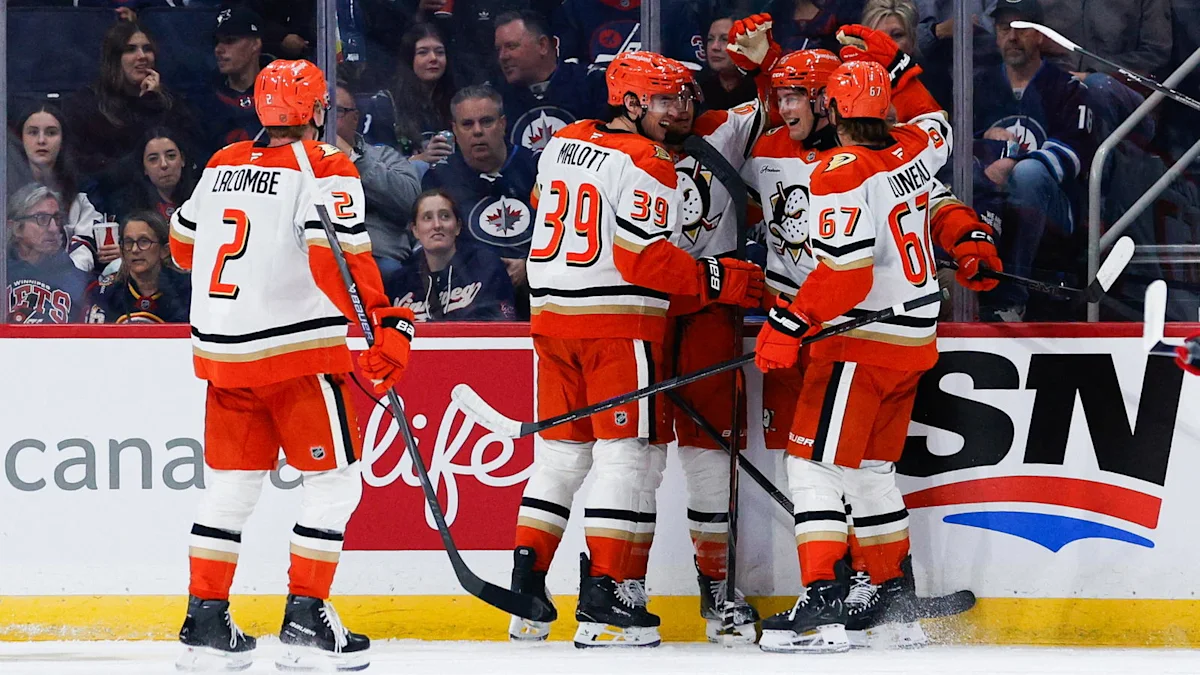
For their first road trip of the 2026-27 season, the Anaheim Ducks set out for a brief two-game-in-two-days trip to Canada to face the Winnipeg Jets on Friday, followed by the Calgary Flames on Saturday.
After winning their first two games of the season, the Ducks suffered their first loss at the hands of the Edmonton Oilers on Wednesday.
The opposing Jets entered the game undefeated in regulation, with a surprising 3-0-1 record on the season. They were without star defenseman Josh Morrissey in this game, who is listed as "day-to-day" with an upper body injury.
Ducks head coach Joel Quenneville shuffled several of his lines and pairs, as he's want to do after losses, and especially losses where multiple lines need a jolt. The only forward line to remain intact from Wednesday was the fourth line and the only defense pair untouched was the middle pair.
Here's how the Ducks lined up to start this game:
Lukas Dostal got the start for the Ducks for the fourth time in four games to open the season and stopped 15 of 16 shots. He was opposed by Clay Stevenson in the Winnipeg crease, who saved 12 of 16.
This was far and away the Ducks' tightest-checking, low-event game of the season and likely such in recent memory. However, it was less sloppy and more efficient an effort, as they were opportunistic on the rush, where all five of their goals were scored, and they allowed virtually no inside looks for Winnipeg and cleared any second-chance opportunities.
Fourth Line : Scoring two of the Ducks' five goals was their consistent fourth line. They did everything expected of a modern NHL fourth line in this game: provided energy, displayed responsible defense, pressured heavily on the forecheck, etc.
However, when they won possession of the puck, they operated like an excellent top-nine line in this game. They were reading how plays were breaking, carried pucks smartly and skillfully through neutral ice with speed, and revealed a finishing quality that's rare among players in their roles.
Washe was disruptive on the defensive end and drove cycles, Mallot showed surprising IQ, speed, and vision with the puck on his stick, and Caulfield made stickhandles and passes under opposing sticks all game.
The Ducks needed to find depth scoring from somewhere, and the fourth line, the last place one would expect to find it, delivered masterfully.
Noah Warren : Warren finished the Ducks' game against the Oilers alongside star defenseman Jackson LaCombe, where he played the entirety of this game. He logged 24:12 TOI, including 5:16 on the penalty kill, where he was a significant contributor to the Ducks killing all four penalties they took.
Warren didn't miss a beat with his promotion, and provided not only "stay at home" support for LaCombe, but he proved remarkably effective with his mobility, more akin to a modern-day shutdown defenseman. As mentioned, he covered a lot of ice on the defensive side of the puck with his stride and reach, greatly and rapidly minimizing time and space for his opponent.
Even on the occasional misread, he recovered remarkably well and was able to disrupt multiple attacks singlehandedly. His puck-moving was simple, but effective, as he was equal parts careful and decisive.
Breakouts : As a whole, the Ducks breakouts were much more simplified in this game. Defensemen weren't quick to settle for rimming pucks to open half walls. Instead, if they were unable to make a tape-to-tape outlet, they resorted to high flips or glass-chips into neutral ice, so as to punt an ensuing battle to neutral instead of deep in the defensive zone.
Forwards, especially lower in the lineup, were similarly elementary with their second touches and more willing to chase down and pressure opponents who attained possession.
Beckett Sennecke : Sennecke's 365-day evolution from turnover-prone rookie to bona fide play-driving sophomore will go a long way toward mitigating what the Ducks' depth chart lost over the offseason. One of his biggest strengths coming out of junior was his ability to read how pucks bounce out of battles and how to manufacture puck touches for himself at full speed.
He's translating that element of his game seamlessly just 86 games into his career. He's understanding his limitations at the NHL level, limiting his propensity for risky plays. Sennecke is attacking the game rather than letting it come to him and operating at breakneck speed. He's singlehandedly dictating the flow of play and not only reading and manipulating single defenders one-on-one, but entire opposing defensive structures. He's playing like a true superstar winger four games into this young season.
The Ducks will have a quick turnaround, as they'll travel to Calgary to face the Flames on Saturday at 7 pm PST.
Topics in this story
Gathered from external sources. Rights to this text belong to whoever originally published it.