Nearly one million Indians stuck in US green card backlog; EB-2 wait could stretch to 179 years
NRI News: Nearly one million Indians are now caught in the US employment-based green-card backlog, accounting for about 79 percent of all people waiting in the .
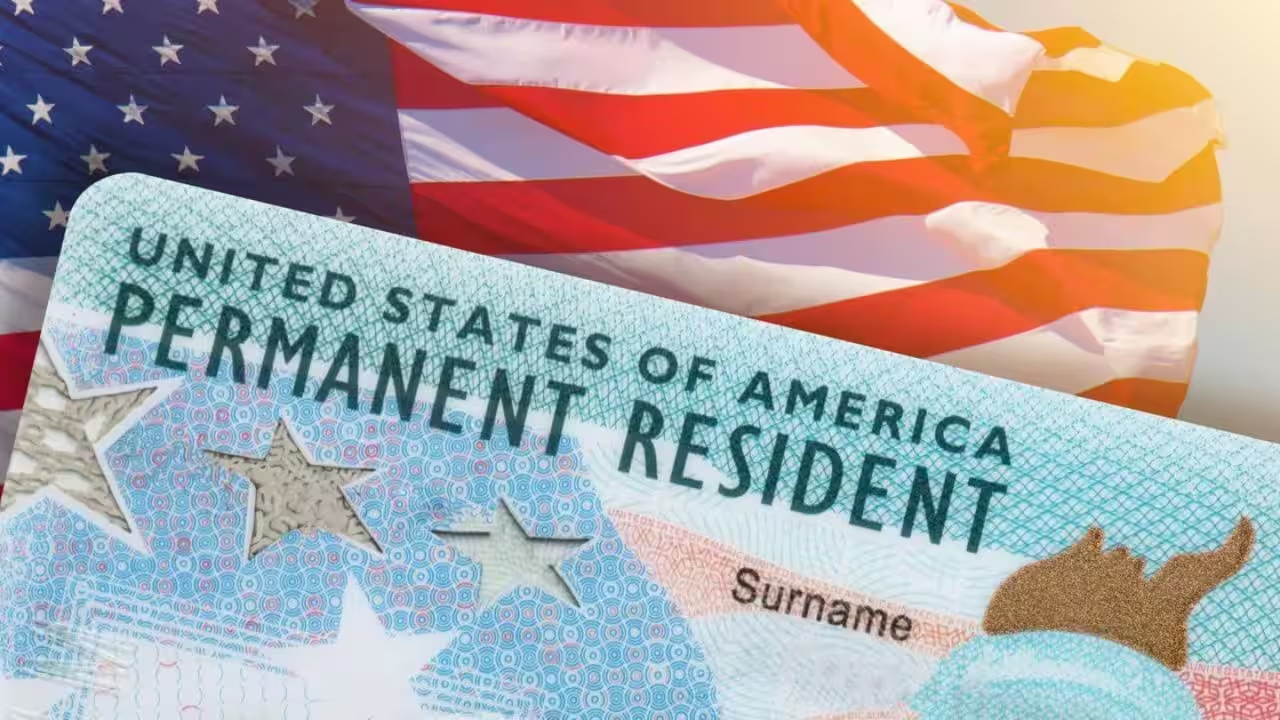
Nearly one million Indians are now caught in the US employment-based green-card backlog, accounting for about 79 percent of all people waiting in the country’s first three employment-based immigration categories, according to a new analysis by the National Foundation for American Policy (NFAP), a public policy research organisation.Many Indian professionals working in the US on H-1B visas pursue permanent residence through the employment-based EB-2 or EB-3 categories. EB-2 covers professionals with advanced degrees, as well as individuals with exceptional ability in the sciences, arts or business. A bachelor's degree followed by five years of progressive experience in the specialty can also qualify as the equivalent of an advanced degree. EB-3 covers professionals, skilled workers and other workers.The backlog has become so severe that an Indian national whose employment-based immigration petition or labour certification application was filed in January 2026 or later could face a potential wait of 179 years for permanent residence in the EB-2 category and 38 years in EB-3, according to the NFAP analysis.India accounts for 79 percent of the employment-based backlogNFAP estimates that nearly one million Indians were waiting in the first three employment-based preference categories as of Dec 2025. That compares with a total estimated employment-based backlog of 1,264,495 people across EB-1, EB-2 and EB-3. In other words, Indians alone account for four out of every five people in these three categories.The overwhelming concentration is in EB-2, which covers workers with advanced degrees or exceptional ability. NFAP estimates that 731,566 Indians were in the EB-2 backlog at the end of 2025. The EB-3 backlog for Indians stood at another 213,414.Interestingly, the Indian EB-1 backlog moved in the opposite direction, falling from an estimated 71,988 in April 2020 to 51,619 in December 2025. EB-1 is aimed at highly accomplished professionals, including people with extraordinary ability, outstanding researchers and professors, and certain multinational executives and managers.The overall US employment backlog has crossed 1.2 millionThe Indian numbers are part of a much larger employment-based immigration problem. This policy brief – ‘Employment based immigration backlogs and waiting times’ recently released by NFAP states that across the three categories EB-1, EB-2 and EB-3, the backlog increased from 1,048,342 in April 2020 to 1,264,495 in Dec 2025, an increase of 216,153 people, or 20.6 percent.EB-2 is therefore the largest component of the backlog, while EB-3 has recorded the fastest percentage increase among the three categories since April 2020. NFAP says the employment-based backlog could exceed two million by 2040 if US immigration law is not changed.Why are Indians hit so hard?There are two principal constraints built into US immigration law, according to NFAP.The first is the annual employment-based immigrant visa limit of 140,000. That number was established by Congress in 1990 and includes both the principal worker and eligible dependent family members. NFAP notes that dependents typically consume half or more of the available slots.The second constraint is the per-country limit. Under Section 202(a) of the Immigration and Nationality Act, immigrant visas available under the employment-based system for nationals of any single foreign state cannot exceed 7 percent of the total.This creates a particular problem for countries with very large populations of highly skilled professionals seeking US permanent residence. NFAP identifies India, China and the Philippines as among the countries most affected. The report points out that, under the statutory per-country ceiling, India and China can effectively receive the same country allocation as much smaller countries such as Iceland and Luxembourg.A massive mismatch between approvals and green cardsThe historical numbers illustrate how the Indian backlog accumulated. In fiscal 2016, US Citizenship and Immigration Services (USCIS) approved 47,601 EB-2 Indian applications, which translated into an estimated 98,594 people once dependents were included, according to NFAP calculations, but only 4,407 people from India were granted permanent residence in this category. In other words, in fiscal 2016 alone, over 90,000 people (principal applicants and dependents) were added to the backlog in just one year. The pattern continued in subsequent years, helping create a queue that is now measured in decades for many Indians.What the August 2026 Visa Bulletin means for IndiansThe NFAP report also examines the August 2026 US Visa Bulletin, which determines when applicants can move forward based on their priority dates.A priority date is the date that determines an applicant’s place in the green-card queue. For most employment-based applicants, it is the date the US government receives the labour certification application (PERM) or, where labour certification is not required, the date the employment-based immigrant petition is filed. The US State Department publishes a monthly Visa Bulletin showing which priority dates are currently eligible to move forward.For Indians, the August 2026 Visa Bulletin shows just how far behind the queue is in the major employment-based categories. To move forward with an adjustment-of-status application, an Indian applicant needs a priority date earlier than October 15, 2022, for EB-1, January 1, 2014, for EB-3, while EB-2 is listed as unavailable in August. EB-2 had a priority-date cut-off of September 1, 2013, in the June 2026 bulletin.In simple terms, someone who applied recently — particularly in 2025 or 2026 — is still very far from the front of the queue in EB-2 and EB-3. NFAP estimates that an Indian whose application was filed in 2026 could face a potential wait of 179 years in EB-2 and 38 years in EB-3, although actual waiting times can change depending on future visa availability, applicants leaving the queue and changes in US immigration law.“For individuals in the EB-2 or EB-3 category from India, the wait is more likely to be measured in decades than in years,” the report says, depending on how close the priority date is to 2025 or 2026.The backlog has grown despite extra green cardsOne of the striking findings is that the employment-based backlog grew even though the US issued more employment-based green cards than the statutory annual expectation between fiscal 2020 and 2024.The normal employment-based allocation is 140,000 a year. But NFAP calculates that 980,460 employment-based green cards were actually issued over those five fiscal years, compared with an expected 700,000 — roughly 280,000 additional green cards.These additional numbers were generated because family-sponsored immigrant visa numbers went unused during the pandemic and other periods of disruption and subsequently became available to employment-based categories. Yet the extra green cards were not enough to eliminate the accumulated backlog.The problem starts before the green card queueFor many employment-based immigrants, the wait begins even before they reach the immigrant-visa backlog.Most employment-based immigrants require labour certification. NFAP says the process can itself take two to three years. The prevailing wage determination, the first step, can take three to eight months, while recruitment must last at least 60 days and can take longer.As of August 2026, the Department of Labor listed average PERM processing times of 403 days for analyst review and 290 days for audit review, according to the NFAP report.For Indian professionals already working in America, these delays can mean spending many years in temporary immigration status while waiting for permanent residence.Need for reformsThe consequences extend beyond an immigration file. NFAP says many people waiting for employment-based green cards remain in the US in H-1B temporary status, with their ability to remain and work tied to extensions and continued compliance with the immigration system.The organisation argues that lengthy waits make it harder for American companies to attract and retain highly skilled workers.For Indian professionals and their families, meanwhile, the uncertainty can stretch over much of a working lifetime.Stuart Anderson, executive director at NFAP said: “These long waiting times for green cards create significant hardships for individuals and their families and undermine the ability of companies to attract and retain talent in America.”The report also stresses that these delays should not be confused with USCIS processing delays. The backlog reflects the limited supply of immigrant visa numbers under the law, rather than simply a failure by the immigration agency to process applications quickly.NFAP argues that the fundamental problem requires changes to US immigration law. The organisation points to a proposal considered by the US House of Representatives in 2022, as part of legislation that became the CHIPS and Science Act. The proposal would have exempted certain individuals with PhDs in science and technology fields and master's degrees in critical industries from employment-based green-card numerical limits and backlogs.According to NFAP, the measure would have significantly reduced the employment-based backlog, but it did not make it into the final legislation. Without legislative changes, however, the existing mathematics remain daunting: demand continues to exceed the number of employment-based immigrant visas available each year, while the per-country limits disproportionately affect nationals of countries such as India.The policy brief concludes that America's legal immigration system faces a problem that has received less attention than border enforcement and other immigration debates: people who have followed the legal employment-based route can nevertheless find themselves facing waits lasting decades.
Topics in this story
Gathered from external sources. Rights to this text belong to whoever originally published it.