5 NBA Teams That Blew It This Offseason
The NBA offseason is supposed to be a vehicle for optimism. Whether your team is starting over, prepping for a leap or fortifying its position as a championship threat, the summer months are a springboard into anything-is-possible waters.
The NBA offseason is supposed to be a vehicle for optimism. Whether your team is starting over, prepping for a leap or fortifying its position as a championship threat, the summer months are a springboard into anything-is-possible waters.
Unless, of course, you're one of the squads we're about to discuss.
Contenders who willingly got worse. Win-now mandates that resulted in overzealous transacting. Organizational pivots to nowhere. Failures to act. Operating in stark contrast to your place in the food chain. These transgressions earn spots on this list.
Appearing here is never about one move or decision. Final selections have a string of misfires in the face of other options.
The Golden State Warriors didn't get LeBron James and are closing out Stephen Curry's heyday settling into mediocrity. That is a bummer, but it wasn't something they could realistically fix this summer.
Similar logic applies to the Sacramento Kings. It'd be nice if they tore it down, but past failures have left them in a position that's not built for it.
This list focuses more on missed opportunities or mistakes from the 2026 offseason alone.
None of the explanations given for the Boston Celtics trading Jaylen Brown pass the sniff test.
They didn't want to extend him? Cool. Brown has three guaranteed years left on his deal. He had no leverage to force the Celtics to offer a new contract or make a trade.
They wanted to get cheaper? Fabulous. They traded for someone making $3.7 million less—and who's more than half a decade older.
They simply needed to get rid of him before he became a net-negative asset? If that's true, why settle for Paul George and modest draft compensation over increasing your offer for Giannis Antetokounmpo?
Assuming this was the best Boston could do doesn't mean "The team had to do it!" The Celtics could have kept Brown, tried to smooth things over and carried on contending for Eastern Conference Supremacy.
Instead, they sold low, weakened their best playoff lineups and are left clinging to the idea of what George's expiring contract can be turned into next summer when attached to draft picks.
Oh, and by the way, poaching Mitchell Robinson isn't any great shakes, either. The Celtics thinned out the New York Knicks, but paying 9 percent of the salary cap to a guy who can't play more than 20ish minutes per game or both ends of back-to-backs isn't the home run some make it out to be.
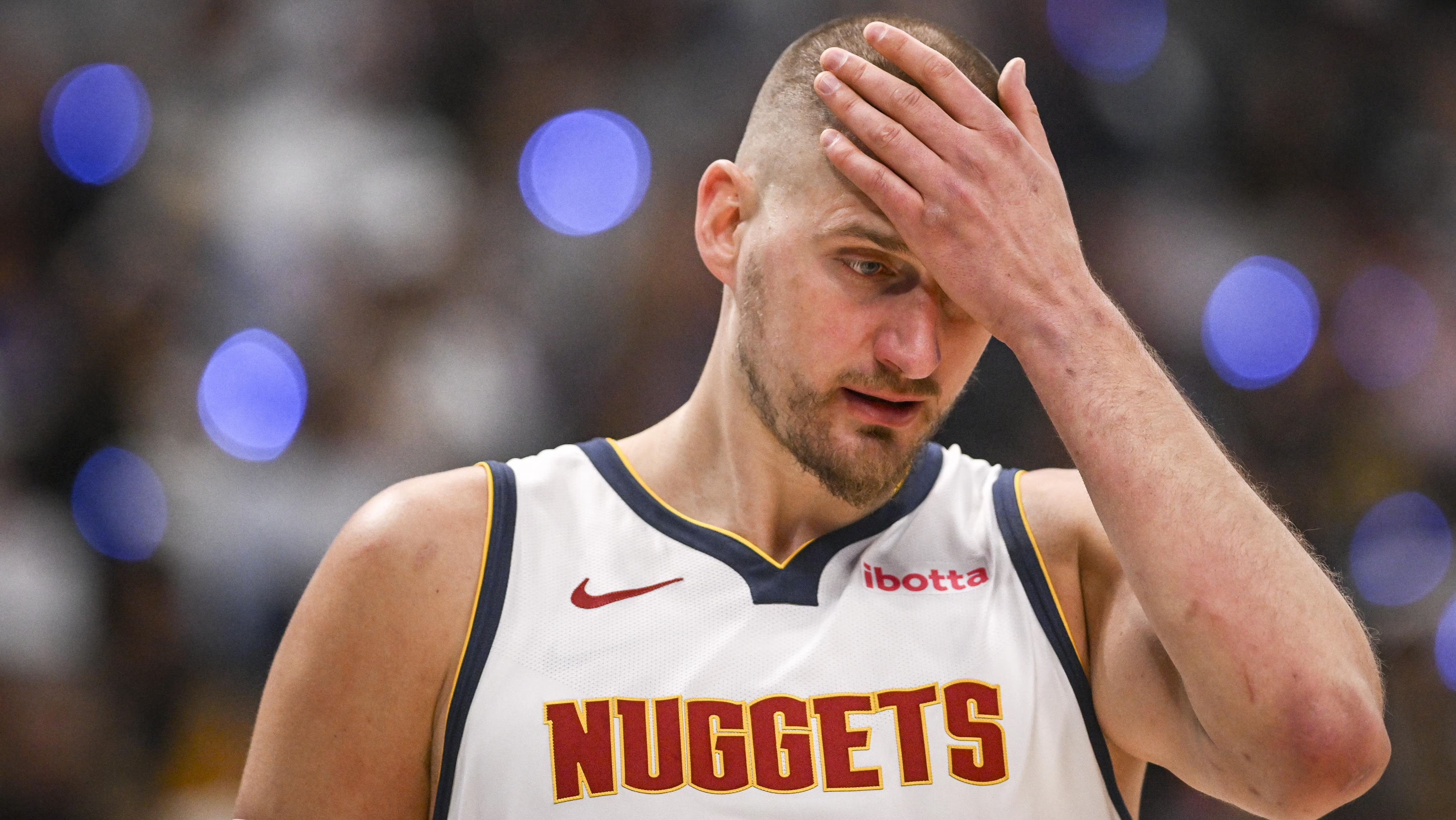
After getting ousted in the first round, the Denver Nuggets saw it as prudent to jettison Peyton Watson without receiving any players in return. This is now the third consecutive offseason in which they've waved goodbye to one of their six most important contributors for the sake of cutting costs.
Blame the second apron all you like. This offseason still verges on malpractice.
Entering the second apron for a year or two isn't the crippling reality owners would have you believe. Also, as a general rule, it's not worth twisting yourself into a pretzel to justify penny-pinching from an ownership group that just bought MLB's Los Angeles Angels at a $4 billion valuation . (By the way: Denver isn't yet out of the second apron .)
It's fair to point out that the Nuggets shouldn't be paying through the teeth for a core that couldn't measure up to the Minnesota Timberwolves. But Watson's four-year, $88 million deal averages out to 12.5 percent of the salary cap. That's more than reasonable for someone with his skill set. Smarter franchises would have paid him and figured out the rest later rather than prioritizing Cleveland's 2031 first-round pick.
Denver might even get a pass if Nikola Jokić signed an extension. For the second consecutive summer, he opted against it.
Framing it as a delayed decision rather than a wait-and-see mode doesn't make the Nuggets look any better. They have one of the world's three best players, in his prime, entering the final year of his contract. And they willfully let themselves get worse.
You don't have to squint very hard to see the Los Angeles Lakers finishing third in the Western Conference next year. The process by which they reformatted the roster just to remain substantially worse than the Oklahoma City Thunder and San Antonio Spurs is what kills them.
Shelling out four years and $129.5 million for Walker Kessler is no sweat. Surrendering control of four first-round picks (two outright, two swaps) on top of that is unhinged desperation.
Kessler's fit on this Lakers roster is inarguable. But everything the team did to land him effectively means he must reach Rudy Gobert-level transcendence on defense for Los Angeles to come out ahead.
Playing the "He was a restricted free agent, Luka Dončić wanted him, and this is what it took" card doesn't fly. The Lakers would have been better off reallocating the picks and money toward multiple players—one of whom, preferably, isn't a minimum-contract wing.
Digesting the Kessler opportunity cost would be much easier if Los Angeles nailed all of its other moves. It didn't.
Giving four guaranteed years to Sandro Mamukelashvili and Quentin Grimes when guys like Mitchell Robinson (three guaranteed) and Norman Powell (one guaranteed) got less is bananas. Forking over player options to, well, everyone from Mamu and Grimes to Austin Reaves and Collin Sexton is absurd.
Rest assured, the Lakers will be Western Conference menaces next season. But this summer's cap and asset allocation has the potential to be remembered as the glaring misstep that eventually drives Dončić out of L.A.
There's nothing quite like a team that seems to operate without rhyme or reason.
The New Orleans Pelicans are more infuriating than the Sacramento Kings because they're not paralyzingly aimless. They have desirable players who could net them the assets necessary to map out a new direction.
Bringing back DeAndre Jordan and taking a flier on Bennedict Mathurin that will vault the Pelicans into the tax can't be your big summer splashes coming off a season in which you won 26 games. Even if they are banking on more availability from Dejounte Murray and Herb Jones, this roster's ceiling maxes out at "probably better than the Kings."
Never mind contrasting timelines. The pieces don't fit.
New Orleans simultaneously has too many bigs and no defensive anchor at center. Properly developing Derik Queen and Jeremiah Fears is impossible with Zion Williamson and the team's lack of shooting.
Shopping Zion, Jones, Trey Murphy III, Saddiq Bey, et al. should have been this summer's primary objective. Failing that, the Pelicans needed to use assets to upgrade the roster's talent and congruence. Granted, this would have been the wrong move. But it would have at least hinted at an intended direction—something New Orleans can't even pretend to have now.
Newly minted Portland Trail Blazers owner Tom Dundon is doing a bang-up job of turning the franchise into a punchline.
Cheaping out on traveling-party amenities predates the offseason, but Dundy Warbucks is primarily responsible for making a mockery of head-coaching searches and arena-renovation negotiations . (Hiring Micah Nori to replace Tiago Splitter is a justifiable decision. The one-minus-two deal Portland had him sign is crap.)
Beyond that, and most importantly, the Blazers entered the offseason in desperate need of shooting. So, naturally, they traded for Ja Morant.
The opportunity cost of that deal is perfectly fine. A Morant flier is worth Jerami Grant and Kris Murray in a vacuum. But basketball isn't played in a vacuum. Even if the soon-to-be 27-year-old regains his previous swagger, his fit with the Blazers is ambiguous.
Portland remains overloaded with guards even after the Shaedon Sharpe injury, and Morant's play style isn't especially adaptable. He has never cut with enough frequency to be used off the rock and has not ranked higher than the 31st percentile in catch-and-shoot three-point efficiency since he was a rookie, according to BBall Index.
Morant at his best also takes the ball out of Deni Avdija's hands and complicates the continued development of Scoot Henderson. This says nothing of what playing Ja and Damian Lillard together will do to the defense.
At a time when the Blazers should have been looking to strengthen and better complement what worked for them last season, they've zig-zagged down the path of functional incoherence.
Dan Favale is a National NBA Writer for Bleacher Report. Follow him on Bluesky ( @danfavale ), and subscribe to the Hardwood Knocks podcast, co-hosted by Bleacher Report's Grant Hughes .
Topics in this story
Gathered from external sources. Rights to this text belong to whoever originally published it.