Ranking Los Angeles Lakers' Top Trade Targets for 2026-27 NBA Season
The Los Angeles Lakers have invested heavily in their roster for the coming season, both in contracts (Austin Reaves, Walker Kessler, Quentin Grimes, Sandro Mamukelashvili) and in draft compensation to acquire Kessler from the Utah Jazz (multiple first-round picks).
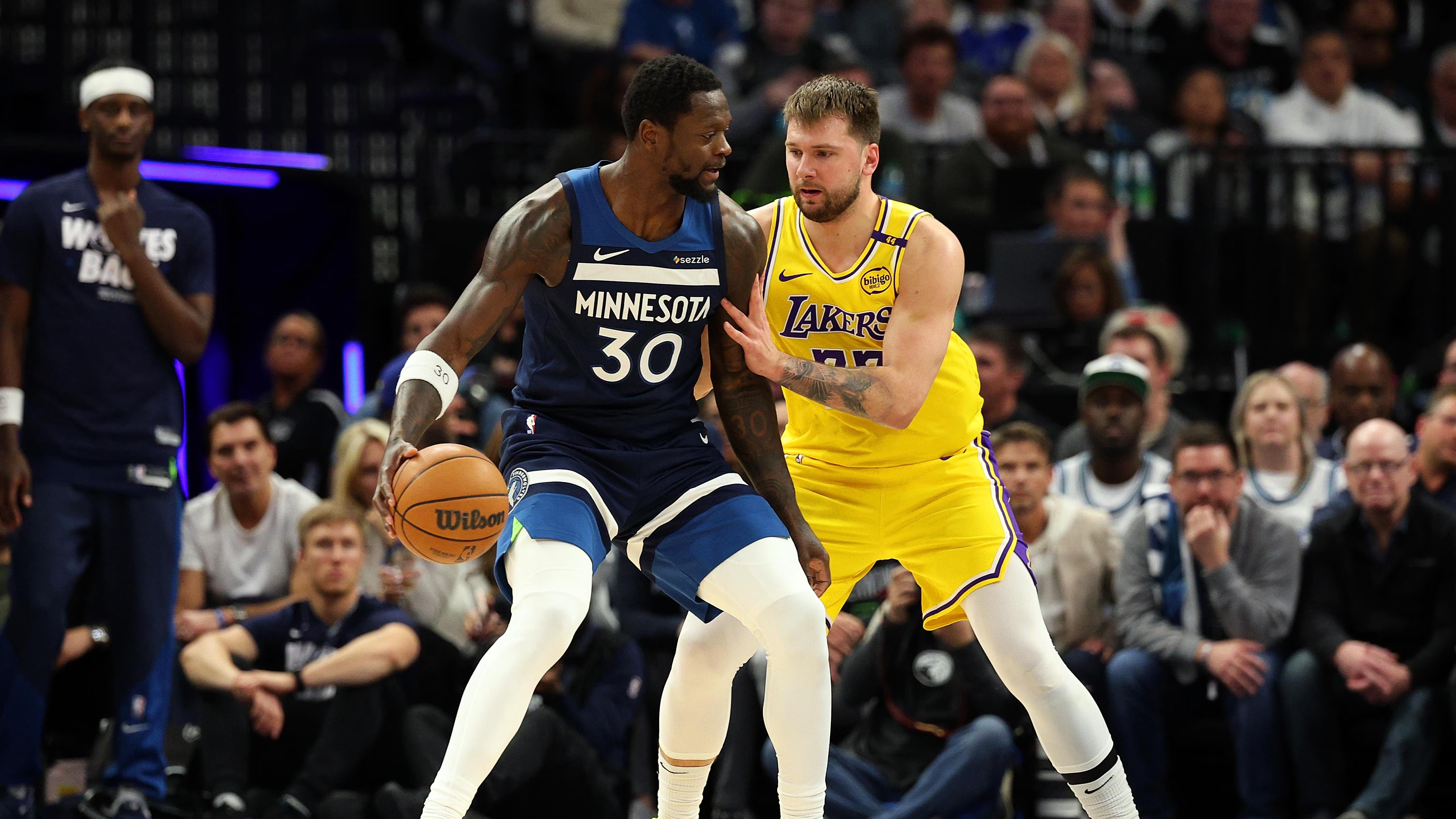
The Los Angeles Lakers have invested heavily in their roster for the coming season, both in contracts (Austin Reaves, Walker Kessler, Quentin Grimes, Sandro Mamukelashvili) and in draft compensation to acquire Kessler from the Utah Jazz (multiple first-round picks).
The team needs to be very good this season because it lacks the means to improve significantly via trade. Outside of one full first-round pick swap in 2032 and three future seconds, the Lakers are spent. Would Trey Murphy III fit exceptionally well on the squad? Of course, but L.A. has nothing of real value to offer the New Orleans Pelicans outside of its top players like Luka Dončić, Reaves, and Kessler.
Still, the Lakers may seek a minor trade before the season starts to get down to the required 15 standard contracts from their current 16. While they still need starting-caliber forwards, that's just on paper. The front office may wait until trade season, from mid-December to the February trade deadline, to get a real look at how the pieces fit together—but some potential targets are easy to identify.
After moving on from LeBron James, Marcus Smart, and other veterans, the Lakers have tried to get younger.
Indiana Pacers forward Jarace Walker, 23, is in the final year of his rookie-scale contract as the No. 8 overall pick in 2023.
At 6'7", Walker is more of a perimeter scorer than a bruising power forward, but he's athletic and would add additional depth to the Lakers' frontcourt. The Pacers have consistently avoided the luxury tax, so it's surprising the franchise projects to be over this year by as much as $6.4 million. Many competing executives expect the team to trim somewhere ahead of the trade deadline to get under the $200.4 million threshold.
Walker is the most obvious, expendable player at $8.5 million. The Lakers would need to send out, though they may need a third team to take on one of Dalton Knecht, Jaden Hardy, or Jake LaRavia, to help the Pacers avoid the tax.
A more complicated deal can be constructed around Obi Toppin and Walker, including Jarred Vanderbilt, but as of the last check, the Pacers still prioritize Toppin in the rotation.
No. 4: De'Andre Hunter, Sacramento Kings
The Sacramento Kings acquired De'Andre Hunter from the Cleveland Cavaliers ahead of the last deadline, getting a solid forward at a relatively low price, as the Kings were ready to move on from guards Keon Ellis and Dennis Schröder.
On paper, the franchise doesn't look highly competitive in the Western Conference this season. The team drafted Darius Acuff Jr. with the No. 7 pick, but he'll need time to develop. Hunter is in the final year of his deal, and unless Sacramento intends to extend him, the team should get the best available return before the February deadline.
Hunter, 29 in December, has shot the three-ball well over most of his career, but he dropped from 40.5 percent in 2024-25 to 30.5 percent last season. The Lakers would want to see that he's healthy—durability has been an issue throughout Hunter's career—and shooting well before making an offer.
At $24.9 million, Hunter also has an unlikely $1.3 million incentive that counts against the first apron. The Lakers may need to include Vanderbilt and the 2032 first-round pick swap, or at least multiple second-rounders to give the Kings enough motivation for a deal.
While he's 6'7" and can play either forward spot, Hunter isn't necessarily burly enough to man that position against some of the stronger power forwards.
The LA Clippers have shifted direction after a difficult year, trading Kawhi Leonard to the Toronto Raptors. The completed investigation stripped the team of five first-round picks, but they recouped others from Toronto in the Leonard swap.
Initially, the Clippers will see what the veterans can do together with Brandon Ingram, Darius Garland, Max Strus, former Lakers forward Rui Hachimura, and Derrick Jones Jr., among others. The real priority is building for the future by developing Keaton Wagler and other young players while preserving long-term flexibility.
LA may struggle to rebuild via the draft and through trade without movable first-round picks; cap room appears to be the path forward. That could make the Clippers a seller by the deadline.
Jones is in the final year of his deal at $10.5 million. He was a productive teammate of Dončić in Dallas during the Mavericks' NBA Finals run. He's athletic, defends, and has a strong enough three-ball to keep teams honest.
The Lakers could build a trade around players like Knecht, LaRavia, and Hardy, but the Clippers would prioritize draft considerations. The Lakers only have the first-round swap in 2032 available (outside of swapping already-swapped firsts, which don't hold as much appeal), but the Clippers don't have a 2032 first to work with.
Jones seems more like a deadline option, with the Clippers not getting any offers greater than the three second-round picks the Lakers can send. While he'd fill an important role as a wing stopper, Jones wouldn't solve the Lakers' frontcourt depth issues.
Ranking 5 NBA Teams With the Worst Salary-Cap Situations 😖
The Mavericks have changed significantly since trading Dončić to the Lakers, with shifts across the front office and coaching staff. PJ Washington was extended last year, but Dallas has increasingly loaded up at his position with Santiago Aldama, Zaccharie Risacher, and last year's No. 1 overall pick, Cooper Flagg.
The latest word from various NBA sources is that Washington's trade market is barren. The four-year, $88.8 million obligation is too rich for any real suitors ahead of the season, including the Lakers.
However, as the season progresses, if L.A. recognizes its need at power forward, Washington is a strong fit as a former Dončić teammate who is a willing role player, defender, and shooter. He's not as accurate from three-point range as the Lakers would want, but Washington knows well where Dončić is going to get him the ball and is willing to let it fly.
The Lakers' advantage in going after Washington is that Dallas would probably be happy to take Vanderbilt's $13.3 million player option for 2027-28 to get out of Washington's longer deal.
Washington would help the Lakers on the court, but it's more a question of the team's appetite for the long-term financial obligation.
The Lakers drafted Randle No. 7 overall in 2014. According to his own account, Randle set massively illegal screens for Kobe Bryant in the 60-point final and legendary game of his career. Now nearing 32, Randle is a three-time All-Star and the kind of physical presence the Lakers don't have on the roster.
Respectfully, Randle is a bully on the court. He can score (21.1 points per game last season for the Minnesota Timberwolves) and pass (5.0 assists), but what impressed the Lakers most when they drafted him was his brute strength. He's not a perfect defender, but he fit in well on a strong Minnesota defensive unit. Randle has shot well from three before, but his career 33.2 percent isn't ideal.
Still, if he's available, Randle would give the Lakers a very different frontcourt alongside Kessler, with Mamukelashvili backing him up. The Timberwolves sent him to the Brooklyn Nets this summer in the LaMelo Ball blockbuster. Randle doesn't fit the Nets' timeline, and while they probably won't deal him before the season starts, he's definitely a player to watch ahead of the trade deadline.
Randle is expensive at $33.3 million. The Lakers would need to include LaRavia, Hardy, Knecht, and Vanderbilt, which would be problematic for the Nets in-season with the 15-man roster limit. A multi-team deal, which has become more common in the NBA, would help.
Randle has a $35.8 million player option for 2027-28. If the Lakers are willing to pay him a new three-year contract—timed with a player option with Reaves, Kessler, Grimes, and Mamukelashvili before 2029-30—and Randle is willing to take a lower starting figure in the $25 million range, L.A. would still have its non-taxpayer mid-level exception at about $16 million next summer.
Instead of Randle, the Lakers could try to acquire his current teammate, Michael Porter Jr., from the Nets; however, a lack of assets and his $40.8 million salary this season make it prohibitive under L.A.'s first-apron hard cap. The math could work later in the year, but the Lakers would need to add Grimes or Mamukelashvili—in addition to Vanderbilt, LaRavia, Hardy and Knecht.
Getting large deals like that done during the regular season is complicated, as teams cannot take on more than 15 players under standard contracts. Porter isn't a "no," but a first-round pick swap and three seconds feels awfully light to Brooklyn.
The Lakers may be better off finding a team looking to get out of salary, like the Orlando Magic, who are surprisingly above the luxury tax threshold despite consistently avoiding penalties. Goga Bitadze would be a strong backup to Walker Kessler, though the Magic seem fond of the Georgian center.
The Denver Nuggets are the only team in the league above the second apron. Would they be willing to send Cam Johnson to Los Angeles? The Lakers would also need a third team to help the Magic or Nuggets reduce salary.
The Lakers would be reluctant to take on Jerami Grant's $36.4 million option for 2027-28 from the Memphis Grizzlies. While Isaiah Stewart II would appeal, he'd be more expensive for L.A. to acquire. Similarly, the Pelicans want too much for Herb Jones.
Email Eric Pincus at eric.pincus@gmail.com and follow him on X/Twitter @EricPincus .
Topics in this story
Gathered from external sources. Rights to this text belong to whoever originally published it.