The NBA's 5 most interesting newcomers, starring LeBron James, LaMelo Ball and the Lakers' big swing
With media day and training camp just around the corner, let's take a look at a few familiar faces in new places.
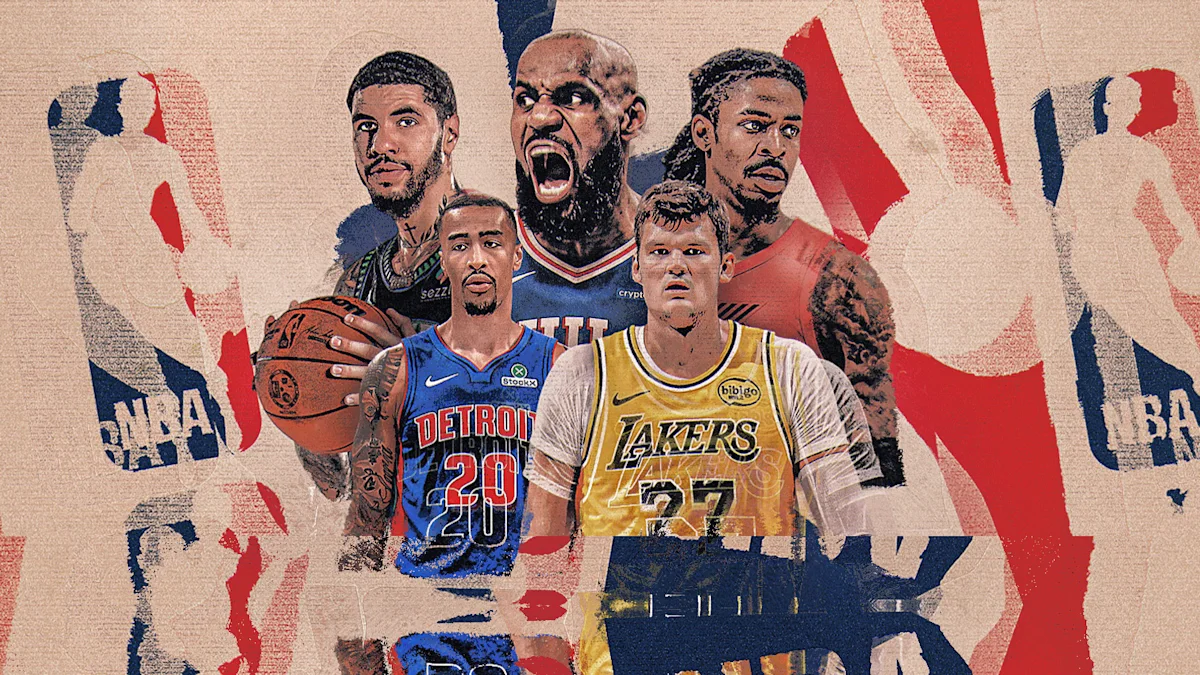
With the 2026 NBA offseason now all but concluded, and with media day and training camp just around the corner, it's time to start looking ahead to what's coming next in the NBA.
In that spirit, let's take a look at the five most interesting — to me! — folks who joined a new team this summer.
(We've previously considered my five most interesting: potential free agents in the class of 2027 , comeback players for next season , rising sophomores in the NBA , and veteran extension candidates . That last column included both Giannis Antetokounmpo and Kawhi Leonard, so I won't be writing about them here — although, obviously, they and their new surroundings are both pretty interesting!)
We begin with this really old guy (read: more than two years younger than me) who decided to move to Pennsylvania in search of fame, fortune and a fifth NBA title:
Yes, yes, yes, we all know: There's only one ball. And when a team that already had Joel Embiid (who has, over the course of his career , finished 35.3% of his team's offensive possessions with a shot attempt, turnover or foul drawn) and Tyrese Maxey (average usage rate over the past three seasons : 29%) adds both Jaylen Brown (36.2% usage rate last season, 31% over the past six ) and LeBron James ( 19 seasons north of 30%, 27.2% last season), the lack of a multi-ball option would seem to be at least something of a problem.
Turning a collection of what ESPN's Dean Oliver recently referred to as "super-users" into a harmonious lineup that can elevate the NBA's No. 17 offense last season into a top-tier unit will require sacrifice across the board. But that sacrifice won't be distributed equally; some Sixers are going to need to give up more touches than others.
It probably shouldn't be Maxey, given his elite production as both a pick-and-roll creator and off-ball movement-shooting weapon, his youth, and the likelihood that Nick Nurse would rather gnaw his left foot off than take his All-NBA guard off the floor more often than is medically necessary. I'm more bullish than some on Brown being willing to take a step back from last season's maximalist approach in a new setting — we've certainly seen plenty of evidence that he can contribute at an All-Star level in a superstar timeshare, after all — but the fact that he's a much better play finisher than playmaker suggests that you wouldn't want to tilt his role too far away from shooting and scoring.
Embiid, as ever, remains the most significant variable: how healthy he is and can reasonably stay, how many games and minutes he can actually play, how effectively he can move in space defensively and how comfortably he might be able to navigate life in a reduced role, etc. Generally speaking, though, it's hard to see the most effective employment of Embiid on the offensive end being something besides leveraging his gifts operating out of the post or isolating from the nail — both of which he still does as well as, if not better than, just about anybody in the sport.
Which leaves LeBron : the best passer, most natural playmaker of the bunch, and the player who, despite lapping the entire rest of the squad in laurels and accolades, is likely best suited to reorienting his individual game toward the broader goals of the collective.
(He's also making like $50 million less than the other guys — in salary, anyway — which may or may not matter in discussions like these.)
The most direct path to fitting four "super-users" — plus ascendant sophomore VJ Edgecombe ! — under the same roof is for one of those four to not command a quarter of the team's offensive possessions. James began that during the latter stage of his tenure in L.A., when a Lakers team suddenly featuring offensive engine Luka Dončić and rising star Austin Reaves required some reorganization.
Across parts of two seasons in L.A., when James, Dončić and Reaves shared the floor together, James posted a 23.4% usage rate, according to PBP Stats — significantly below his 28.8% overall mark in those seasons . Narrow it down to just the 2025-26 campaign, and James' usage rate dipped to 21.3% in the minutes the trio shared .
During that March-to-April stretch when the Lakers were rolling, Dončić was getting MVP buzz, and everyone was talking about LeBron suddenly being an overqualified third option ? It dropped all the way down to 19.1% , with James averaging 18.4 points on 55% shooting, 7.4 rebounds, 7.4 assists and nearly 2 blocks-plus-steals per game in that span , with his average time of possession, number of touches, and dribbles and seconds per touch all (slightly) below where they'd been earlier in the season and (significantly) below where they'd been in previous years.
"I know what I'm capable of still doing as an individual, but what's important for this team, I'm able to adapt," James told reporters back in March . "And that's the only thing that matters."
Even approaching age 42, that version of LeBron — the high-efficiency, high-IQ, low-turnover floor-raiser who doesn't need to dominate the ball to elevate others — can thrive in Philly . He can work either end of a pick-and-roll with Maxey and play the high-low game with Embiid. He can sprint the floor in transition with Maxey, Brown and Edgecombe, turning defensive rebounds and turnovers into the kind of easy fast-break buckets the Sixers haven't generated much in the past two seasons .
He can hunt opportunities for duck-ins, back-cuts and drives against closeouts when defenses load to his high-wattage teammates. He can serve as the connective playmaking tissue to turn talented but somewhat disparate parts into a more cohesive and dangerous whole. And when problems arise — and they will, whether in the form of injuries, your-turn-my-turn stagnancy, natural ego-driven friction, or whatever other obstacle emerges when the teeth stop showing and the stomachs start growling — it'll be up to him, the most decorated dude on the Eastern seaboard, to troubleshoot the concerns and get everyone singing from the same hymnal again.
This is the challenge that James set for himself when he assessed the landscape and determined that Philly gave him the best chance to compete for another ring. It's a tall task, and one that's going to demand something radically different from what James has provided throughout the course of his legendary career: not doing more with less, but doing less to provide more.
It's not Kessler's fault the Lakers sent two unprotected first-round picks and two first-round pick swaps to the Utah Jazz for his services. Nor is it his fault that he graciously (I assume) accepted the $130 million contract they offered him to provide those services in L.A. for the next four seasons — top-10 center money for someone who has spent the better part of his NBA career to date far, far away from playing games, minutes or even individual possessions of consequence amid the perpetual rebuild in Salt Lake City.
Now that the picks are sent and the contract's signed, though, it is Kessler's responsibility to carry that burden — the Mikal Bridges Memorial Huge-Pick-Haul-Plus-Nine-Figure-Extension Millstone Around the Neck — as he sets about the work of manning the back line for a Lakers team that has finished league-average or worse in defensive efficiency , and 24th or worse in field-goal percentage allowed at the rim , in four of the last five seasons. And that just saw its best perimeter defender, Marcus Smart , leave for Houston . And that will be fielding lineups with Dončić and the re-signed Reaves — in whose minutes sans Smart the Lakers conceded points at a bottom-10 level last season.
Kessler won't be alone in that effort, of course. A number of the Lakers' other offseason additions — wings Quentin Grimes , Matisse Thybulle and Ziaire Williams , veteran bigs Kevon Looney and Sandro Mamukelashvili — have all shown signs in past stops of being active, positive contributors on the defensive end. Add in holdover chaos agent Jarred Vanderbilt and recent draftees Cameron Carr, Adou Thiero and Bronny James , and head coach JJ Redick might have enough of the bodies and temperament necessary to build the kind of high-motor lineups that have been a hallmark of so many successful teams in recent years.
Since the Jazz drafted him 22nd overall out of Auburn in 2022, Kessler has consistently ranked among the league's premier per-minute rim-runners, rebounders, shot-blockers and interior deterrents. He finished third in Rookie of the Year voting in 2022-23, led the NBA in offensive rebounds per game in 2024-25 (and finished fifth in rebounding overall), has posted top-five finishes in blocks per game three times in four seasons (and he missed nearly all of his fourth season following surgery to repair a torn labrum in his left shoulder ), and has the sixth-highest effective field-goal percentage of anybody who's played at least 100 games since entering the league.
In some respects, according to analysis conducted by Iztok Franko , Kessler's defensive metrics compare favorably to the likes of Evan Mobley and Jaren Jackson Jr. — both of whom, you might recall, own Defensive Player of the Year trophies. If he can be the kind of space-eating, mistake-erasing, back-line presence that can cover up for Luka's and Reaves' misdeeds at the point of attack while also providing the sort of "A-list" center production Dončić sought as a pick-and-roll lob threat and board-crashing possession-extender, then Kessler could well live up to the great expectations the Lakers have placed on him; the weight of that millstone gets lighter when you win a ring. ( Just ask Bridges. )
If Kessler can't propel the Lakers above the mountain, though — if they play closer to their mid-40s win total projections and struggle to scratch out wins in one playoff series, let alone the three necessary to get to the Finals? That kind of burden can be awfully heavy to carry around. (At least he'll be well compensated to do it.)
I think Collins — now entering his 10th year in the NBA, which feels like it happened freaking fast — is a perfectly fine player. He's developed into a solid floor-spacing power forward, shooting 39.1% from 3-point range on 4.3 attempts per 36 minutes over the last three seasons , making him one of only a dozen 4/5 types to hit that consistently on that kind of volume in that span. Beyond just the shooting, though, he's a skilled offensive player who can contribute in a number of ways: running the floor in transition, attacking a mismatch in the post, hitting the offensive glass, finding space underneath for cuts and duck-ins, and sometimes serving as a pick-and-roll big who can either dive hard to the rim — something that might not have a ton of utility in Detroit in lineups next to Jalen Duren , but still — or pop to the perimeter, giving defenses something to think about as they try to navigate the manifold unpleasantness that comes with Cade Cunningham bearing down on them.
Collins can shoot (especially from the corners), rebound, play some small-ball 5, run and chew gum at the same time, all while being 6-foot-9 and still sitting on the right side of age 30. (He actually turns 29 on Wednesday. Happy birthday, John.) That Detroit would view that collection of skills and traits to be worth three years and $51 million in free agency seems to be, once again, perfectly fine.
I find myself wondering, though, just how much bringing in Collins to replace Tobias Harris — who got one year and $20 million less to sign with San Antonio — really improves a Pistons team that just stomped its way to 60 wins and won a playoff series for the first time in 18 years, with Harris as its second-leading postseason scorer.
It's possible that Collins, who's more than five years younger than Harris, will be both a better fit for what chief exec Trajan Langdon envisions the Pistons to be and a more productive player than his predecessor in three years' time — an important consideration for a franchise that has to consider how best to construct a roster to compete for titles with Cunningham on a max contract through 2030, Ausar Thompson now on a five-year, $155 million extension and Duren (Detroit hopes) soon sewn up on a sub-max multi-year pact of his own. In that respect, getting Collins on a deal that is non-guaranteed in 2027-28 and 2028-29 to maximize financial flexibility seems like a good piece of business.
It feels at least equally possible, though, that Collins just, y'know, isn't better than Harris. ( Multiple advanced stats certainly suggest that's the case, anyway.) And that a team that was one win away from the conference finals despite Duren being locked in the pain cave for the entirety of the postseason just downgraded in the starting lineup for the purposes of flexibility. And that, by the time next spring rolls around — hey, spring rolls, all right — we find ourselves thinking, "Man, the Pistons' big move really was signing John Collins, huh?"
Maybe we won't. Maybe Detroit's around-the-margins revamping — bringing in Collins, re-signing Kevin Huerter , adding Isaiah Joe , Taurean Prince and Gary Harris — represents a significant enough aggregate addition of shooting and floor-spacing to allow the Pistons' offense to take flight in ways it struggled to at times last season, and particularly in the postseason, when opponents packed the paint against lineups featuring Duren and Thompson, and essentially dared either Cunningham to beat them by himself or for someone else to do something. (You know who was pretty good to have around when that happened? Tobias Harris!) And maybe the Pistons — with a handful of mid-sized salaries, expiring and partially guaranteed contracts , and full control of all of their first-round draft picks moving forward — do finally make that big swing that their fans have been waiting for, pushing their chips in to make a real run at a ring right now.
Maybe, though, Collins winds up looking in Detroit more or less the way he looked in L.A., and Utah, and Atlanta — like a perfectly fine player who doesn't necessarily move the needle when it comes to contention. And maybe, after taking such a dramatic leap forward over the past couple of seasons, the Pistons wind up realizing that "perfectly fine" just isn't quite good enough for where they want to go.
Yes, you read that right: Ja Morant is on Portland now. You would be forgiven if you'd missed that bit of late-June news , or just forgotten about it, considering the two-time All-Star played all of 90 minutes after New Year's Day; while "absence makes the heart grow fonder" is a popular turn of phrase, so is "out of sight, out of mind."
The things that made Morant feel so vital, so electric, so compulsively watchable over his first four NBA seasons — the stuff that led me to once (perhaps a bit too breathlessly!) write that he "leads the NBA in Holy S***, Dude" — were scarcely on display over the last three years in Memphis . Myriad injuries, suspensions and shutdowns have limited Morant to just 79 games in the last three seasons; when he has gotten on the floor, the inconsistent production and largely corrosive vibes he brought with him helped hasten the broader teardown and hoped-for rebuild of the Grizzlies.
More than perhaps any player in the NBA, Morant at his best has existed as an arrow, nocked and loosed directly downhill and aimed at the front of the rim. But the share of his shots that come from point-blank range has declined five years in a row , from nearly half of his total attempts as a rookie in 2019-20 to just 30% in limited action last season ; he also shot 61% on them , his lowest conversion rate since his rookie year.
Combine that with a rising turnover rate and a jumper that has never improved enough to mitigate any decline in up-close effectiveness — of the 255 players who've taken at least 500 3-pointers over the past four seasons, Morant's 29.7% hit rate ranks … 255th — and it's fair to wonder just how much of the exhilarating, explosive, superstar version of Morant we now only vaguely remember is still in there. That the going rate for his services wound up being the balance of Jerami Grant 's underwater-from-the-moment-it-was-signed deal and underwhelming fourth-year forward Kris Murray suggests broad skepticism about how regularly Morant can or will summon that version of himself over the two years and $87 million remaining on his contract .
"There's a growing gap between what Morant is supposed to be and what he's actually been recently," Chris Herrington wrote in the Daily Memphian back in January. "Who can say how those pressures may weigh on him?"
We do have some evidence that it's not gone , though. In the last six games he actually played as a Grizzly, Morant averaged 23.5 points and 9.3 assists in 29.2 minutes per game, driving to the basket 24 times per game , shooting 53.7% from the field (including 74.2% in the restricted area ), 38.9% from 3-point land and 84.2% from the free-throw line on more than six attempts per game.
That included a late-December performance that saw him score 40 points on 16-for-22 shooting against the 76ers, repeatedly dusting VJ Edgecombe and Philadelphia's other perimeter defenders off the bounce and torching Joel Embiid in drop coverage en route to getting pretty much whatever he wanted:
That version of Ja — one that can still get downhill, can still finish on the interior and get to the line, and can still act as an offensive engine — has value, can help a team, and might just be a distressed asset. Which, of course, is music to Tom Dundon's ears .
It's still very much an open question, though, whether a buy-low flyer on a 27-year-old former All-NBA talent can lead to soaring harmonies on this specific Blazers roster.
Lest we forget: Portland will also be welcoming back Damian Lillard , now 36 and coming off a ruptured Achilles tendon, and evidently intends to start him alongside Morant in the backcourt. How can new head coach Micah Nori maintain the spine of last season's near-top-10 defense with two undersized and negative defenders at the point of attack ? Maybe the answer is, " Donovan Clingan and Toumani Camara play like All-Defensive First-Teamers," and maybe, given how they've trended since carving out their places in the league, that's even a pretty decent answer. It's a pretty hard way to live, though — and it's a framework that requires the new-look backcourt paving a pathway to producing more points than it concedes, which comes with its own concerns.
How do Nori and Co. square the likelihood that getting the most out of Morant requires giving him the keys to the offense with the fact that the Blazers were at their best last season with the ball in All-Star wing Deni Avdija 's hands? Can a Portland team that ranked 28th in team 3-point shooting accuracy effectively spread the floor for Morant to be able to attack the rim? (The return of Lillard should help there, at least.)
Beyond that, how does creating enough space in the structure for Morant to soak up his customary star-level usage impact the development of former No. 3 overall pick Scoot Henderson , who started to come on late last season but could still use more seasoning and reps if he hopes to grow into a primary offensive option in a crowded Portland guard room? (Some cold comfort: Losing Shaedon Sharpe to a torn meniscus at least ameliorates some of the competition for minutes, touches and shot attempts in that increasingly crowded backcourt.) Wouldn't it seem to make more sense to bring one of Morant or Lillard off the bench , keeping Jrue Holiday in the starting lineup to better balance the lineups and rotations?
Morant, for his part, told reporters after the trade that he's open to coming off the bench if need be, and that he's excited to play alongside Avdija, Lillard and Holiday, concerns about usage and ball dominance be damned.
"All those guys will most likely unlock new parts of my game, and I'll do the same for them," Morant said . "I don't think it will be a problem having us on the floor or making sure minutes match or anything. We're all very unselfish."
The best intentions of summertime don't always sustain once the temperature starts dropping; if the offense starts to bend away from Morant, as it did late in Taylor Jenkins' tenure in Memphis , it'll be interesting to see how he reacts, and whether he'll be able to find other ways to contribute, and to show the fans in Portland that he really is, as he put it, "a different Ja."
"It's like starting all over again. [...] Over the years, I've grown a lot and learned a lot," he said. "My mindset changed. I go into things differently now. I feel more mature, and I'm ready to work."
The million-dollar question: While the mindset might be different, is Morant physically capable of consistently producing the way he used to? And, if so, does that put Portland in position to push its way up the Western Conference standings back toward serious contention?
Viewed through one lens, the fact that the Wolves took the eventual Western Conference champions to six games in the second round after losing Donte DiVincenzo to a ruptured Achilles tendon and seeing both All-NBA mainstay Anthony Edwards and Denver series folk hero Ayo Dosunmu suffer injuries could be considered something of a success. But that was not the lens through which Tim Connelly saw the team he built once again fall short of the NBA Finals.
"We know our competition is not going to sit still, and nor will we," Minnesota's president of basketball operations told reporters after the season. "If we mess up, we'll mess up loudly. We're going to try to be as aggressive as possible."
You have to give Connelly this much: "loud," "aggressive," "unable to sit still" and "potential for messing up" all certainly feel like prospective descriptors for the play-style of the high-priced, high-wattage, high-wire point guard for whom he so boldly swung this summer .
Betting big on Ball carries risk, both in the combination of high cost ( three years and $130.7 million remaining on the maximum-salaried extension he signed in 2023 ) and low availability due to persistent ankle issues (he's played more than 51 games just twice in six pro seasons) that led the Hornets to look to move him in the first place, and the oft-derided showman's approach to facilitation that can sometimes seem to careen from carefree to careless. In a recent conversation with Britt Robson of MinnPost , Wolves head coach Chris Finch referenced the need for "some redistribution" of Ball's shot selection, which has produced one of the lowest true shooting percentages of any high-usage player in the NBA since his arrival in 2020.
Ball's freewheeling nature could also provide plenty of benefits, though. The Wolves clearly and desperately needed an answer at point guard, another source of shot creation besides superstar guard Anthony Edwards, a ball-handler capable of making opponents pay for double-teaming and trapping the ball out of Edwards' hands, more 3-point shooting, and someone capable of getting the rest of the Wolves — including Ant — higher-quality looks. At his best, Ball ticks every last one of those boxes.
The Hornets scored a scorching 125 points per 100 non-garbage-time possessions in Ball's minutes last season. They posted a 57.2% team effective field-goal percentage with him on the court — a mark that would've ranked third in the NBA for the full season . Nearly every Charlotte player who logged significant minutes with Ball shot demonstrably better with him on the floor ; among 287 dudes to play at least 1,000 minutes last season, Ball finished fourth in assists on 3-pointers per 100 possessions, behind only Giannis Antetokounmpo, Josh Giddey (about whom the Wolves also inquired this summer, according to Jon Krawczynski of The Athletic ) and Isaiah Collier, according to PBP Stats .
While he has not been a particularly efficient scorer himself, Ball has consistently run efficient offenses ; the Hornets were better, often a lot better, with him on the court every year of his career . A cynic might suggest those gaudy on-off splits owe more to the relative lack of talent in Charlotte than to anything inherently special about LaMelo. A more optimistic sort might note that last season, the first time Ball had something like commensurate talent around him, the Hornets finished with a top-five offense and a near-top-10 defense and went 33-16 after Jan. 1 … and were still 9.9 points-per-100 better with LaMelo on the floor than off it .
The Wolves are betting that, even in a new context, Ball can still be that sort of rising tide. They think they'll reap the benefits of allowing Edwards to go back to his more natural off-guard position after his average time of possession, seconds and dribble per touch, and overall on-ball percentage (literally how big a share of your total floor time you have the ball in your hands) have exploded over the past two seasons amid Mike Conley's aging, Rob Dillingham's ineffectiveness and a general paucity of viable point-guard play.
Moreover, they think Ball can boost their offense — a middling 14th last season — not only by reducing Edwards' ball-handling and shot-creation burden, but by creating the sort of advantages that generate more good looks and easy opportunities for others.
"We needed a guy like LaMelo to make everybody better," a Wolves source told Krawczynski after the trade . "That was the thing that was missing."
Jaden McDaniels, fresh off averaging a career-best 14.8 points per game in the regular season and 16.3 points per game in the playoffs, could hang 20 a night given more chances to attack and slice through a coverage that Ball has already compromised. Rudy Gobert stands to benefit immensely from the arrival of a pick-and-roll savant who can not only make every read on the floor, but actually throw a catchable alley-oop to the 7-foot-1 Frenchman. Ball's predilection toward pace-pushing and hit-ahead passing could unleash newly minted power forward Jonathan Kuminga, and potentially unlock more fast-break opportunities for an offense that has gotten out in transition at middle-of-the-pack-or-worse rates in each of the last four seasons .
Along with all the excitement surrounding how LaMelo can supercharge Minnesota's offense, questions still abound. How effectively will Edwards and Ball mesh? After being the centerpiece in Charlotte for a half-dozen years, will LaMelo struggle to defer to a peer that is both more richly decorated with individual and team success and firmly ensconced as the face of the franchise? (That the two stars were reportedly working out together in Minnesota for most of August seems like a promising start.)
Can Minnesota's medical and training staff succeed where Charlotte's struggled in keeping Ball on the floor? Is the 2025-26 campaign, which saw Ball play 72 games and 2,017 minutes, more likely to repeat than the previous three, which saw him play an average of 35 games and 1,161 minutes ? How well can Gobert, McDaniels, Edwards and Co. insulate Ball on the other end of the floor, where Finch acknowledged to Robson that the Wolves will "have to build a defense around helping him?" And after playing a grand total of zero postseason games through six professional seasons — and having his fair share of shaky moments in Charlotte's multiple play-in tournament appearances — is Ball ready for the quantum leap in operational duties required of the primary ball-handler and table-setter of a team that harbors legitimate championship aspirations?
"We think the sky is the limit with his game," Connelly told reporters in July . "When he's healthy, there's not more than a handful of more impactful guys on winning in the NBA."
If Connelly's right, the reconstituted Wolves may well have the firepower to be able to stare down the likes of Oklahoma City and San Antonio without blinking come springtime. And if he's not … well, if nothing else, they'll have messed up loudly.
Jaylen Brown , whose fit in Philly should be fascinating, and could be fantastic; Paul George and Mitchell Robinson , who have to stay healthy to make the Celtics' post-Jays pivot stand up; Naz Reid , stepping into a starting spot in Charlotte; Marcus Smart , who should be nails in Houston ; Luguentz Dort , whose arrival could make the Hawks a snarling defensive team with real offensive questions; Julius Randle , getting a second opportunity to be a floor-raising franchise-changer in New York (albeit in a different borough this time); Tyler Herro , now the highest-paid player and highest-profile guard on a Bucks team built to be torn down; Peyton Watson , a gamble the Cavs really need to pay off; Ben Simmons , starting over at age 30 in Sacramento.
Topics in this story
Gathered from external sources. Rights to this text belong to whoever originally published it.