Future NBA Power Rankings for the Next 3 Years
The veteran-led New York Knicks are defending NBA champions, and they won their title by going through the rising San Antonio Spurs. Which of those two teams is most likely to reach the mountaintop over the next three seasons, and who else might join them in the climb?
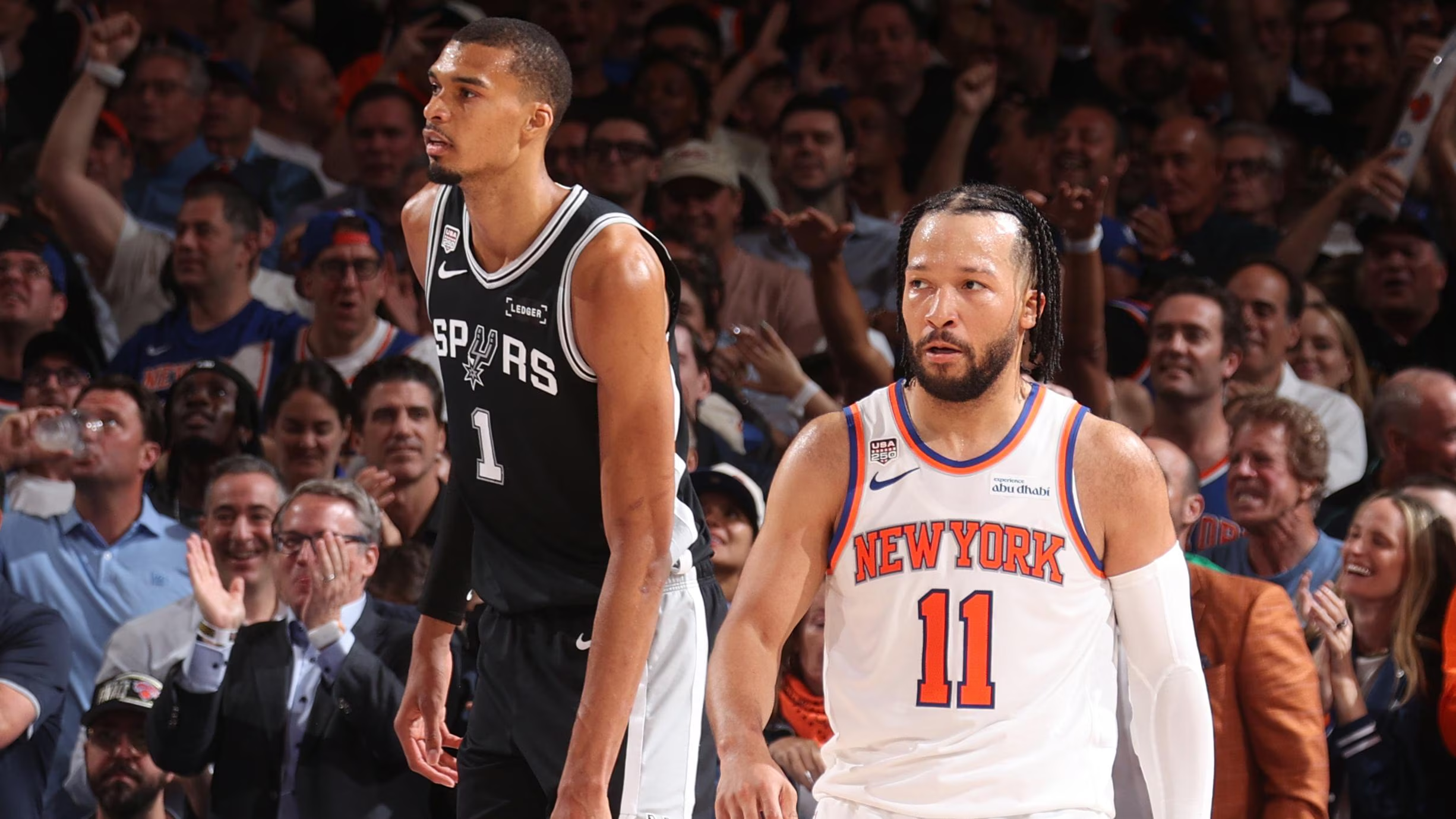
The veteran-led New York Knicks are defending NBA champions, and they won their title by going through the rising San Antonio Spurs. Which of those two teams is most likely to reach the mountaintop over the next three seasons, and who else might join them in the climb?
To set up a multi-year power rankings like this, we first have to consider present strength, the best indicator of how good a team will be in the future. Hold onto the talent that's making you effective today, and the odds are pretty strong your high level will hold—unless injuries, trades or decline mess up the operation.
That last part is where the exercise gets interesting. We know some teams are on the downswing of their competitive arcs, and we also know that up-and-comers will overtake them.
Which up-and-comers? That's where the (informed) guesswork comes in. We need to evaluate which younger teams will rise as some of the older and less stable ones fall.
We have to look at where each team is now, what its trajectory might lead to in the near future and what tools it has to affect that rise or fall. We might even need to think about which way a team might steer itself. Bottoming out on purpose is still an option.
We have a three-year window, beginning in 2026-27, to rank the organizations most likely to succeed.
History impacts the Sacramento Kings' future more than it does that of any other team.
The organization has cycled through countless coaches, executives, lottery picks, signings and trade acquisitions over the years, producing exactly one postseason appearance since 2006. Vivek Ranadivé has been Sacramento's principal owner for the last 13 years of that stretch.
He is the constant in all that mismanagement and failure, and he's still making decisions. In fact, one of the Kings' many recent blunders, taking back Zach LaVine after botching their relationship with and trading De'Aaron Fox, came at a time when Ranadivé had " taken control of personnel power ."
The Kings are in far better shape than teams like the Phoenix Suns in the draft-asset category. The only one of their future firsts they don't control is in 2031. LaVine's contract will expire after this season. Darius Acuff Jr., Sacramento's most recent lottery pick, might turn into something.
But this team is in the cellar now, has no clearly projectable stars and, most importantly, is still run by an owner who has produced the least success in the entire league while in charge.
Even if Derik Queen pops, Jeremiah Fears builds on his rookie season and Zion Williamson stays relatively healthy, it'll be hard to see the New Orleans Pelicans as more than a Play-In threat between now and 2029.
That means the wisest course involves trading Trey Murphy III for two or three first-rounders and retooling for a post-Zion run at relevance. Of course, that's been the pretty obvious move for a while now, and the Pels haven't shown an inclination to make it.
New Orleans controls all of its own future first-round picks from 2028 to 2033, and next season's will be the most favorable of its own and Milwaukee's. The runway is clear for a more thorough rebuild a couple of years from now, but Williamson and the large contracts belonging to Dejounte Murray and Jordan Poole clog up the books at the moment.
Lastly, nothing the management combo of Joe Dumars and Troy Weaver has done since taking over inspires confidence. All things being equal, we should expect less from New Orleans than most teams with its assets and roster.
The Brooklyn Nets' roster might be the least threatening in the league, though that could change if they use Michael Porter Jr.'s expiring salary to bring back a player who could take on a first-option role beyond this season. The other top talents, led by second-year guard Egor Dëmin and rookie Mikel Brown Jr., are a long way from stardom.
Jordi Fernandez is a good coach who gets whatever talent he has to play hard, and the Nets don't have a bad contract on the books. They've had Fernandez and flexibility before, though, and the losses keep piling up.
A great candidate to finish in the relegation zone this season, Brooklyn is a draft or two and a big free-agent haul away from relevance.
Updated Rankings After Kuminga Signing 📊
Offseason Overreactions for Every Team 🫨
Devin Booker is a very good player, but not one worthy of the four years and $250 million remaining on his current contract.
It'll be awfully tough for the Suns to bring in somebody as good or better than Booker while paying Bradley Beal $19.4 million every year through 2029-30 not to play for them.
Phoenix is also bereft of draft capital, having most recently dealt away its unprotected 2033 first-rounder to bring Miles Bridges aboard from Charlotte. That's the kind of move a surefire contender makes to add the final piece of the puzzle, not one you'd expect from a squad that shocked the world by winning just 45 games a year ago.
The Suns may not be able to deal Booker for positive value because of his contract. They have the league's smallest stockpile of draft capital and are fairly committed to a roster that might top out as a Play-In team over the next three seasons. The only good news is that this exercise covers only a three-year timeline, and Phoenix could be moderately competitive this coming season.
If we expanded the exercise to look further into the future, Phoenix's outlook would be even bleaker.
All those years of trading draft capital and taking on expensive deals to appease Giannis Antetokounmpo leave the Milwaukee Bucks in whatever developmental stage comes before a rebuild.
Milwaukee is on the hook for $21.3 million in waived-and-stretched salary for Damian Lillard annually through 2029-30. It doesn't control its own first-round pick until 2031, and the two incoming firsts it received from Miami won't arrive until the next decade.
Lacking a cornerstone and very likely to flip most of the roster within the next couple of years, the Bucks are paying the price for hanging onto Antetokounmpo a little too long. It's hard to fault them; giving up on the best player in modern franchise history isn't easy.
Rookie Brayden Burries shone in Summer League, and Milwaukee should be able to get positive value for Myles Turner, Tyler Herro, and a few others in trades. The Bucks took the first, hardest step in starting over. But they have many more to make before they're a threat to do any consistent winning.
A year ago, the Memphis Grizzlies dealt away Desmond Bane to trigger a teardown that would eventually send Jaren Jackson Jr. and Ja Morant out the door after him. It's hard to believe how promising they look in the wake of a total overhaul like that.
No, the Grizzlies don't figure to be playoff threats any time soon. But rookie Cam Boozer might be their best player by November, and a hoard of incoming picks from the Bane and Jackson trades means a win-now trade will be possible as soon as the option presents itself. Memphis could have as many as six extra first-rounders coming in from other teams between now and 2031.
We need to be careful in overvaluing flexibility and youth, two qualities the Grizzlies have in abundance. The trick is turning those things into a product that can win games on the floor. For all of Memphis' long-term potential, it's difficult to imagine a consistent winner emerging until at least 2028.
After years of hanging around the league's "meh" middle, refusing to fully rebuild and showing little ambition to spend what it takes to contend, the Chicago Bulls finally seem to have picked a direction. They're getting younger, starting fresh and under the new management of Executive Vice President Bryson Graham.
Chicago isn't necessarily going to tank because the payoff is less certain in the new lottery environment, but it does seem more likely to trust its youth and avoid chasing the Zach LaVines and DeMar DeRozans of the world over the next three years. That's to say the Bulls are building deliberately, rather than hunting quick fixes.
Caleb Wilson is bursting with potential, and Matas Buzelis could be a quality starter on both ends as soon as this season. Maybe Norman Powell's $21.5 million salary will return a first-rounder at the February deadline.
Things aren't as aimless and bleak in Chicago as they once were, but this season feels like the early phase of a process that won't be complete until after our three-year timeline is over.
Let's assume the Kawhi Leonard trade goes through and the LA Clippers avoid meaningful league penalties following an ESPN report that the NBA found no evidence owner Steve Ballmer circumvented the salary cap in connection with Leonard.
In that hypothetical, the Clippers have a core of Darius Garland and Brandon Ingram with Keaton Wagler, Jordan Miller and Yanic Konan Niederhäuser providing youthful upside.
Optimistically, L.A.'s capable veteran role players—Rui Hachimura, Derrick Jones Jr., Brook Lopez, Kris Dunn—could contribute to a group that hangs around .500 and challenges for a Play-In spot for a couple of years.
The draft won't offer much help, as the Clippers don't have a first-rounder until 2030—assuming the league doesn't dock them one or two.
The market in Los Angeles and a deep-pocketed owner willing to spend aggressively to compete are both helpful factors. The Clippers have shown a willingness to swing big deals in the past and should be expected to do so again.
The baseline they're starting from just isn't all that high, though, and the Clippers also don't have the draft assets to pull off something like what they did in getting Paul George and Leonard in 2019.
If Kyrie Irving returns at close to top form, Dereck Lively II finally stays healthy enough to build on the stellar rookie season he enjoyed in 2023-24 and Cooper Flagg fast-tracks himself into the All-NBA conversation, the Dallas Mavericks could make some serious noise as soon as this year.
That scenario requires a clean sweep of good breaks and probably isn't the likeliest outcome. The safe bet is on the Mavericks being at least a couple of years away from real relevance, and by that time Irving may have aged out.
He, at least, could bring back a good trade return if he's moderately healthy. A deal like that would suggest the Mavs are retrenching, though, which would make it tough for them to profile as a playoff team until they acquire another rising star to pair with Flagg.
That player probably won't be arriving in the draft. Dallas doesn't have outright control over its first-round pick until 2031.
The Golden State Warriors aren't as good as many fans would like them to be right now, as Stephen Curry enters the final few seasons of his career. Nobody is in love with the team returning a 37-45 roster for 2026-27.
The good news is that their repeated refusal to send off massive asset packages for a Curry-supporting star means the Dubs also won't be as bad as some expect when Steph is gone.
Golden State has full control of all but one of its first-round picks through 2033, currently has no bad money on the books beyond this season and could use Jimmy Butler's $56.8 million expiring salary to reel in more picks or a star on a longer deal this season.
Much depends on the size of Curry's looming extension. If he takes the full max, it'll make it much harder for the Dubs to give him a contending roster. A team-friendlier deal could create some intriguing possibilities if the Dubs also get serious about adding high-end talent and putting all those picks on the table.
Ends of eras, which the Warriors are approaching, can be difficult. But Golden State is actually better prepared than most to stay relevant if and when Curry is gone toward the end of this three-year window.
The Washington Wizards' official timeline is "all of them."
How else to describe a squad that probably needs to win right now while Anthony Davis is still in the last stages of his prime (if healthy), while also committing to a late-20s Trae Young and rostering the most recent No. 1 overall pick in AJ Dybantsa?
Those are the Wizards' three most expensive players this coming season, though the overall roster will get costlier when extensions for Alex Sarr, Bilal Coulibaly, Kyshawn George and Tre Johnson enter the picture.
If Davis isn't traded and Young plays his best ball, the Wizards could thread the needle here by performing like a playoff team in the short term while Dybantsa and the other youngsters develop. Maybe in a year or two, Washington's recently drafted core will be ready to either play at the level of AD and Trae or take over from them as they age out.
There's real potential here, even if the plan seems disjointed, and the Wizards control all their own future firsts. They can add to...whatever this is...if they want to.
Ja Morant is currently slated to be the Portland Trail Blazers' highest-paid player in each of the next two seasons. Our projections have to consider the possibility that the former star's salary is effectively a dead cap hit, even while acknowledging there's a non-zero chance Morant is actually worth that money.
Even if Morant hits the higher end of his possible outcomes, the Blazers' roster is oddly constructed with a glut of guards and not enough shooting to make sense around Deni Avdija. Having now seen Avdija prove over a season-and-a-half that he can dominate games as a driver, you'd think the Blazers would have made opening up the floor with better spacing a priority.
There's enough upside-laden talent here between Avdija, Donovan Clingan, Scoot Henderson and Shaedon Sharpe to retain optimism about a leap. Temper that with the knowledge that owner Tom Dundon is an epic cheapskate who might extend his thriftiness to player payroll while alienating fans with his threats to move the team.
Based on the money they're paying over the next three years, the Orlando Magic have already chosen their core. They'll spend $154 million on Paolo Banchero, Franz Wagner, Jalen Suggs and Desmond Bane next year, and that number will only go up through 2028-29.
Toss in an average salary of $19 million per year for Wendell Carter Jr. during that same stretch, and Orlando is basically at (and later over) the salary cap between just five players. That's without factoring in Anthony Black's looming extension.
Banchero is the key figure. He needs to prove he can knock down threes and ditch his ball-stopping ways to make good on his No. 1 pick pedigree and max extension. Just 24, he should have plenty of growth ahead. Note, though, that Orlando has already changed coaches by replacing Jamahl Mosley with Sean Sweeney. If the Magic's offense doesn't take a step forward, a Banchero trade could be the next move.
While the Magic could get positive value for Banchero and basically every other highly-paid player on the roster, that kind of deal might only bring back picks and set the organization back a year or two.
There's real upside here, but the Magic could be closer to a soft rebuild than it seems.
Some view the LaMelo Ball trade as an intentional step backward, but the presences of Kon Knueppel and Brandon Miller mean the Charlotte Hornets still have the potential stars they need to climb the standings between now and 2029.
While Ball clearly made those two better when sharing the floor last year, Knueppel and Miller could both expand their games in larger roles. Charlotte could use the flexibility and draft capital it gained in the Ball trade to fill in around its new core, and we should give this organization the benefit of the doubt.
The Hornets have won virtually every transaction they've made in recent seasons, highlighted by a series of moves that resulted in sending the Suns back their own 2029 first-rounder for an unprotected 2033 pick. That selection won't feature in Charlotte's three-year window (unless it goes out in a trade), but it exemplifies the smart, measured thinking that has the Hornets so well positioned.
You don't trade an entire rotation and every draft pick that's not nailed down for a 31-year-old two-time MVP if you're focused on the distant future.
The Miami Heat's acquisition of Giannis Antetokounmpo was solely motivated by a desire to win right now. Whether they can put together a good enough supporting cast to maximize their title chances around Giannis and Bam Adebayo remains to be seen, though the 2026-27 version of the squad looks like it'll have some serious depth issues.
You have to squint hard to imagine the Heat belonging among the East's top threats this coming season. While that could change if Antetokounmpo's presence attracts free-agent interest over the next couple of summers, we also need to consider Antetokounmpo's health issues last year and what they might mean for his performance level going forward.
It's very possible we're past the days of relying on Giannis as a top-five superstar, which means Miami's desperation for depth will only intensify as he ages.
The San Antonio Spurs control the Atlanta Hawks' first-round picks in 2027 and 2028, which actually makes success over the next three years more likely. The option to bottom out, devalued by lottery reform, is not on the table.
The Hawks wouldn't pursue that path anyway. They have too much young talent, led by 24-year-old All-NBA third-teamer Jalen Johnson, to consider tanking.
Johnson's $30 million salary through 2029-30 assures he'll remain one of the most underpaid stars in the league, giving Atlanta flexibility other teams should envy. Onyeka Okongwu and Nickeil Alexander-Walker give the Hawks two more underpaid quality starters, both still in their 20s.
Atlanta's real upside lies in its ready-made setup for a star better than Johnson. The payroll is under control with no large long-term commitments, the roster is loaded with movable salaries and role players who'd benefit from moving down a spot in the pecking order, and the Hawks still have plenty of their own picks and a juicy one coming in from either Milwaukee or New Orleans in 2027.
The Hawks are ripe for a major acquisition that could put them in the fringe-contender class at some point over the next three years.
Until the Kawhi Leonard trade resolves, it's hard to determine where the Toronto Raptors belong in a set of power rankings.
If we assume the trade with the Clippers goes through as expected, Toronto probably deserves to be considered a second-tier contender that could at least reach the 2027 Conference Finals.
That presumes good health and that Leonard holds up in his age-35 season. The longer-term outlook is a little less enticing than the one for next year, but even if Leonard slips a little, it's hard to argue the Raptors' three-year run with him will be any less successful than it would have been with Brandon Ingram and Gradey Dick.
Scottie Barnes offers stability and a high floor as a 25-year-old All-NBA stud who showed last postseason that he could run a credible offense while bringing elite defensive impact. He and Collin Murray-Boyles should ensure Toronto defends better than most through 2029.
Leonard is the swing piece. We'll just slot the Raptors here, based as much on Barnes' ascent as the hope that Kawhi shows up and stays healthy for a year or two.
The Utah Jazz should be in contention for a playoff spot this season, a welcome change after several years of deliberate losing. All that purposeful failure yielded Darryn Peterson and Ace Bailey, two core pieces who could develop into positive starters toward the end of our three-year window.
Bailey showed enough promise to project as a helpful rotation player who could start in 2026-27, and he'll join a handful of stars—Keyonte George, Lauri Markkanen and Jaren Jackson Jr.—to give the Jazz the right mix of experience and upside.
None of the three first-round picks Utah sent to Memphis for Jackson were its own, so flexibility is still a factor here. If the Jazz want to add to their core, they have the assets and matching salary to acquire a superstar.
Though not a likely contender given the current roster, the combination of in-prime stars, youthful upside and movable draft capital makes the Jazz an intriguing bet to reach that level by 2029.
As long as they don't overcommit on Amen Thompson's rookie-scale extension, the Houston Rockets can easily trade all of their best players for positive value.
A bevy of deals that flips over the roster isn't Plan A, but the ability to pivot easily if the need arises helps their outlook.
Ideally, Houston will get continued development from Alperen Sengün (24), Reed Sheppard (22) and Thompson (23) while vets Kevin Durant, Steven Adams and Fred VanVleet all hang onto their current production levels.
Half-court offense seems like it'll be a problem for as long as Sengün and Thompson are key pieces of the puzzle, but a breakthrough could be possible if one or the other makes a leap as a shooter.
The Rockets are about as dangerous as a team can be without a clear "best on a title-winner" player. Sengün has made back-to-back All-Star games and probably comes closest, but he needs to take another step or two before Houston will have the necessary top option to tangle with Wembanyama and SGA out west.
Nikola Jokić could be gone in free agency as soon as the summer of 2027, Jamal Murray's deal may be too large to trade for positive value if things go south and the Nuggets have dealt away so many future firsts that they're now stuck with only three swaps to trade.
The bottom could fall out very quickly in Denver, and recovery would be a long and painful process. At the moment, Christian Braun is the only Nuggets player on a fully guaranteed salary for 2029-30.
Really, this comes down to Jokić. We're taking him at his word that he intends to play out his career in Denver, and we're assuming his skill and processing speed will keep him in the MVP conversation as he ages into his 30s over the next three years. But if he walks, the Nuggets will immediately find themselves in one of the bleakest situations anywhere in the league.
One potential third option, trading Jokić ahead of his upcoming free agency, would replenish Denver's assets and avoid a worst-case scenario. It's hard to imagine the organization dealing the best player in franchise history, but we shouldn't rule it out if Jokić communicates an intent to leave.
Anthony Edwards, LaMelo Ball and Jaden McDaniels are all under contract through 2028-29, which means the Minnesota Timberwolves have most of the key ingredients they'll need to stick among the West's top playoff threats for the foreseeable future.
Rudy Gobert is 34 but has held up well enough during his time with the Wolves to raise the possibility he'll remain an All-Defense force for a few more years. As long as his decline is gentle (and as long as he takes a pay cut on his next deal), the Wolves will be dangerous on both ends.
This team's ceiling depends on the synergy between Ball and Edwards. Brought aboard to lighten the playmaking load on Edwards, Ball has to prove he's kicked the injury bug. He must also defend with respectable effort and mature off the floor. If this goes well and Edwards benefits from Ball's control of the offense, something special could develop.
Charlotte gave up on LaMelo for a reason, though, and we can't ignore the downside risk Minnesota took on by adding him. Short on draft capital, very expensive and at least peripherally aware of 29 other teams hoping Edwards gets a wandering eye, the Wolves' position is more precarious than it might seem.
Luka Dončić is under contract through 2027-28 with a player option for 2028-29, which means he'll be around for at least two of the three years we're considering.
That is, unless he tires of ownership turnover, decides he'd actually like to choose where he plays for the first time in his career or otherwise determines Los Angeles isn't for him.
None of that seems especially likely at the moment, and the Lakers have bent over backwards to build the supporting cast Dončić wants, including Walker Kessler.
Even with Dončić, Austin Reaves and Kessler, it's hard to view the Lakers in the same contender class occupied by the Spurs, Thunder, Knicks and others. Given the assets Los Angeles sent out to get Kessler, its resources to improve the roster are limited.
In other words, the Lakers' ability to move up these rankings depends mostly on Dončić staying healthy, happy and perhaps even finding a new level as he moves closer to 30. None of those are sure things.
The Indiana Pacers are pretty committed to their current core, which is both encouraging and concerning.
Indy was a win from a championship in 2025 and could be even better this year with Ivica Zubac joining a recovered Tyrese Haliburton and a gracefully aging Pascal Siakam. Aaron Nesmith, Andrew Nembhard, Obi Toppin and T.J. McConnell are all still around from that Eastern Conference champion squad, and offseason addition Kelly Oubre Jr. deepens the rotation.
If the Pacers get anything from Jarace Walker, Ben Sheppard or Johnny Furphy, they'll supplement the entrenched vets with some younger options.
That's the encouraging part. The worry arises when considering the uncertainty of Zubac's fit, Haliburton's potentially bumpy recovery and Siakam's possible slippage as he begins his age-32 season in 2026-27.
The only first-rounder the Pacers don't control is their 2031 selection, so they can tinker with trades if they need to. Ultimately, though, this team's window depends on Haliburton and Co. proving they're the contenders they once were.
Few teams have a higher three-year variance than the Philadelphia 76ers, whose ceiling depends on Joel Embiid staying healthy and LeBron James continuing to buck the aging trend as he gets deeper into his 40s.
You've got to acknowledge Philly's potential this season with the addition of James and Jaylen Brown, even if Embiid is not a good bet to play more than half the year or be in good form when the playoffs roll around. Brown, James and Tyrese Maxey will keep the Sixers highly relevant, but it'll probably take a miraculous turning back of the clock from Embiid to reach contender status.
The downside in Philadelphia is deeply concerning.
Embiid is probably the worst contract in the league at the moment, and it could actually get worse if his health and mobility continue to decline. The Celtics gave up on Brown partly because they don't believe he's worth what he's making. James' run has to end at some point.
Between Maxey and VJ Edgecombe, the Sixers have pieces that can lead them into their next era. But they're the only stable part of an otherwise very shaky (though intriguing) short-term build.
Though it sounds strange to say about a 60-win team led by a legitimate 24-year-old MVP candidate in Cade Cunningham, the Detroit Pistons are at a crossroads.
The way they resolve Jalen Duren's restricted free agency and the looming extension decision for Ausar Thompson will either leave them with the flexibility to pivot in their roster construction around Cunningham or lock them into a flawed (while promising) core.
Duren has already earned an All-NBA nod, and last postseason's no-show effort probably won't repeat itself. The Pistons are right to play hardball with him in restricted free agency, and they should be able to retain him on a contract that doesn't preclude the addition of another star or better playmaking depth down the line.
Thompson is a trickier proposition. He's a top-one-percent athlete with exceptionally disruptive talent on D, but he's an underwhelming playmaker who can't shoot a lick. Detroit will box itself in if it pays him like a future star—unless he makes dramatic improvements on offense.
The Pistons are going to contend for top-four position in the East as long as Cunningham is healthy and the defense holds up. Whether they can do more than that depends on keeping their books under control.
If Jayson Tatum regains his full form, the Boston Celtics should have the down-ballot MVP candidate they need to build a contending roster. Paired with a head coach in Joe Mazzulla and a tactical scheme that emphasizes winning the shot-math game, the Celtics have also proved that they can get more out of their roster than most.
The Jaylen Brown trade will have a major effect on the next three years in one of two ways. It'll either be remembered as the bold move that freed up cash and restocked the draft cupboard while unloading an overrated player, or the deal that officially knocked the Celtics out of serious contention during the Tatum era.
Right now, it's hard to argue next year's version of the team will be better without Brown. But we need to trust Brad Stevens and a management group that has gotten a lot of its decisions right over the years. Hugo Gonzalez, Baylor Scheierman, Jordan Walsh, Neemias Queta and others are proof Boston can draft, acquire and develop talent with limited resources.
As long as they don't trade 25-year-old Evan Mobley, the Cleveland Cavaliers should have a high defensive floor. Donovan Mitchell's recent re-commitment to the team on an extension that keeps him locked up through 2029-30 also assures the presence of a lead offensive option with multiple All-NBA nods.
Peyton Watson fits right between those two stars and could be the reason Cleveland ditches the not-quite-contender status it has held for the last handful of seasons.
The Cavs have been extremely expensive for a while, and Mobley's extension will take up 30 percent of the cap for most of the next half-decade. Without control of a first-rounder until 2030, Cleveland is also short on flexibility. If things go very wrong, a reset that involves a Mitchell and/or Mobley trade could restock the cupboards.
For now, the Cavs feel like a lock to win 55-plus games and should scare teams more than ever with Watson's defense and athleticism joining the operation.
The defending champion New York Knicks should stick in the contender class for at least another year or two, but there's no denying they lack the shelf life of some other teams ahead of them in the rankings.
Jalen Brunson's craft, post game and willpower should age well, but are we sure Karl-Anthony Towns has another couple of postseason runs in him as good as the one he completed in June? And wasn't Mikal Bridges' waxing and waning impact a story throughout both the regular season and playoffs?
Those three and Josh Hart will play the upcoming season on the wrong side of 30, and OG Anunoby is 29. Steep decline isn't imminent, but the Knicks certainly aren't expecting any of their core rotation pieces from the title run to improve as the years advance.
The Knicks' championship run means they deserve our full respect, but we need to be realistic about where they are on the aging curve relative to some of the competition near them in the rankings.
An in-prime MVP, two All-NBA stars locked into long-term deals that'll never pay them more than 25 percent of the cap and a deep supporting cast built by a front office that knows what it's doing—the Oklahoma City Thunder have it all.
Well, except for the upper hand in their most recent postseason meeting with the San Antonio Spurs.
Jalen Williams' hamstring injury had plenty to do with OKC falling in the Western Conference Finals, but Williams and Chet Holmgren have lengthy enough injury histories to warrant real concern about their durability going forward.
And while two-time reigning MVP Shai Gilgeous-Alexander is probably the best player in the league right now, Victor Wembanyama could seize that title early next season and hold onto it for a decade.
Oklahoma City has won at least 60 games for two years running, and none of its main weapons is in the decline phase yet. The Thunder can hold this level for at least another three seasons. San Antonio, though, feels like it has only just begun its rise.
Health is the biggest obstacle between the San Antonio Spurs and at least one championship between now and 2029. They already checked the "learn a hard lesson" box by losing to the Knicks in the Finals, when inexperience in key moments proved costly.
With that out of the way, Victor Wembanyama, Dylan Harper and Stephon Castle should complete the team's ultimate objective sooner than later.
The Spurs will likely begin 2026-27 as title favorites, and Wembanyama should be the preseason MVP pick. Harper is a superstar in waiting, and he joined Castle in proving himself ready to compete at the absolute highest level. Wemby is the oldest of the three at just 23.
With plenty of draft capital to swing a trade for another star, the Spurs may not be done adding to the roster. If they can figure out how to turn De'Aaron Fox's salary slot into a more useful player to balance out the rotation, the gap between them and the Thunder could widen.
Stats courtesy of NBA.com , Basketball Reference and Cleaning the Glass . Salary info via Spotrac .
Grant Hughes covers the NBA for Bleacher Report. Follow him on Bluesky and subscribe to the Hardwood Knocks podcast, where he appears with Bleacher Report's Dan Favale .
Topics in this story
Gathered from external sources. Rights to this text belong to whoever originally published it.