7 NBA Offseason Moves That Could Go Horribly Wrong
There's no such thing as a risk-free NBA transaction. Every trade and free-agent acquisition comes with downsides, but a few deals from the 2026 offseason just have more disaster potential than others.
There's no such thing as a risk-free NBA transaction. Every trade and free-agent acquisition comes with downsides, but a few deals from the 2026 offseason just have more disaster potential than others.
Many of the incredibly risky moves we're covering have reasonable justifications. If you have a shot to increase your championship equity with a trade, for example, it's often the right decision to go for it—even if it's not technically likely that the decision will pay off.
Here, we'll run through several swaps and signings that could go especially wrong for a variety of reasons. That's not to say these transactions are sure to fail. We're just highlighting the ones that could do the most damage if they don't work out.
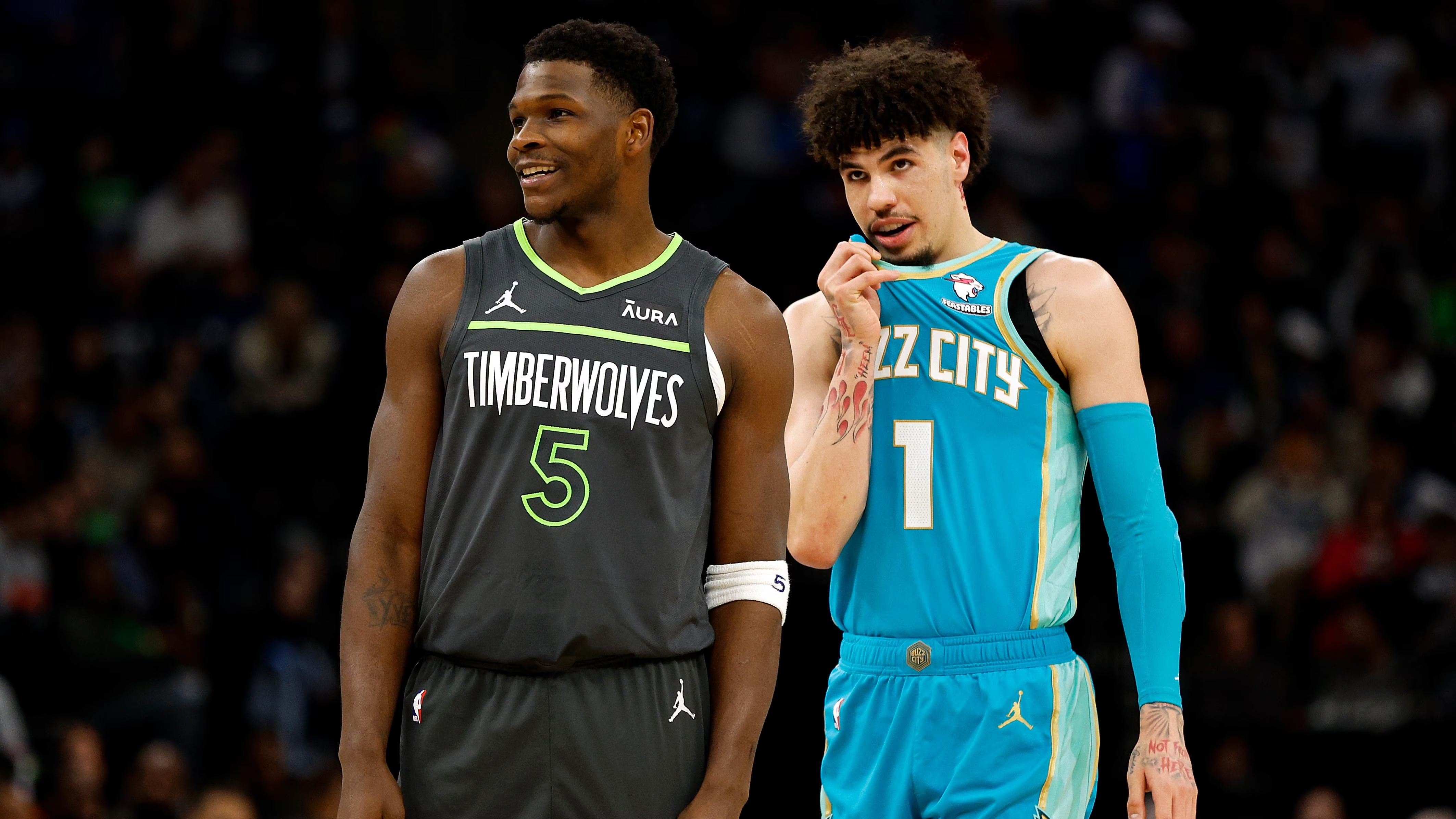
The Charlotte Hornets will regret trading LaMelo Ball if he stays healthy and elevates the Minnesota Timberwolves to the contender class. But even if that happens, Charlotte will still have the first-rounders and players it acquired in the deal.
Minnesota, on the other hand, will be in a brutally tough spot if Ball doesn't deliver.
Consider: The Hornets just watched Ball enjoy the most productive season of his career and still chose to move on, despite having the most complete view of his health history, contract and the concerns about whether he can be the face of a winning franchise. Charlotte's decision is worth noting, particularly given the front office's track record under general manager Jeff Peterson.
If Ball proves he can stay on the floor for more than last season's 72 minute-managed appearances, elevate Minnesota's offense and answer questions about his defensive engagement and ability to lead a winning team, the Wolves will be thrilled with the deal.
If he falls short in any of those areas, Minnesota could be left questioning why it accepted so much risk for a player with Ball's injury history, expensive contract and uneven two-way track record.
Walker Kessler might be worth $130 million over four years. When last healthy, he graded out as one of the league's top offensive rebounders and rim protectors. Add a little offense to that profile, and it's not that hard to justify paying him like a top-10 player at his position.
Throw in the two unprotected first-rounders and two swaps the Los Angeles Lakers sent the Utah Jazz in the sign-and-trade to get Kessler, and the bar for his performance gets considerably higher.
Justifying that cost is probably beyond Kessler's ability. He'd need to stay healthier than he has in any of the last three years, land in the conversation for Defensive Player of the Year and help turn the Los Angeles Lakers into contenders.
Los Angeles paid a superstar price for a quality starter because it was desperate to support Luka Dončić with the kind of paint-patrolling, rim-rolling center he wanted. If this goes badly, a Lakers team that fired all its bullets at the wrong target could wind up losing Dončić to a team that can actually reach contender status.
You never want to be involved in a trade where everyone agrees the other side absolutely had to say yes.
No draft picks or prospects changed hands when the Washington Wizards acquired Trae Young for the expiring salary of CJ McCollum and the marginally underwater four-year, $54 million deal belonging to Corey Kispert last January.
Despite that trade signaling Young's relatively low value, the Wizards decided he was worth a four-year, $212 million max contract.
Washington attempted damage control almost immediately, leaking its belief that "Young would have commanded maximum-salary contract offers from other franchises," per Josh Robbins of The Athletic.
Few teams had enough cap space to give Young what Washington did, and ESPN's Zach Lowe nixed the notion that any of them were interested: "From what I know, it was not Brooklyn... Chicago has [Josh] Giddey. The Lakers have guards galore. The Pistons have Cade Cunningham and we're now out of teams with cap space. I don't know what they were afraid of or who they were bidding against."
Young is one of the worst defenders in the league, gives no off-ball value on offense and has never shed the reputation that "even the players who were eating off his passes didn't like him or enjoy playing with him," per The Athletic's John Hollinger .
If this contract deal was part of the price of acquiring Young in the first place, it was a mistake. If the Wizards fooled themselves into believing there was competition for him in free agency, even worse.
'Over-Under' Predictions for Every NBA Team's Record 🔮
Trades That Should've Happened During NBA Offseason 🏀
The Phoenix Suns shipped snipers Royce O'Neale and Grayson Allen to the Charlotte Hornets for Miles Bridges, who owns a career 33.8 percent mark from three.
If that were the entirety of the deal, it'd rate as a likely mistake for the Suns.
Bridges has posted net-negative defensive numbers throughout his career while almost always producing true shooting percentages below the league average . Considering he shared nearly 3,000 possessions with ace facilitator LaMelo Ball last year, Bridges' accuracy marks of 46.0 percent on twos and 33.3 percent on threes look pretty bad.
Bridges has also been dependent on his athleticism and could be in for decline as he enters his age-28 season. In fact, regression is already hitting. The percentage of his field-goal attempts at the rim has declined for five straight years.
Bridges is a borderline starter who could sign a huge extension while potentially hurting a Phoenix offense that needs its space.
Oh, and the Suns attached their unprotected 2033 first-rounder in the deal, coughing up their best future asset for a forward who probably won't make the team better on the floor this season.
The last time James Harden signed a contract or extension for longer than two years, he was a perennial MVP candidate playing for the Houston Rockets. In his travels since then—from Houston to Philly to Brooklyn to Los Angeles and now to Cleveland—no team has felt sure enough of his reliability to offer more than two guaranteed years.
The Cavs inked Harden to a fully guaranteed three-year, $97 million deal with a player option in 2028-29, his age-39 season.
What could go wrong? Other than the natural aging curve rendering Harden even less available and less effective defensively, his history of trade demands and his track record of postseason failures effectively capping Cleveland's ceiling at the Conference Finals?
Harden remains a very useful offensive player, and he's as durable as any late-30s star can be. But we know things tend to end badly when Harden sours on his circumstances, and Cleveland's championship-or-bust posture only further pressurizes the environment. Before this three-year deal is over, we're going to be reminded of why it's been so long since someone invested this heavily in Harden.
Based on the 8.1 points per game and 53.3 true shooting percentage he managed last season, Gary Trent Jr. isn't going to provide $64 million worth of production over the four years of his new contract.
But at around nine percent of the salary cap next year, Trent's deal isn't going to ruin the Milwaukee Bucks. They're rebuilding anyway, and they're already living with much bigger financial missteps than this one. For example, Damian Lillard will collect $21 million per season through 2029-30, and he hasn't played for the team in 18 months.
Overpaying Trent isn't a catastrophe, at least in part because the Bucks aren't built to win or maximize every dollar this coming season. It's the longer-term fallout they should be worried about.
Reports questioning whether Trent's deal complied with NBA salary-cap rules prompted the league to open an investigation , which could lead to further consequences if it finds a violation.
The charitable interpretation is that Trent's contract reflects Milwaukee's evaluation despite his recent production and prior, smaller salaries. A more concerning possibility is that the deal may have been arranged earlier than NBA rules allow—an issue the league is reportedly examining.
The Miami Heat can win the 2027 NBA championship with Giannis Antetokounmpo, and they couldn't have without him. Drill all the way down to that simple truth, and it justifies the trade that brought the two-time MVP to Miami for four quality players and virtually all of the draft capital the Heat could trade.
When you move past the binary "can vs. can't win a championship" style of analysis and think of Miami's situation probabilistically, the downsides become obvious.
It is certainly not likely that the Heat will win the title this season. In addition to a laughably loaded East, depth issues and the separate class of contenders out West (OKC and San Antonio), Miami's slim chance at success will vanish if Giannis declines or can't stay healthy for the regular season and playoffs.
Odds are, the Heat's massive trade won't yield a ring and may not even assure home-court advantage in the first round. Given the extent to which Miami mortgaged its future, you'd like to see more present promise.
Stats courtesy of NBA.com , Basketball Reference and Cleaning the Glass . Salary info via Spotrac .
Grant Hughes covers the NBA for Bleacher Report. Follow him on Bluesky and subscribe to the Hardwood Knocks podcast, where he appears with Bleacher Report's Dan Favale .
Topics in this story
Gathered from external sources. Rights to this text belong to whoever originally published it.