Ranking the NBA's Biggest Bag Fumbles of the Past 15 Years
Every offseason, dozens of NBA players cash in by signing contracts for life-changing amounts of money. Not every player is so fortunate, though. When the…
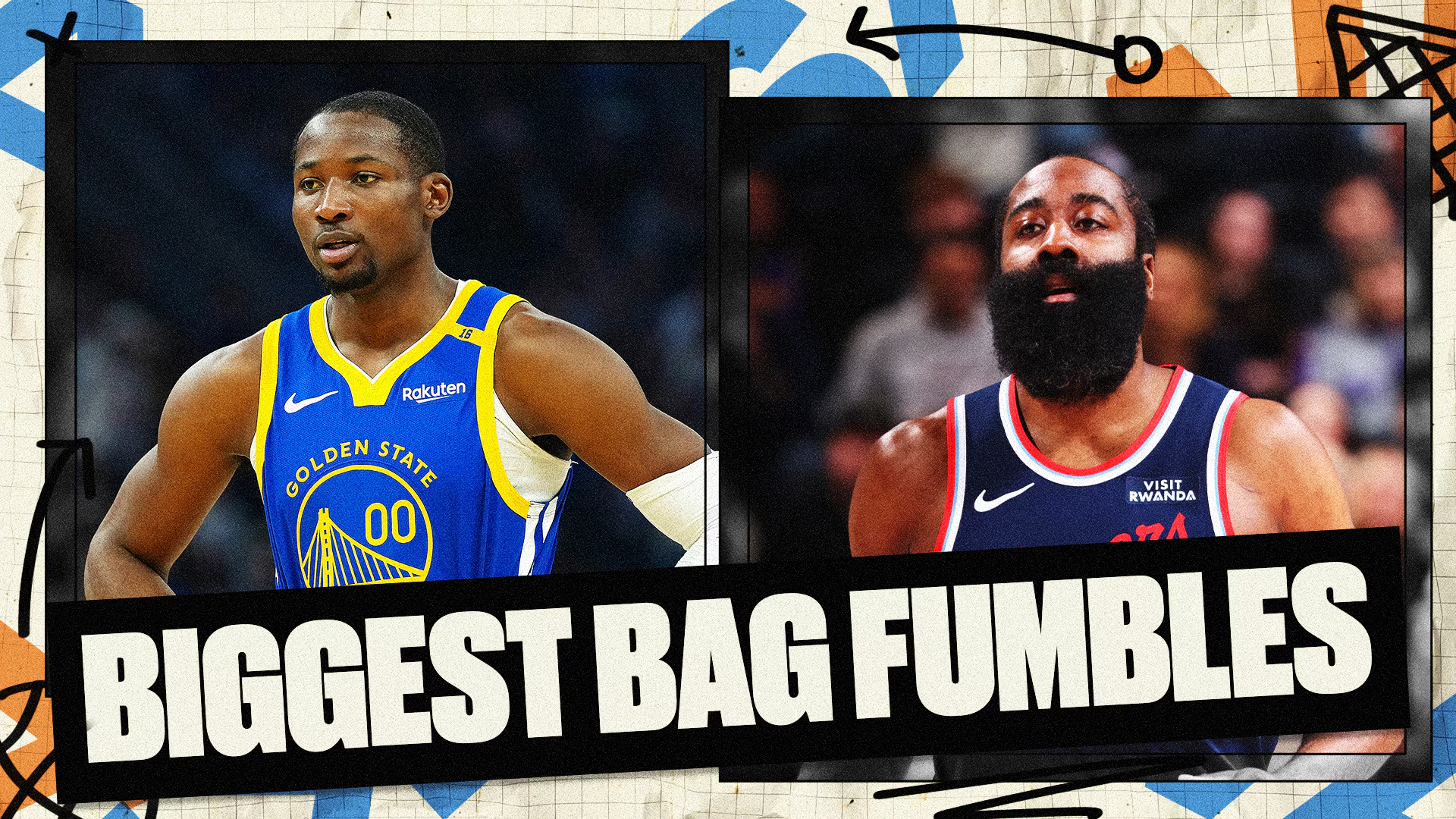
Every offseason, dozens of NBA players cash in by signing contracts for life-changing amounts of money.
Not every player is so fortunate, though. When the free-agent game of musical chairs ends and cap space dries up around the league, plenty of players are forced to sign below-market deals and try their luck again next year.
Here, we're focused on the players who blew the biggest bags in recent years.
Players who lost out on major paydays because of injuries won't be appearing in these rankings. Victor Oladipo, DeMarcus Cousins and Isaiah Thomas all made far less money than they would have prior to their respective career-altering injuries, but that isn't their fault.
The players featured here all had a choice at some point. They all just chose poorly from a financial standpoint.
We've ranked them here based on how much they reportedly gave up, what they ended up signing for and how much each of them earned from that point forward.
Heading into the 2024 offseason, the Miami Heat offered Caleb Martin a five-year, $65 million extension, according to Ira Winderman of the South Florida Sun Sentinel. He would have needed to pick up his $7.1 million player option in 2024-25, and the Heat would have tacked on an extra four years and $58 million from there.
Instead, Martin declined his player option to become an unrestricted free agent. He wound up signing a four-year, $35 million deal with the Philadelphia 76ers that contained an additional $5.3 million in unlikely-to-be-earned incentives.
"I mean, you're always going to wish you can make as much money as you can," Martin told reporters after he signed with the Sixers. "It's part of the game, it's part of life. You live and learn. You take risks. Sometimes it works, sometimes it doesn't."
Martin didn't even last a full season with the Sixers. They sent him to the Dallas Mavericks ahead of the 2025 trade deadline for Quentin Grimes, and it's been all downhill for him ever since. In 2025-26, he averaged a career-low 3.9 points in 14.8 minutes per game.
Martin is earning $10.0 million in 2026-27 and has a $9.4 million player option in 2027-28, which will be his age-32 campaign. In theory, he'll still have a chance to recoup some of the money he lost by declining the Heat's offer in 2024. But barring a drastic turnaround, it's difficult to imagine him receiving an offer that tops his player option in 2027.
Martin might be a minimum or near-minimum player from here on out, which means this could wind up being a roughly $30 million bag fumble.
Jonathan Kuminga and the Golden State Warriors spent the entire 2025 offseason in a restricted-free-agency standoff. Shortly before the Oct. 1 qualifying-offer deadline, Kuminga agreed to sign a two-year, $46.8 million deal with a second-year team option.
The deal was "designed for the Warriors—or another team if and when Kuminga is traded during the upcoming season—to rip up and complete a fresh new contract after the 2025-26 campaign," ESPN's Shams Charania reported at the time . The Warriors did trade Kuminga to the Atlanta Hawks ahead of the trade deadline, and the Hawks did decline their $24.3 million team option on Kuminga, but that's just about all that went according to plan for him.
Instead of landing a hefty payday, Kuminga once again languished in free agency for nearly two months. Finally, in late August, he agreed to sign a two-year, $12.4 million contract with the Minnesota Timberwolves.
Kuminga did secure a second-year player option, so he'll have another chance to cash in as a free agent in 2027. But he's earning less than $6.1 million in 2026-27, which is a far cry from the team option that the Hawks declined.
Here's where it gets painful: The Warriors reportedly offered Kuminga two contract structures during their standoff in 2025. They offered him the two-year, $46.8 million deal that he wound up signing, and a three-year, $75 million contract with a third-year team option, according to Charania and ESPN's Anthony Slater .
In essence, Kuminga could have been guaranteed $24.3 million in 2026-27, and the Warriors would have had a $26.1 million team option on him in 2027-28. Instead, he's now set to earn roughly $18.2 million less in 2026-27, but he'll have the freedom to become an unrestricted free agent in 2027.
The jury is still out on how momentous of a bag fumble this winds up being, but for now, Kuminga's agent has a lot of explaining to do.
In 2016, the Brooklyn Nets signed restricted free agent Donatas Motiejūnas to a four-year, $37 million offer sheet, according to ESPN's Calvin Watkins . The Houston Rockets decided to match, which is where the drama typically ends for restricted free agents.
Motiejūnas proved to be the exception to that rule.
According to Watkins , the Rockets only had to match the "principal terms" of the offer sheet, which was $31 million. As a result, Motiejūnas then refused to show up for his physical, leaving the Rockets to wait him out or pull the offer sheet and let him become a restricted free agent again.
The Rockets initially did the latter, but they then signed Motiejūnas to a four-year, $35 million deal . However, an issue arose in his physical, and the Rockets wound up renouncing their rights to him entirely. That made him an unrestricted free agent who was free to sign with any team.
Motiejūnas wound up signing a one-year, $1.5 million minimum-salary contract with the New Orleans Pelicans. He played only 37 NBA games in total from that point forward.
That's a casual $35-plus million bag fumble.
Michael Jordan expected to leave media role
After the NBA's salary cap exploded in 2016, the Minnesota Timberwolves offered Shabazz Muhammad a four-year extension "believed to be worth at least $40 million," according to Jerry Zgoda of the Star Tribune .
The following summer, he wound up re-signing with the Timberwolves on a two-year, $3.4 million minimum-salary contract.
According to ESPN's Adrian Wojnarowski , "Muhammad re-signed with the Timberwolves last offseason with hopes of a substantial bench role, only to find [then-head coach Tom] Thibodeau reverting to the longstanding practices of shorter bench rotations and heavy starter minutes that became a staple of his five years as Chicago Bulls coach." He averaged only 9.7 minutes per game with Minnesota in 2017-18 after playing 20.5 minutes per game over the previous three seasons.
Muhammad asked for the Timberwolves to either send him elsewhere at the 2018 trade deadline or release him, according to Wojnarowski. They eventually chose the latter, leading him to sign a rest-of-season contract with the Milwaukee Bucks. Muhammad played in 11 games for the Bucks that season and has yet to appear in an NBA game since then.
Muhammad met with the Los Angeles Lakers when he was a free agent and reportedly turned down bigger offers from other teams to re-sign with the Timberwolves, per Zgoda. Considering how caustically their partnership ended later that season, it might have been better for both parties to part ways in free agency.
Montrezl Harrell hit free agency at the perfect time in 2020. He was fresh off winning the NBA's Sixth Man of the Year award after averaging a career-high 18.6 points and 7.1 rebounds per game while shooting 58.0 percent overall with the Los Angeles Clippers.
Harrell just finished a two-year, $12 million contract with the Clippers and appeared poised for a significant raise. He wound up signing a two-year, $19.0 million deal with the Los Angeles Lakers and never got more than a minimum contract after that.
Brad Turner of the Los Angeles Times reported that Harrell turned down a bigger offer from the Charlotte Hornets when he signed with the Lakers. According to ESPN's Kendrick Perkins , the Hornets offered him a four-year, $80 million deal.
Considering that Harrell earned roughly $25 million over that same span, this would be a legendary bag fumble if Perkins is right. Harrell earned nearly $39.5 million across his nine-year career.
If Harrell won a championship with the Lakers, perhaps the discount would have been worth it. He was joining the reigning champions, after all. The only problem is, they lost in the first round of the playoffs in 2020-21 and missed the playoffs entirely the following season.
In February 2021, the Los Angeles Lakers approached Dennis Schröder's agent to discuss a contract extension, according to ESPN's Dave McMenamin . They reportedly offered him a four-year, $84 million deal, per ESPN's Brian Windhorst (via Dan Feldman of NBC Sports), but McMenamin reported that "Schröder's side said they would rather wait until the offseason to discuss a deal when he reached free agency."
Although Schröder averaged 15.4 points, 5.8 assists and 3.5 rebounds per game for the Lakers during the 2020-21 season, the free-agent market wasn't kind to him the following summer. He wound up settling for a one-year, $5.9 million contract with the Boston Celtics via the taxpayer mid-level exception.
Schröder initially had a good sense of humor about his bag fumble. However, he later began pushing back on the narrative that he turned down an extension offer from the Lakers.
"I mean, end of the day, there never was a contract," Schröder told McMenamin. "There never was a contract, never rejected anything ... That's not true."
Had the Lakers made him an official offer, Schröder told Jake Fischer of Yahoo Sports that he would have signed it. "I would never just leave money on the table," he added. "My mom didn't raise me that way."
In 2022, Schröder took a one-year, $2.7 million contract to rejoin the Lakers. And he finally did cash in by signing a two-year, $25.4 million contract with the Toronto Raptors in 2023 and a three-year, $44.3 million deal with the Detroit Pistons two years later.
Still, the roughly $34 million he earned over that four-season stretch pales in comparison to the $84 million deal that the Lakers were reportedly willing to offer him in 2021.
When Nerlens Noel entered restricted free agency in 2017, the Dallas Mavericks offered him a four-year, $70 million deal, according to ESPN's Tim MacMahon . Noel declined and requested a max contract, at which point the Mavericks "immediately pulled the offer off the table and never made another one," per MacMahon.
Noel wound up signing his $4.2 million qualifying offer with the Mavericks instead. The following summer, he left Dallas to sign a two-year, $3.8 million minimum-salary contract with the Oklahoma City Thunder.
From there, Noel signed a one-year, $5 million deal with the New York Knicks in 2020 and then re-upped on a three-year, $28.8 million contract the following summer. However, he wound up getting bought out of that contract in February 2023 and has appeared in only three NBA games since then.
In total, he came nowhere close to recouping what the Mavericks originally offered to pay him in 2017.
"They think he should of taken the [$17 million]," a source close to the Mavericks told SB Nation's Tim Cato at the time. "That's a good number for him. But if he's willing to risk it and bet on himself, you can't knock someone looking for their first big bag of money."
Noel wound up suing his former agent, Rich Paul of Klutch Sports, after Klutch accused Noel of not paying his commission on one of his contracts, according to Windhorst . A judge dismissed his lawsuit in September 2022, and the two sides settled a few months later .
Everyone featured here so far turned down tens of millions of dollars. James Harden is the only one who's turned down hundreds of millions.
In 2021, the Brooklyn Nets offered Harden a three-year, $161 million contract extension, according to Brian Lewis of the New York Post . Harden declined to sign it, perhaps in part because he would be eligible for a four-year, $227 million extension the ensuing offseason.
Five months later, the Nets traded him to the Philadelphia 76ers, where he reunited with former Houston Rockets team president Daryl Morey.
That reunion proved fruitful at first. Morey convinced Harden to sign a two-year, $68.6 million below-max contract, which gave the Sixers enough space under the first apron to use both the non-taxpayer MLE to sign P.J. Tucker and the bi-annual exception to sign Danuel House Jr. Harden got a second-year player option on the deal, which allowed him to opt out and try to cash in the following summer if he wanted.
Things went south between Harden and the Sixers ahead of his opt-in decision in 2023. Morey and the Sixers reportedly ghosted Harden in the days leading up to the start of free agency, which eventually led him to pick up his option and request a trade.
That was not exactly the $227 million payday that was promised.
The Sixers eventually traded Harden to the Los Angeles Clippers last fall, but the NBA's new collective bargaining agreement effectively defanged the unmatched spending power of team governor Steve Ballmer. With the second apron looming large, the Clippers refused to give Harden or Kawhi Leonard full max contracts. Instead, Harden agreed to a two-year, $70 million deal with a second-year player option.
In total, Harden made just over $100 million across the three seasons that his extension with the Nets would have spanned. Granted, he's now one of the only players in NBA history with more than $500 million in career earnings , so he'll be fine either way.
Still, misreading the market for mid-30s stars in the new CBA landscape cost Harden upward of $60 million.
Unless otherwise noted, all stats via NBA.com , PBPStats , Cleaning the Glass or Basketball Reference . All salary information via Spotrac and salary-cap information via RealGM .
Topics in this story
Gathered from external sources. Rights to this text belong to whoever originally published it.