Mock NBA Expansion Draft for New Las Vegas and Seattle Teams
Las Vegas and Seattle are reportedly moving closer to getting NBA expansion teams.
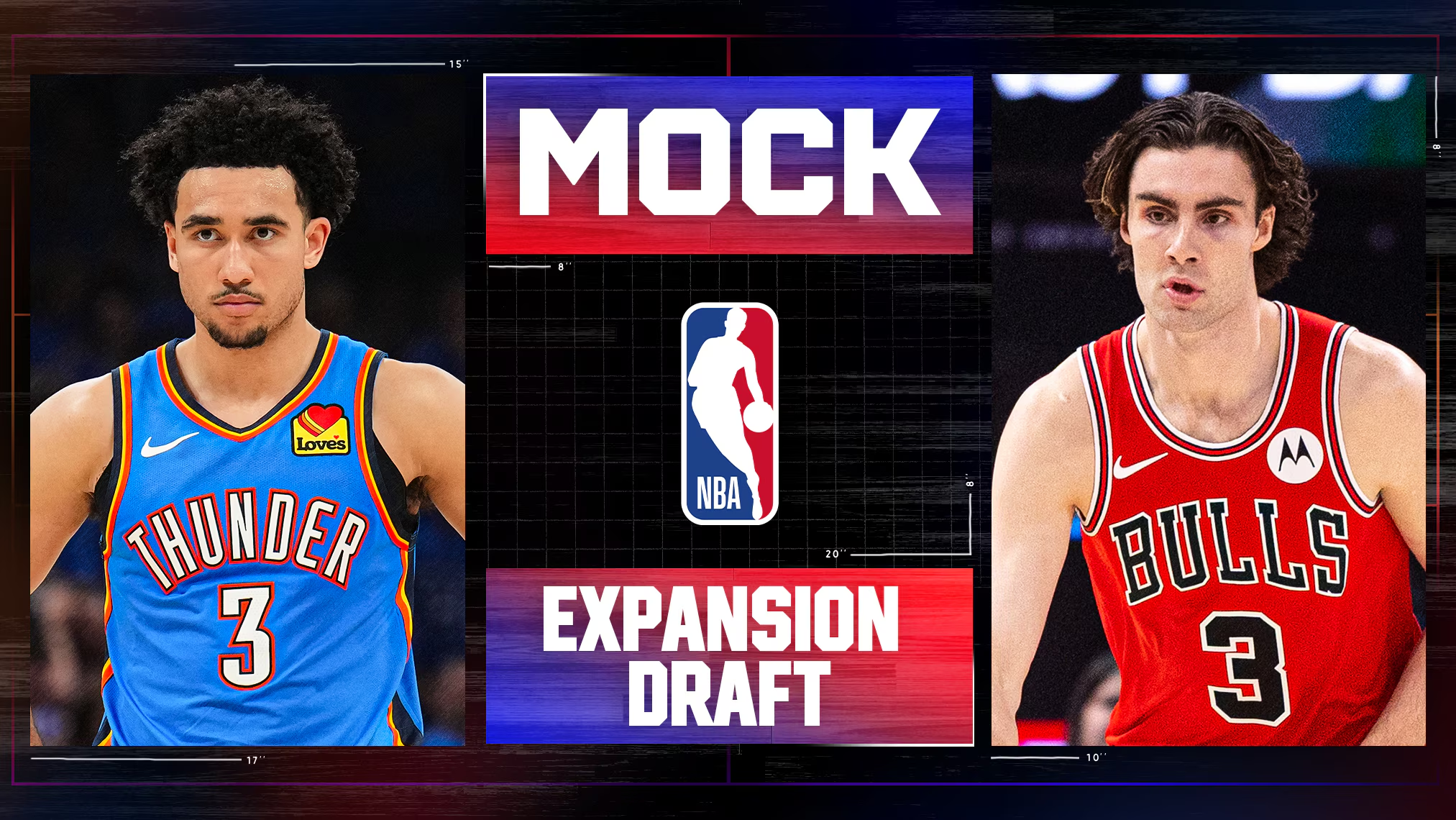
Las Vegas and Seattle are reportedly moving closer to getting NBA expansion teams.
On Tuesday, ESPN's Shams Charania reported that the process for gathering bids for an expansion team in Las Vegas "has moved with more pace than Seattle, but those Seattle conversations are continuing as well."
Charania added that "the league has been targeting as soon as the 2028-29 season for the start of these expansion teams." We weren't patient enough to wait.
B/R NBA Analysts Dan Favale and Grant Hughes have already decided which players each team would protect from an expansion draft if one were being held today. Using that pool of available players, they held their own mock expansion draft for the Vegas and Seattle teams.
A few rules of note before we get underway:
Expansion teams have only 66⅔ percent of the usual salary cap in their first year of existence. Since the 2026-27 cap is $164,961,000, our expansion teams were limited to a $109,974,000 salary cap.
Each team had to select at least 14 players.
Existing teams can lose only one player in an expansion draft. So, if Las Vegas selects a player from the OKC Thunder, Seattle cannot take one from OKC, etc.
Will any team spend 40-50 percent of their cap space on the likes of Paul George, Joel Embiid, Ja Morant or Zach LaVine? Which current teams managed to make it through the expansion draft unscathed?
Let's see how the new Las Vegas Vipers and Seattle SuperSonicBooms fill out their rosters while staying under the salary cap.
Keep scrolling to explore the entire draft.
1. Las Vegas Vipers: Jared McCain, Oklahoma City Thunder
Jared McCain isn't just unusual among the players in this pool. He might be unique.
While putting together different mock roster builds before the draft, McCain kept ending up on my team because he ticked boxes no one else did.
Young at 22, very cheap at $4.4 million and already a scorer who'd proved himself against a great defense on a postseason stage, McCain became a player and a value whom I decided the Vipers couldn't live without.
Slotting him into a prominent role meant my team would need defensive help up and down the roster, but I figured I could find that later. McCain's low-cost scoring chops and upside were too good to pass on.
The other key factor here: Taking McCain eliminated the rest of the Oklahoma City Thunder's players from the pool. Jaylin Williams and a handful of others could have helped Dan's team, but now they're unavailable. Gamesmanship!
2. Seattle SuperSonicBooms: Ty Jerome, Memphis Grizzlies
The SuperSonicBooms always planned to take someone with our first pick who could run the offense without a bank-breaking salary. Owed under $10 million this coming season, Ty Jerome topped our big board.
Last year's 15-game sample size would be a red flag if he hadn't just finished third in Sixth Man of the Year voting during the 2024-25 campaign. That allows us to place genuine stock in Jerome grading out as one of the league's most efficient self-created shot-makers in his brief time with Memphis.
Even if he tapers off a bit, the 29-year-old is a viable floor spacer, reasonable half-court initiator and push-shot extraordinaire. Landing someone like him for under 8.5 percent of our salary cap is a friggin' coup—both on the court and as a potential trade asset down the line.
3. Las Vegas Vipers: Josh Giddey, Chicago Bulls
For most of the pre-draft run-up, I thought I was going to take Josh Giddey with my first pick. That was a weird place to be.
I'm not the biggest Giddey fan around. I think his defensive warts and shaky pull-up shooting limit his effectiveness, but there aren't any perfect players in the draft pool. There certainly aren't any others who racked up 17.0 points, 9.1 assists and 8.3 rebounds per game in 2025-26.
Giddey is a five-year vet heading into only his age-24 season. He's perhaps the only available player whose passing occasionally rubs up against the "makes everybody better" level of offensive transformation. He's certainly not Tyrese Haliburton in that regard, but Giddey also costs just $25 million. I can afford that after spending just $4.4 million on McCain.
Downside: Perimeter defense and rim protection just became even bigger issues for the Vipers.
4. Seattle SuperSonicBooms: Mitchell Robinson, Boston Celtics
Our search for a defensive anchor in the middle was going to wait another pick or two. The Vipers' decision to open the draft by taking two major defensive liabilities forced our hand. They'll surely snag a big man with their next selection.
Mitchell Robinson's three-year, $47.4 million deal is a slight overpay relative to his injury history and how he must be managed moving forward. Playing him in back-to-backs is probably a no-go. He's not someone who should routinely (if ever) log 25-plus minutes a game.
Still, Robinson's offensive rebounding is generational , and he's gotten better at grabbing those misses and throwing them to shooters. We can't put a price on these second-chance opportunities when we're building a squad from other teams' spare parts.
Though Robinson's defensive malleability has slipped a tad, he remains more mobile than most other behemoths. That gives us the flexibility to run him alongside a floor-spacer with center-like size if the opportunity presents itself.
Also notable: Our own selection of Jerome removes Isaiah Stewart from consideration. That increases the urgency behind tapping the "capable center" button now.
5. Las Vegas Vipers: Marcus Smart, Houston Rockets
I don't know if this was the best pick of the draft, but it was definitely my favorite. While Marcus Smart's playmaking and defensive versatility add key dimensions to my team, the real appeal of getting him at No. 5 was Dan's deeply anguished reaction when I selected the 12-year vet.
Sometimes, making a good pick is really just about hurting your competitor. Smart, a known agitator who looks for edges wherever he can find them, would probably agree.
Though Smart's shooting comes and goes, he's always willing to fire from deep. Combined with his postseason experience, veteran savvy, rugged defensive work and capable facilitation, he's an ideal fit next to Jared McCain and Josh Giddey. He'll guard who they can't, keep the ball moving and generate extra possessions with his unmatched grifting talents.
This team is starting to get pretty interesting.
6. Seattle SuperSonicBooms: Rasheer Fleming, Phoenix Suns
So much for the Vipers grabbing a big man. Las Vegas President of Curiously Carried Out Basketball Operations Grant Hughes is apparently building a team of all guards.
Are we just salty because they scooped us on Marcus Smart? Most definitely. But Rasheer Fleming was next on our board.
The selection might evoke laughter. Let it. Fleming is just 22, and at 6'9", he can play either forward spot. His 34.6 percent clip from distance as a rookie is high enough to suggest it can improve with more volume. He's among the league's feistiest offensive-rebounding combo wings.
This still rates as a dice roll, but Fleming's contract is worth the gamble. We just snared a rotation player making under 2 percent of our Year 1 salary cap. He's under team control through 2028-29.
7. Las Vegas Vipers: Allen Graves, Toronto Raptors
Allen Graves went to Santa Clara. Many years before that, I also went to Santa Clara. I'm not sure we needed to disclose that, but it might help some of you understand how he landed on the Vipers as their presumed starting power forward.
Don't worry, homerism isn't the only justification for this pick.
Graves went to the Toronto Raptors at No. 19 in the 2026 NBA draft after establishing himself as an analytics darling in college. The 6'9" forward excels at the little things, is wildly disruptive on defense and shot 41.3 percent from deep as a Bronco.
As The Athletic's Sam Vecenie wrote, "He gets steals. He rebounds, creates second chances and doesn't turn the ball over."
Though Graves doesn't project to be an elite NBA athlete, his hustle, smarts and size should allow him to make an impact on both ends. In a league increasingly obsessed with winning the possession game through offensive boards and turnover generation on D, the 20-year-old has an in-demand skill set. With a rookie-scale deal on top of all that? Yes, please.
Between him and Smart, we've got more glue guys than an Elmer's factory.
8. Seattle SuperSonicBooms: Micah Potter, Portland Trail Blazers
The hunt for premium bargains continues.
Micah Potter is earning $2.8 million next season, which works out to under 2.6 percent of our salary cap. He also just drilled more than 42 percent of his triples with the Indiana Pacers on nearly seven attempts per 36 minutes. Some of these makes were absolutely filthy, too .
While Potter won't elevate our defense beyond adding size on the glass, the stretch element will be hyper-useful in five-out lineups and let us contemplate using him in tandem with Mitchell Robinson.
As an added bonus, going with him also means the Vipers, who have yet to take a true rotation big, cannot steal him for themselves.
9. Las Vegas Vipers: Jose Alvarado, New York Knicks
The draft started to get tricky right around here, as my Josh Giddey pick suddenly meant that cost-consciousness was a major factor in every choice going forward. Or, at least that's how I'm explaining my decision to take Jose Alvarado with my fifth overall pick when I still don't have a big man.
Alvarado's high-energy, on-ball defense and general chutzpah are all valuable characteristics. He adds another point guard to the mix for me. Between him and Smart, the Vipers are already locked in as the most irritating team in expansion-franchise history.
Were those intangibles worth spending my fifth pick on? Did we need to add a player who is no more than a fourth guard on this team? Can the locker-room gains and spark-plug impact matter that much, especially when the roster is still short a center?
10. Seattle SuperSonicBooms: De'Anthony Melton, Golden State Warriors
Ty Jerome needs bodies in the backcourt who can help insulate him against the toughest (and quickest) defensive assignments. With the Vipers hoarding guards, now feels like a necessary time to check that box.
De'Anthony Melton has a perpetually checkered health bill and shot under 30 percent from three last season, but he retains his flair for defensive disruption. If he can regain the touch he parlayed into a 38.3 percent clip on triples in the previous four seasons, having him on a mini-mid-level salary is a coup for the SuperSonicBooms.
Now, if Melton's outside shot is cooked, we'll have some difficult decisions to make. Expect us to be on the prowl for more dependable spacers in upcoming picks to increase our optionality beside Jerome.
11. Las Vegas Vipers: Sion James, Charlotte Hornets
Sion James puts a meager $2.4 million hit on our cap, a bargain price for someone who appeared in all 82 games as a rookie. James is a pure three-and-D wing, destined to take over for Lu Dort as "the player most likely to have a second career as an inside linebacker" whenever that mantle is passed on.
Between Marcus Smart, Jose Alvarado and now James, the Vipers have a growing collection of players who are absolute nightmares for opposing scorers. These are the kinds of balancing moves you need to make when you build your backcourt initially around Josh Giddey and Jared McCain.
Imagine all the tricks Smart and Alvarado will teach James, whose physicality and lateral quickness already make him one of the best young on-ball defenders around.
12. Seattle SuperSonicBooms: Ziaire Williams, Los Angeles Lakers
Ziaire Williams is one of the best three-and-D options on the expansion-draft board, period. That might say more about the overall pool of available players. There are the breaks when you're building your team from the ground up using other squads' castoffs.
Also, Williams gets grabbed during this process anyway, even if higher-end options are on the table. Minimum contracts are catnip for franchises with budgets as tight as ours.
Standing 6'9", the 24-year-old guarded up-and-down the positional spectrum during his past two seasons on the Brooklyn Nets. Although he won't help us on the glass, his defensive playmaking has improved, as has his overall strength level, making it easier to stick him on bigger, burlier forwards if we deem it necessary.
Question marks abound on the offensive end, where Williams shouldn't dribble unless absolutely forced to, despite his impulses to the contrary. That'll require us to maximize his time alongside Ty Jerome—or ensure we lasso in other ball-handling options to stash around him.
This is doable. After Williams hit 38 and 35 percent of his arc threes in each of the past two years, respectively, the hope is that he can nudge up his efficiency and volume from the corners going forward.
13. Las Vegas Vipers: Isaiah Collier, Utah Jazz
Isaiah Collier is 21 and already does a couple of things extremely well: getting to the rim and setting up his teammates.
He ranked in the 88th percentile in assist percentage at his position last year and finished with a 74.0 percent clip near the basket. The Vipers already have a handful of guards, but none of them tick the boxes that Collier does.
As a shooter and defender, the two-year pro has a ton to work on. Collier has what amounts to a first-option starter kit and could develop into a pretty interesting player in his third season if he addresses some of his shortcomings. For $2.8 million in salary, it's worth betting that a guy who was regarded as the No. 1 overall player in the 2023 recruiting class has a leap in him.
If it seems like we're getting a little too conservative in our spending by targeting two straight minimum-salary players, you should know something about vipers (and Vipers). Both the snake and the team are very patient. They'll bide their time, sitting still for hours until the right opportunity to strike presents itself, at which point they move with great speed and purpose.
14. Seattle SuperSonicBooms: Duncan Robinson, Detroit Pistons
Are we having a competition to see who can stockpile the most guards in the top half of this draft? I'm asking for the Vipers, whose selection of Isaiah Collier doesn't pass the sniff test.
At any rate, here is that deadeye shooting we promised—and desperately need.
Duncan Robinson will take his licks defensively against certain matchups, but we can't pass up the chance to add his career 39.9 percent long-range clip, which comes on over seven attempts per game. He's not a stationary spacer, either. Robinson pressures opponents with his movement and has even improved his inside-the-arc decision-making and passing connectivity over the past three seasons.
Taking on his $16 million salary isn't ideal. Then again, we have money to burn with this pick—and, quite frankly, our future ones. Robinson's expiring contract also comes in handy if, as we march toward a title in Year 1 of our existence, we decide to take a swing on the midseason trade market.
15. Las Vegas Vipers: Myles Turner, Milwaukee Bucks
Myles Turner is the most expensive player either team has selected so far, but his $26.6 million doesn't wreck the Vipers' books because of all the dirt-cheap picks we've made to this point. Plus, his ability to space the floor at center while still protecting the rim fits perfectly into the gaps on the roster.
Now, if Josh Giddey or Jared McCain's matchup gets loose, he'll just run into Turner at the basket. If we don't get the shooting we're hoping for from Allen Graves, Marcus Smart, Sion James or anyone else, we've got the cheat code with a floor-stretching big man to ensure good spacing.
Turner is only 30, has Finals experience (don't ask how he played in that series) and is being dramatically undervalued because he joined everyone else who played for the Milwaukee Bucks last year in having a forgotten season. Even toiling in obscurity, he put up 15.9 points, 7.1 rebounds and 2.2 blocks per 36 minutes while drilling 38.3 percent of his threes.
For this team, Turner is a premium asset who justifies the premium price. Also, Dan took Mitchell Robinson several rounds ago, and I panicked.
16. Seattle SuperSonicBooms: Bub Carrington, Washington Wizards
With our expansion-draft counterpart finally taking an (overly expensive) center, it's time for us to fill another hole: secondary ball-handling.
Catch-all metrics don't tend to love Bub Carrington. That can happen when you're one of the primary engines of the tanking rebuilding Washington Wizards for the first two years of your career.
Carrington can throw some truly awful passes for someone who doesn't attack at warp speed. It's pretty clear he won't ever consistently get two feet in the paint or draw fouls. His shooting has quietly improved at a reasonable volume, as he's a viable caretaker for second units.
Given his 40.3 percent clip on threes last season, positional size and familiarity working off others in Washington, we also envision him getting reps next to Ty Jerome, while we backstop the two of them with Mitchell Robinson and a combination of our rangy wing defenders.
17. Las Vegas Vipers: Jay Huff, Indiana Pacers
Wings and guards had been in short supply for a couple of rounds by this point, so I figured it made sense to take a second straight center.
Jay Huff was a per-minute star with the Memphis Grizzlies in 2024-25 and performed similarly for the Indiana Pacers in an expanded role last season. He won't be asked to start, as Turner is ahead of him on the depth chart, but Huff brings similarly valuable shooting and shot-blocking to a backup role. In theory, the team can play with the same spacing regardless of which big man is on the floor.
Huff joined Turner and Victor Wembanyama as the only players (minimum 500 minutes) to average at least 2.0 blocks and 2.0 made threes per 36 minutes in 2025-26.
At $2.7 million, the price was right, too.
18. Seattle SuperSonicBooms: Mouhamed Gueye, Atlanta Hawks
Jay Huff was a cost-controlled big on our radar, so good job by the Vipers. Another cheap big on our radar? Mr. Mo Gueye.
The 23-year-old is recovering from left foot surgery, so this could be a tad bit early, especially knowing the Vipers just took back-to-back bigs.
Still, Gueye's defensive versatility and playmaking are too tantalizing to pass up.
Frontcourt mobility is paramount for a roster built around Ty Jerome. When healthy, Gueye can bring it in spades at both the 4 and 5 spots—all for the bargain price of $2.4 million.
19. Las Vegas Vipers: Brook Lopez, Los Angeles Clippers
As it turns out, waiting on big men was the right call after all.
Brook Lopez transitioned into a backup role for the first time in his career last season. He gets to take it even easier as the Vipers' third-stringer.
Still a high-volume gunner from deep who has drilled at least 36 percent of his threes in each of the last four seasons, and a reliable deterrent against paint scorers, the 38-year-old big man also adds locker-room wisdom to the mix.
He and Jose Alvarado give the Vipers two players with relatively recent championship runs.
Lopez has the heft to match up against the burlier bigs who'll be too much for Turner and Huff. Of course, he allows the Vipers to keep a spacing center on the floor at all times.
At $9 million, Lopez isn't cheap. But we're nearing the end of the draft and can't take any leftover cash with us.
20. Seattle SuperSonicBooms: Justin Edwards, Philadelphia 76ers
We can already hear the boo birds. We acknowledge them. Understand them.
Justin Edwards gives us a sub-$2.5 million flier on another three-and-D wing. Yes, he declined from his rookie to sophomore season, yet he still drained 37.2 percent of his triples last year despite his role evaporating.
Better players are on the board. We admit that, but we're positioning ourselves to throw some real money around in these later rounds after amassing plenty of clearance-priced rotation swings.
21. Las Vegas Vipers: Jamal Cain, Orlando Magic
Jamal Cain is 27, shot 38.4 percent from beyond the arc in a limited role last year and might be the last player on the board whom you could credibly call a two-way wing.
He started playoff games for the Orlando Magic last season, while being a monster on the offensive glass, playing extremely hard and doing this in a game where he also capably defended Cade Cunningham:
Cain has seen action for three teams since entering the league during the 2022-23 season. He is being selected here based on a very small sample of solid play last year.
It's possible that he'll prove his shooting from last season was real while doubling down on the rim attacks and disruptive defense he flashed. Is it likely? Probably not, but we're only spending $2.6 million to find out.
22. Seattle SuperSonicBooms: Bones Hyland, Minnesota Timberwolves
Upon further glances at the Vipers' roster, the SuperSonicBooms are getting uneasy about how many players can make something happen on offense with the rock in their hands.
Enter Bones Hyland, a ball-handler on the come-up, who doesn't even burn 2.6 percent of our salary cap.
Among 108 players who took as many pull-up jumpers last year, Hyland's 55.0 effective field-goal percentage ranked eighth. Bub Carrington's 55.5 effective field-goal rate ranked sixth.
Nobody in Seattle is under the impression that Hyland will help the defensive mission. That is what the many, many hybrid wings we already have are for. The on-ball jiggle and joggle he provides is worth the concession, particularly relative to the makeup of our roster.
23. Las Vegas Vipers: Keon Ellis, Brooklyn Nets
Do the Vipers really need Keon Ellis, whose post-trade play with the Cleveland Cavaliers last year never quite justified the wrath of Sacramento Kings fans who were certain he should have been playing more?
Not exactly, but all our cash is burning a hole in our pocket. It's time to spend some of it after being so careful for most of the draft. Ellis' cap hit is a relatively high $9 million.
If money is being thrown around a little more recklessly than before, it might as well go to a guy who can make life hard for opposing ball-handlers while also hitting threes at a just-good-enough clip.
Ellis is a good complement to Jared McCain, Josh Giddey and Marcus Smart, as he can work off the ball while chasing around the quicker guards those three shouldn't have to. Plus, the further removed he gets from the Kings, the better he's likely to be.
24. Seattle SuperSonicBooms: Daniel Gafford, Dallas Mavericks
It's time for the SuperSonicBooms to spend some real money.
Bringing in another big who will be more available than Mitchell Robinson is non-negotiable. Micah Potter and Mo Gueye are already on the roster, but Daniel Gafford more effectively mirrors what we get from Mitch.
The 27-year-old Gafford isn't as mobile on the defensive end. Fewer possessions will be swallowed whole by opposing half-court offenses. But the baseline rim protection is more than good enough.
Among 32 players who challenged at least five close-range looks per game last year, the 55 percent finishing rate Gafford gave up was the sixth-stingiest. Career stalwarts Victor Wembanyama, Chet Holmgren, Jaren Jackson Jr., Rudy Gobert and Anthony Davis (with a small sample size) were the only names ahead of him.
What Gafford lacks in defensive dynamism beyond protecting the hoop, he makes up for with elite finishing chops he can access on a variety of catches and spots around the floor. On nights in which both he and Robinson are available, we now have one of the league's better center rotations.
25. Las Vegas Vipers: Harrison Barnes, San Antonio Spurs
With about $10.5 million left to split between two or three picks, the Vipers are making sure their culture is solid.
Harrison Barnes is an NBA champ who's earned respect for his maturity and high character wherever he's played. He may still have enough to contribute as a spacing power forward as he enters his age-34 season.
Though the San Antonio Spurs booted him from the first unit late last year, Barnes still shot 38.8 percent from deep. That wasn't nearly as impressive as his 43.3 percent hit rate from three in 82 starts the prior season, but the veteran was still a helpful contributor.
Barnes can certainly occupy that role here, where we don't feature a championship-caliber roster like the Spurs. If anything, Barnes' poise and value as a tone-setting adult in the room will matter far more on an expansion team.
By paying $8 million for Barnes, we've foreclosed the possibility of adding a 15th player in this draft and have only one minimum salary slot left. No regrets.
26. Seattle SuperSonicBooms: Malik Monk, Sacramento Kings
Did we wait until our third-to-last pick to grab our leading scorer and perhaps our best on-ball option? Who's to say, really? (Yes. Yes, we did.)
Malik Monk's microwave scoring comes in a unique form. He doesn't need the ball as much as other players who fall under this archetype. Most of his most effective possessions come from putting pressure on the basket.
Nearly 10 years into his career, Monk has never ranked lower than the 80th percentile in assists per pass out of drives. Coupled with a sufficiently high 36.8 percent clip from behind the rainbow since 2021, he's equal parts dynamic and adaptable to just about any situation.
We will not take this as a license to overwork him as the primary facilitator. That will be fine for secondary lineups, but he'll preferably spend time next to Ty Jerome, thanks to our surplus of wing options.
27. Las Vegas Vipers: Marvin Bagley III, Denver Nuggets
Did you guys know that Marvin Bagley III was a statistically dominant big man at Duke?
He averaged 21.0 points and 11.1 rebounds on 61.4 percent shooting, earning several honors, including ACC Player of the Year, All-Conference and Consensus All-American.
We all know how good Luka Dončić has been as a pro, yet Bagley was selected ahead of him in the 2018 draft.
I have to admit I haven't really kept up with his career since then, but I can only assume Bagley validated his collegiate performance and draft slot by earning several All-Star and All-NBA nods. What other outcome was even possible with an amateur resumé like his?
It seems like a pretty big oversight by both Dan and me that Bagley fell all the way to the 14th round of this draft. Also, a little strange: Bagley's salary is only $2.5 million. He must have taken less so his championship-worthy roster could spend more on support pieces around him.
28. Seattle SuperSonicBooms: Dru Smith, Miami Heat
The SuperSonicBooms are back to bargain shopping with our final two picks. We could reel in a more expensive player and soldier onward with 14 players, but serviceable depth is our greatest ally.
Our first order of business: taking a flier on an Erik Spoelstra favorite—a distinction that definitely factors into this decision.
At one point, Dru Smith looked like a semi-capable three-point shooter who stifled or submarined rival offenses. Last year's performance hardly proves anything, but he was working his way back from an Achilles injury.
The swiftness with which Smith returned from such a devastating setback is a desirable quality in itself. Since the Heat continued to roll him out against tougher offensive matchups in smaller doses, the limb we're stepping out on with our penultimate selection isn't as flimsy as it might seem.
The Vipers are only $333,000 below the salary cap at this point in the draft, so we cannot draft another player. We're rocking with a 14-man roster for now and can sign someone to a prorated minimum contract sometime in March.
30. Seattle SuperSonicBooms: Nae'Qwan Tomlin, Cleveland Cavaliers
Nae'Qwan Tomlin plays all-gas-no-brakes basketball. The SuperSonicBooms are thrilled to have him.
The physical tools are undeniable, especially on defense. Listed at 6'10", Tomlin is hyper-malleable. His 10 highest-volume assignments last year featured bigs, one-position forwards, wings and even a guard.
Tomlin's offense is tougher to pin down. Last year's percentages from beyond the arc and at the basket don't really line up with the most idealistic projections. The situational ball-handling he displayed at Kansas State and Memphis hasn't really translated (unless you count the most recent summer league, kinda).
Even so, it's the last pick. We're taking a stab in the dark at a 25-year-old hybrid defender whose jumper form isn't broken. Sue us.
Topics in this story
Gathered from external sources. Rights to this text belong to whoever originally published it.