5 NBA Players Who Should've Been Traded This Offseason
We're coming off an objectively bonkers offseason that gave us the following (non-comprehensive) list of moves:
We're coming off an objectively bonkers offseason that gave us the following (non-comprehensive) list of moves:
Jaylen Brown and LeBron James to the Philadelphia 76ers;
Kawhi Leonard back to the Toronto Raptors (officially, after Los Angeles Clippers owner Steve Ballmer was suspended for a year and fined $30 million for the cap circumvention that facilitated Leonard's tenure in L.A.)
LaMelo Ball to the Minnesota Timberwolves; and
Walker Kessler to the Los Angeles Lakers;
Again, that's far from everything from the summer of 2026. And yet , there are still a number of players who should've been moved but weren't.
Whether because of where the current team is headed with or without them, or the simple need for a change of scenery for an individual player, the players below should be starting 2026-27 on a different team than the one they ended 2025-26 with.
Zach LaVine's individual trade market probably has more to do with him still being a Sacramento King than the team's desire to hang onto him.
It's hard to imagine any front office (even Sacramento's) not recognizing the need for a total roster teardown to the studs.
If any team had offered the Kings a remotely reasonable deal for LaVine, they would've had to seriously consider it.
At 31, and after a season and a half of way-below-.500 basketball together, LaVine simply doesn't make sense for a Sacramento team that should be thinking about what it'll look like in three or four years and how it can give incoming rookie Darius Acuff as many on-ball opportunities as possible.
That doesn't mean LaVine can't help someone else.
He's only made the playoffs once. Teams with him as a lead scoring option have often struggled to win. But on the right roster, if he were a third option surrounded by solid defenders, LaVine could still be a dynamic, winning floor spacer, closeout attacker and occasional isolation scorer.
Even with all his well-documented shortcomings, particularly on the defensive end, LaVine is statistically among the best outside shooters of all time.
There are only 10 players in NBA history who match or exceed both of LaVine's career marks for threes per game (2.4) and three-point percentage (39.1). And he's done a lot of that damage off the dribble.
On a team with a high-end creator, his volume and efficiency could creep up.
Of course, being able to check all of those boxes while also absorbing a $49 million salary would be no small feat. There has to be at least one situation out there that would finally give us a chance to see LaVine thriving in a winning culture and situation.
Much the same could be said of Domantas Sabonis, LaVine's Sacramento teammate, who actually did help establish a winning culture for the Kings before his front office dismantled it for some misguided desire to build "Chicago Bulls West."
In the year Sabonis led Sacramento to its only playoff appearance since 2006, he averaged 19.1 points, a league-leading 12.3 rebounds and 7.3 assists. Over his four-plus years with the team, he's averaged 19.0 points, 13.1 rebounds and 6.9 assists.
Even with the difficulty of building a competent defense anchored by the sometimes lumbering big man, that kind of production could supercharge someone's offense.
At the risk of sounding redundant, it's not the Kings who are in need of that supercharging. Their 2026-27 campaign (and beyond) should focus on exploring younger lineups and discovering who their next center is. It shouldn't be about scratching and clawing for mediocrity with two stars better suited for roles a little further down the pecking order.
In the right situation, Sabonis can contribute to winning again as one of the league's best rebounders and a uniquely gifted playmaking 5.
Paolo Banchero and Franz Wagner are only 23 and 25, respectively. It wouldn't be hard to justify keeping them together a little longer. In fact, that's effectively what they're doing.
But there's a growing mound of evidence that suggests this duo just doesn't work. The roster, as currently constructed, is both expensive and set to be more expensive in the coming years , especially if Anthony Black is extended.
Breaking up the two most expensive players (Wagner and Banchero) could alleviate some of the potential financial pressure. The numbers suggest Banchero is the one to go.
During their four seasons together , Orlando is:
plus-1.6 points per 100 possessions when Banchero and Wagner are BOTH ON the floor;
minus-2.0 points per 100 possessions when Banchero and Wagner are BOTH OFF the floor;
minus-4.3 points per 100 possessions when Banchero plays without Wagner; and
plus-6.5 points per 100 possessions when Wagner plays without Banchero.
Wagner is a little more consistent defensively, a little more efficient offensively, turns it over at a slightly lower rate and doesn't use quite as many possessions. None of the individual differences are big, but together they create the impact illustrated by the numbers above.
Despite all that, fans and the media still widely view Banchero as the better player. He's also younger. That means Orlando might get a better haul in a trade involving Banchero than it would for Wagner.
Either way, splitting them up for a deal might add a little depth and remove some redundancy. Wagner and Banchero are both big, playmaking forwards who do a lot of the same things and would help the Magic in both the short and the long term.
Ranking 5 NBA Teams With the Worst Salary-Cap Situations 😖
The league's new anti-tanking rules make total roster resets a bit less logical than they were in the past, but organizational timelines still make sense.
With Giannis gone, the Milwaukee Bucks should've moved Myles Turner for any reasonable combination of players or picks who'd more closely align with Brayden Burries, Kel'el Ware and Kasparas Jakučionis.
That may not have given Milwaukee a ton of rebuild capital, but surely some team in the league would've given up something for Turner's unique combination of skills.
Even after a down 2025-26 campaign on a team staggered by the looming loss of its best player, Turner has still averaged 14.9 points, 1.9 threes and 1.8 blocks, while shooting 38.0 percent from three, over the last three seasons.
He'll still be a helpful three-and-D center, while his 2026-27 salary will account for only around 16 percent of the salary cap.
There may not be anything the Golden State Warriors can do to give Stephen Curry one more realistic shot at a championship, but that shouldn't stop them from trying.
He's earned the organizational effort, as there is a combination of assets that could land a helpful player.
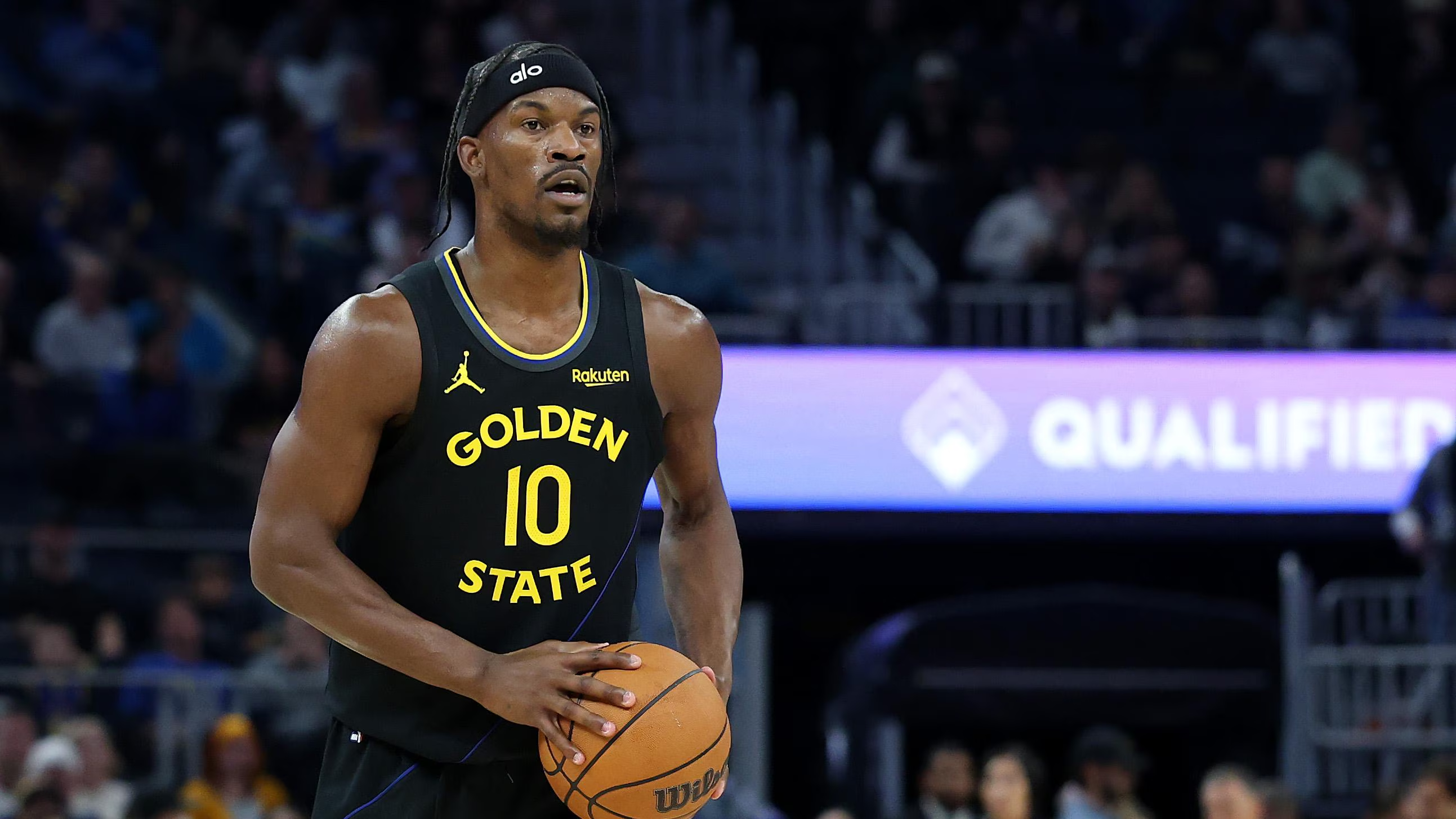
It starts with Jimmy Butler, who's recovering from a torn ACL and has a 2026-27 salary of $56.8 million that would do most of the heavy lifting for the salary-matching part of a trade.
That money, combined with one or two of the three tradable first-round picks owned by the Warriors, could be enough to land a difference-maker ( maybe even Banchero ).
Even if that kind of deal wouldn't instantly put Golden State on the same level as the San Antonio Spurs or Oklahoma City Thunder, it'd at least give Curry a puncher's chance or decrease the likelihood of missing the postseason altogether.
That's more than can be said of the current roster, which may not have Butler till it's too late to even make a playoff push.
Topics in this story
Gathered from external sources. Rights to this text belong to whoever originally published it.