World Series 2026: 10 wild stats from the Brewers' first title
There has never been a team quite like the 2026 Brewers.
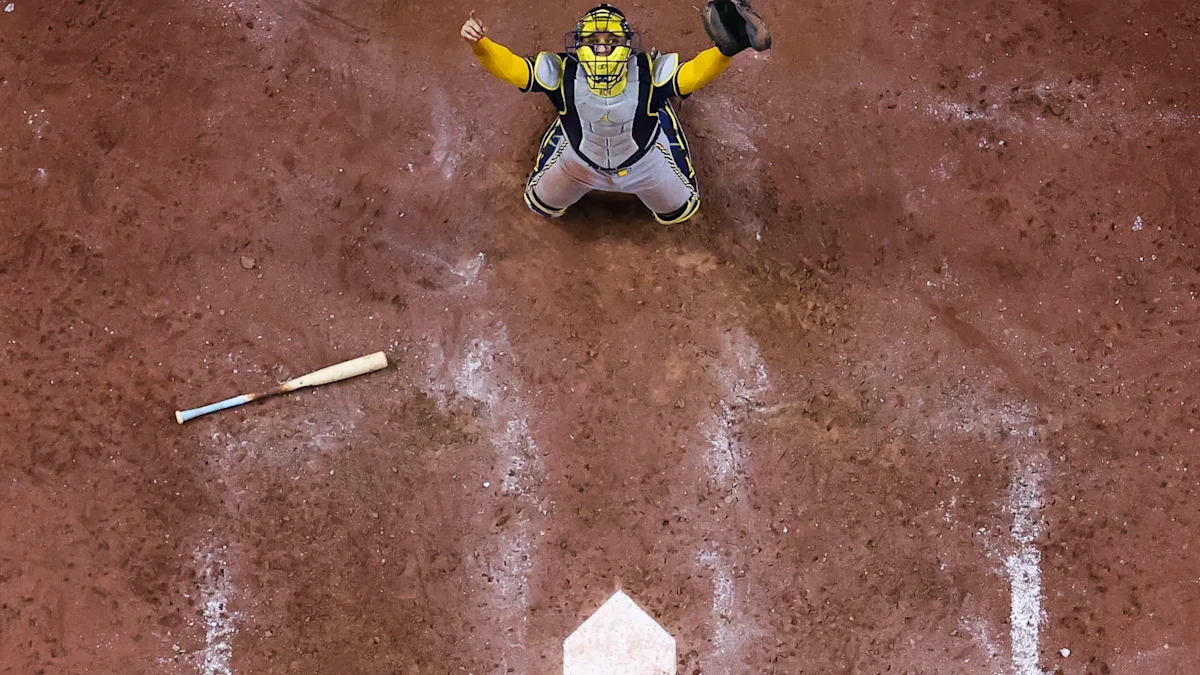
The Milwaukee Brewers are your 2026 World Series champions, having capped off a dominant postseason with a 4-1 win over the Tampa Bay Rays on Wednesday .
It's a cathartic night for the Brewers, who were previously tied with the San Diego Padres as the oldest MLB team to have never won a World Series title. They are now permanently off that list , thanks to a team that leveraged its strengths all years.
How did the Brewers do it? Let's dive into that via numbers.
We're going to go ahead and list off every starting pitcher the Brewers faced in their 12 postseason games: Robbie Ray, Michael King, Nick Pivetta, Walker Buehler, Tarik Skubal, Yoshinobu Yamamoto, Blake Snell, Tyler Glasnow, Nick Martinez, Drew Rasmussen and Freddy Peralta.
That his a formidable group, even by playoff standards. Combined, they have 15 total All-Star appearances (and five Cy Young awards) compared to the Brewers rotation's two, both by Jacob Misiorowski. And even Misiorowski's first All-Star appearance last year was a matter of some controversy .
Would you like to know how long that group lasted against the Brewers lineup on average?
It's 4.2 innings. Only one pitcher lasted longer than five innings at all and it was surprisingly Snell, despite the Los Angeles Dodgers left-hander being infamous for short starts even while posting zeroes.
The Brewers chased nearly every pitcher they faced this postseason by doing what they did all regular season. No team swung less at pitches. No team drew more walks. Only two teams in MLB missed less often when they did swing. They hit the most ground balls and the most balls to the opposite field.
They didn't hit home runs much, ranking only 29th in MLB, but that entire previous paragraph turned their offense into a torture device for even some of MLB's best pitchers.
Funnily enough, the Brewers starters lasted just as long as those opponents this postseason at 4.2 innings per start, but for very different reasons (and that number goes up to 4.5 when you take out Shane Drohan's one-inning appearance as an opener).
The Brewers starters were definitely solid this postseason, but Milwaukee removed them as early as possible in basically every game and roll out its comically dominant bullpen.
The Brewers relievers pitched 65 innings this postseason and posted a 1.38 ERA and a .173 batting average against, per MLB.com's Sarah Langs .
That was the Brewers's formula when you zoom out as much as possible: force the other team's starter out early and turn the game into a battle of the bullpens. It worked to perfection.
There's something to be said, though, about what that means for baseball. The starting pitcher who regularly goes seven innings or more in a start is bordering on extinction. Sandy Alcantara led all pitchers with 214 innings during the regular season, which would have ranked for ninth in MLB 10 years ago and 22nd in MLB 20 years ago.
Teams are now perfectly willing to accept a five-inning start, if it means those are five good innings. This has been a slow shift in MLB for years, but the Brewers just brought it into sharp focus.
That's the proportion of innings the Brewers bullpen covered during the postseason.
That makes Milwaukee the fourth champion in MLB history to get a majority of its innings from relievers, joining the 2020 Los Angeles Dodgers, 2021 Atlanta Braves and 2024 Dodgers.
It had never happened before 2020, another sign of the aggressive-bullpen era. The closest any team ever got before that was the 1960 Pittsburgh Pirates, though that was hardly a conscious decision. That team took three double-digit losses to the New York Yankees before winning in seven games, with relievers forced to cover for short starts in each defeat.
That is the number of home runs hit in the 2026 World Series, per ESPN , the fewest since the 1985 Fall Classic between the Kansas City Royals and St. Louis Cardinals.
The Brewers had three of those homers, from perhaps the three players you would least expect: Sal Frelick, Cooper Pratt and David Hamilton, the No. 6, 7 and 9 hitters in the Game 5 lineup.
The Brewers built their offense around not needing homers to punish pitchers, but they still out-homered the competition in every round, with a total margin of 13 to 4.
In another world, the 2026 World Series ends in Game 4 on Tuesday as a Brewers sweep and rookie shortstop Cooper Pratt gets remembered as the guy who homered his club to its first title.
A 12th-inning collapsed prevented that from coming to pass, but it did give the 22-year-old a chance to make some history. With two more hits in Game 5, Pratt became the first rookie to post a base hit in six straight at-bats in the World Series .
Pratt made his MLB debut in June and was playing high school baseball only three years ago, with the Brewers taking him in the sixth round of the 2023 MLB Draft. He rocketed to the majors thanks to his well-regarded glove, then made his mark with his bat.
With a single in the seventh inning, Brewers star Jackson Chourio became MLB's all-time leader in postseason hits before turning 23, breaking a tie with Andruw Jones with his 31st hit.
Jones posted his 30 hits in 45 games for the Atlanta Braves. Chourio posted his 31 in 25 games. He also tied some guy named Babe Ruth for the most hits in the first four games of a World Series , and now has the second-most in five games behing only Pepper Martin in 1931 .
You would think with either of the above stats, Pratt or Chourio would have been named World Series MVP. It's a sign of how thoroughly great William Contreras was that neither were.
Contreras earned MVP after a postseason in which he was basically the best player in baseball. The three-time All-Star slashed .373/.448/.588 at the plate during the postseason. He threw out 6-of-13 baserunners. And he won won 21 out of 31 ABS challenges (67.8%) in the first postseason with the system, with accuracy and decisiveness becoming a running joke in the Fox Sports booth.
In the World Series, Contreras hit 8-for-21 (.381) with four RBI, including one on a double in Game 5.
What else could you possible want from a catcher?
Misiorowski began the World Series by throwing the fastest pitch in its tracked history at 103.5 mph . He would go on to throw 89 pitches of at least 100 mph between his starts in Games 1 and 5.
Misiorowski didn't reach the end of the sixth inning in either start — exiting Game 5 due to calf cramps — but he allowed only one run in 10 2/3 total innings. His five strikeouts were lower than his regular season norm, but he was still an ace by Brewers standards.
Aaron Ashby went from a relatively anonymous set-up man to the most feared reliever in baseball over the course of the postseason, making nine appearances in 12 games and pitching multiple innings in all but one.
The left-hander didn't allow a single run in his 18 innings pitched, the most innings a reliever has ever thrown in a postseason without giving up a run . He didn't factor into Game 5 after experiencing diminished velocity in a long Game 4 appearance, but he had already contributed more than enough.
There will be plenty of analysis about what it means the Brewers — a classic small-market, big-brain team — winning the World Series means for baseball.
Their $142 million payroll, as estimated by Roster Resource , ranked 19th in MLB this season, right between the Kansas City Royals and Cincinnati Reds. They were actually the financial heavyweight this series, as the Rays ranked 28th at $90 million, followed by their ALCS opponent Cleveland Guardians at $87 million.
You build a champion on that budget with smart decisions and long-term planning. The highest-paid player on the 2026 Brewers was Christian Yelich ($26 million), still playing on the mega-deal he got from his MVP days, followed by the mostly injured Brandon Woodruff ($22 million) and two trade deadline acquisitions in Dustin May and Antonio Senzatela ($12 million each).
No other player on the Brewers made more than $10 million this year. Chourio and Pratt, both 22-year-olds who just starred on a World Series team, are both under team control through at least 2031, at the cost of around $132 million.
Conteras will be back next year on a $14.5 million club option. Nearly every other big contributor is under contract beyond 2027, save for NLCS MVP Jake Bauers, a pending free agent. And let's not forget the Brewers still ranked third in MLB Pipeline's farm system rankings after the trade deadline , with a group headlined by No. 1 overall prospect Jesús Made.
The Brewers were incredible this year. There is every reason to believe they will stay incredible for years to come.
Topics in this story
Gathered from external sources. Rights to this text belong to whoever originally published it.