How the restaurant burger went from cheap indulgence to luxury meal
The $30 burger can be found on menus from New York to California, despite efforts to rein in soaring beef prices.
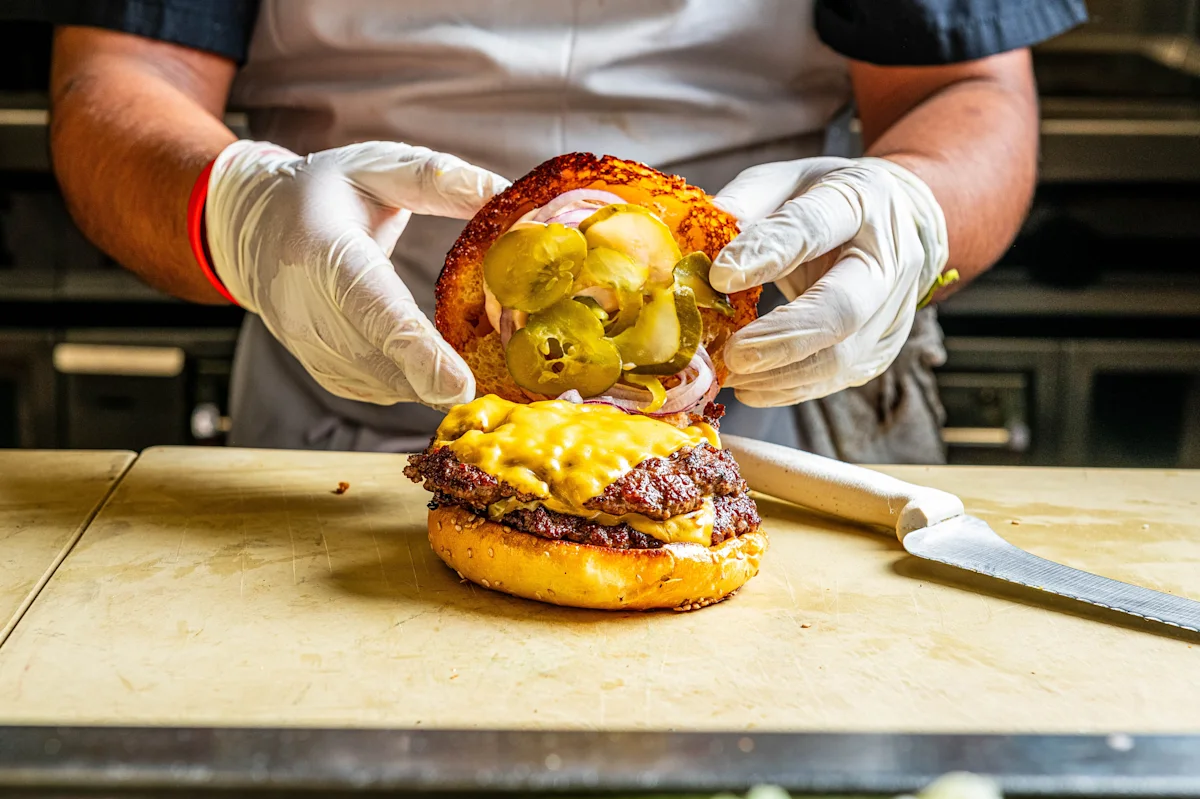
The Burger Américain, a fastidious and Frenchified version of the Big Mac served at Le Diplomate, set diners back $14 when Stephen Starr debuted his stylish brasserie in Washington in 2013. Thirteen years later, the same burger and fries cost $29.
Starr had a one-word reaction when informed about the 100-percent-plus price increase for one of Washington's favorite burgers :
Recipes, food trends and culinary inspiration. Sign up for free
If Starr, a highly decorated restaurateur with dining rooms in multiple cities, is stunned by the burger inflation at one of his own places, imagine how other Americans feel. The wholesale price of ground beef has soared between 18 and 30 percent in the past few years, restaurateurs tell The Washington Post, and that doesn't take into account the other factors contributing to the increasingly lofty price of a restaurant burger: insurance, labor, rent, utilities, repairs. Prices for each have increased as well, owners say.
A $30 — or higher — burger can be found on menus from New York to California , but operators say these prices reflect the reality of current restaurant economics. "Restaurants are not gouging people," Starr said in an interview. "They are simply responding to their own expenses."
To compound the problem for burger enthusiasts, consumers are seeing similar increases in supermarket ground beef.
The costs are adding up to something that earlier generations once considered unthinkable: The hamburger — a deeply American dish beloved across the socioeconomic spectrum — has become unaffordable to many. It's not just finicky, chef-crafted restaurant burgers, either, the ones built with dry-aged beef or stuffed with foie gras or topped with black truffles. Low-income Americans are scaling back on McDonald's as they struggle to cover the ever-increasing costs of daily life. Some say the revamped McValue Menu offers little to justify the title . Some fast food workers can't even afford the very meals they prepare and sell .
"To me, a hamburger should be an everyday enjoyment that should be affordable, and it should be something that people can comfortably do and not have to break the bank over," said Andrew Schnipper, managing partner of Hamburger America, the celebrated diner in New York City, co-owned by burger scholar George Motz.
Since 2023, restaurant burger prices have increased 14 percent, according to Datassential's Burger Price Index report , last updated in March. The report pulls data from 14 full- and limited-service restaurant chains. The menu increases, while significant, still haven't kept pace with beef production costs, which have skyrocketed nearly 44 percent since 2023, according to a Washington Post analysis of data from the Bureau of Labor Statistics.
The data suggest, in other words, that even as Americans complain about overpriced burgers , especially among casual chains, prices could even be worse without some clever cost manipulations by restaurant operators.
Restaurants have developed a number of tricks to try to absorb the rising cost of beef without passing it all on to consumers.
Some rely on a streamlined, high-volume, quick-serve model — with few menu options and an efficient method for preparing burgers fast — to keep prices low. Others, especially full-service restaurants with larger menus, spread the inflated beef costs among other dishes so they're not concentrated in the burger price. Still others look for ways to reduce costs across the entire operation, whether negotiating better deals for paper products or using technology to schedule workers more efficiently. Some may just eat a fraction of those costs, cutting into their own profits.
As the founder and chair of the board for both Shake Shack and Union Square Hospitality Group, Danny Meyer understands how to squeeze out savings in both burger chains and full-service restaurants.
"The last thing one ever wants to do is to pass on costs to the consumer," Meyer said in an interview. "The second-to-last thing people want to do is to lose money, because then you don't have a business. "
Burger lovers aren't finding much relief at the supermarket, either. The cost of preparing a quarter-pounder at home, complete with bun, cheese and toppings, has jumped by 14.5 percent in a two-year span, more than double the rate of inflation for that period, based on a 12-month rolling average of prices. The cheeseburger would cost on average about $2.29, up from $2 two years ago, according to a Post analysis of average retail prices collected by the BLS.
The patty alone accounted for $1.67 of that price. Since 1984, ground beef has become four times as expensive, and it accounts for roughly three-quarters of the total rise in ingredient costs. Everything else on the burger has stayed comparatively cheap.
Beef prices have increased more sharply in the past two years: Ground chuck, the cut most often used for burgers, sold for an average of $6.85 per pound in July, up 25 percent from July 2024.
Beef consumption per person has remained broadly flat for several years, between 55 and 57 pounds a year, though consumption has dropped by more than a third since 1976, when Americans ate 89 pounds annually, according to the Agriculture Department. The flat rate is still notable, given the sharp increase in price, said Andrew Griffith, a professor in the Department of Agricultural and Resource Economics at the University of Tennessee Institute of Agriculture.
"The whole point of higher prices is to ration consumption of a product," said Griffith, who runs his own farm about 60 miles southwest of Nashville. "We definitely see that in the marketplace where there are certain consumers that would rather not spend that many dollars on their beef consumption."
Sustained, multiyear droughts are the primary reason for the rise in prices, Griffith said. As calves are weaned in the fall, ranchers must decide whether to retain their heifers to expand the herd or sell off the female calves. Drought conditions in multiple cattle-producing states have deteriorated pastures, and if ranchers don't have enough hay on hand to feed the herd they already have, they will opt to sell their heifers. This is largely why the national cattle herd is the smallest in 75 years .
At the same time, consumer demand for beef has grown 9 percent over the past decade, according to the Agriculture Department.
Domestic cattle shortages mean more beef is arriving from abroad — and it's more expensive, up from $4.96 per pound in June 2025 to $5.59 per pound in June 2026. The U.S. spent $26.3 billion on imported beef in 2025, 24 percent more than the previous year.
The Trump administration is trying to confront rising beef costs on at least two fronts. Earlier this year, the Justice Department's Antitrust Division sent letters to major retailers , looking into their beef prices and margins. In August, the president also issued a proclamation to allow more than 660 million pounds of lean beef trimmings to enter the country at a reduced tariff rate over the next three months. The meat is destined for the U.S. ground beef market, said Will Harris, owner of White Oak Pastures, a regenerative farm in Bluffton, Georgia, that has its own USDA-approved slaughterhouse.
The foreign beef is so lean it's "barely edible," Harris said. The meat will be combined with excess fat from U.S. slaughterhouses to create ground beef blends, with various fat-to-lean meat ratios.
"You take those two inedible products and you make ground beef out of it," Harris said.
The imports have been criticized by the National Cattlemen's Beef Association and politicians from cattle-producing states , saying they will hurt U.S. ranchers. Some have raised consumer safety issues about the meat and suggested it will only help the "big four" meatpackers that control about 85 percent of the beef market . But, mostly, critics say the foreign imports will do little to lower the price of ground beef.
Griffith, the University of Tennessee Institute of Agriculture professor, said even if the U.S. brings in 660 million pounds of beef, that only represents about six weeks of added imports. "The needle's not going to move that much. " He said consumers might see ground beef prices drop by a "few cents" a pound.
On the restaurant level, operators are looking for ways to keep their burgers affordable, particularly at the kind of casual shops where diners expect a good, greasy and cheap meal. At Hamburger America in Manhattan, a double smash burger sells for $12.50, which is a dollar more than what the diner charged when it debuted nearly three years ago. The markup is less than a 10 percent increase, but Hamburger America pays 30 percent more for ground beef than when it opened, said Schnipper, the managing partner.
"Our view, generally, is we'd rather keep the prices a little bit tighter," Schnipper said. "We make a little less margin, but we're hoping to always make it up with volume."
At Shake Shack, the chain is walking a tightrope. It buys Angus beef from Pat LaFrieda Meat Purveyors, the reputable New Jersey company that sells only prime and upper levels of choice grade beef. Yet Shake Shack competes in a market in which consumers are looking for value as much as quality. As such, Meyer said, the chain can't afford to raise prices far above those at McDonald's or Burger King, even though the latter are not buying the same kind of beef. In Washington, a single-patty ShackBurger sells for about $8; a similar-sized Quarter Pounder from McDonald's goes for about $7.20.
Meyer wasn't certain but he thought Shake Shack had not raised prices on burgers so far this year, even as the price of beef has soared. (A spokesman for the chain declined to comment on prices.)
"Have beef prices gone up for Shake Shack? Absolutely," Meyer said. "But I can tell you that the team has done backflips trying to take cost out of everything else we do. "
In full-service restaurants, some owners are leaning into this new world of elevated burger prices by trading on expensive and custom ingredients. At Bar Angie in Washington's West End neighborhood, the native New Yorkers behind the bistro offer a triple-stack smash cheeseburger built with prime beef patties, which are tucked into a custom-made bun. The burger and hand-cut fries cost $35.
"We try really hard not to pass every increase along to our guests, but at some point we do have to adjust our pricing. And if we're going to charge $34 for a burger, we want to make sure we're giving our guests a burger that's actually worth it," co-owner Joe Ragonese said in an email, misquoting the price of his burger.
After learning about the burger inflation at Le Diplomate, Starr said he would look into changing the blend for his ground beef. He might switch from more expensive cuts, such as brisket and hanger, to ground chuck, a common ingredient in many grinds. If his team comes up with an acceptable — and cheaper — new blend, Starr said he would do something rarely seen at restaurants: He would lower the price of his burger.
Topics in this story
Gathered from external sources. Rights to this text belong to whoever originally published it.