South Dakota turned 575 old military bunkers into a survival community, but residents paying up to $55,000 now face legal disputes
US News: In a former Army munitions depot outside Edgemont, South Dakota, rows of concrete bunkers with steel blast doors sit across the Black Hills landscape,.
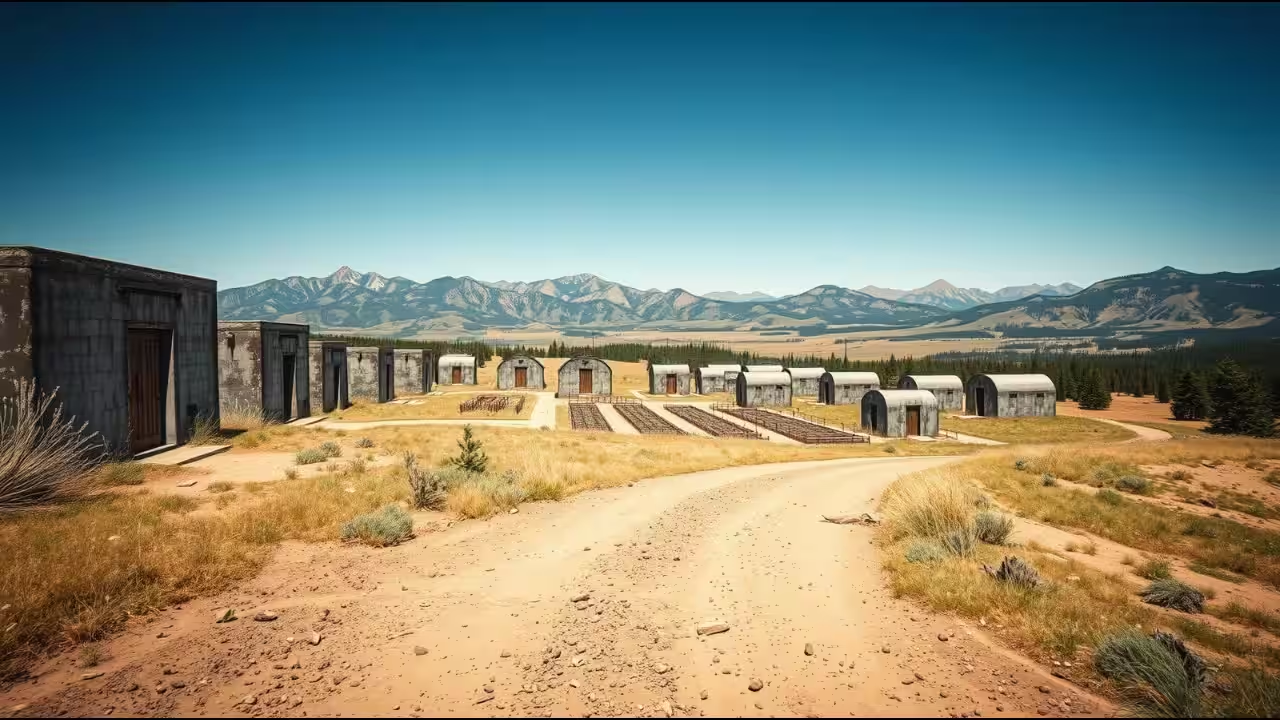
In a former Army munitions depot outside Edgemont, South Dakota, rows of concrete bunkers with steel blast doors sit across the Black Hills landscape, forming a survival community called Vivos xPoint. The complex contains 575 bunkers originally built in 1942 to store bombs and other military munitions. According to the South Dakota Supreme Court, Vivos later acquired the property and began marketing the structures as survival shelters that could be purchased or leased and converted into living spaces. Leases have cost residents tens of thousands of dollars upfront, with some paying as much as $55,000 for a 99-year term. The company markets the community as a place where people can prepare for catastrophic events. But years after residents moved in, the development has become the subject of multiple legal disputes involving leases, community rules, evictions and conflicts between residents and Vivos personnel.How Vivos xPoint turned old military bunkers into a survival communityThe 575 concrete bunkers at Vivos xPoint were built in 1942 as part of a military ammunition depot. The structures remained empty from 1967 until Vivos acquired the property and began promoting them as survival shelters. Rather than selling the concrete structures outright, Vivos offers 99-year leases. The bunkers are delivered as empty, unfinished concrete shells, leaving lessees to turn them into livable accommodation either by hiring Vivos employees or arranging their own construction work.The arrangement has attracted people looking for an emergency shelter as well as those interested in living away from conventional cities. Philippe Briggs, a recently retired Los Angeles police detective and former Army reservist, told the Wall Street Journal that he paid $25,000 for a 99-year lease on his bunker several years ago. He now lives in Las Vegas and uses the property as a vacation spot and potential emergency shelter. Briggs said he had not experienced problems with the way Vivos managed the property. The legal record shows that the leases also contain community rules and regulations. In the case of Daniel Sindorf, who signed a 99-year lease in July 2020 after paying $35,000 upfront, Vivos retained the contractual ability to modify its community rules with at least 30 days' written notice. Sindorf later challenged the enforceability of the lease after Vivos sought to evict him over an alleged violation of the community rules.Why disputes over leases and amenities have taken over Vivos xPointResidents have raised concerns about the way the community is managed, including disputes over rules, fees, evictions and the condition of infrastructure. Vivos has also promoted amenities intended to make the development function as a self-contained community, including facilities such as recreational and commercial spaces. Some residents have complained that promised amenities have not materialised as expected.The disputes have increasingly moved into the courts. In April 2026, the South Dakota Supreme Court ruled in Vivos xPoint Investment Group v. Sindorf that the 99-year lease was not an illusory contract simply because Vivos retained the right to change its community rules. The court reversed a lower-court decision that had found the lease illusory and sent the case back for further proceedings. The Supreme Court emphasised that the lease was supported by consideration because Sindorf agreed to pay Vivos in exchange for its promise to lease him a survival bunker. That case was only one part of the legal disputes surrounding the development. Other residents have challenged actions taken by Vivos, while the company has pursued eviction proceedings against some lessees. The litigation has also reached South Dakota's highest court in a separate case involving resident David Streeter and Vivos contractor Kelly Anderson.How a septic dispute at Vivos xPoint ended in a shootingStreeter purchased a bunker in July 2023 and began preparing to move in with his family. According to his testimony in court, he soon experienced problems with the property's septic system and began complaining to Vivos management. Streeter testified that Vivos employees subsequently monitored his bunker, made gestures at him and his family and drove past the property at high speeds. These were allegations made by Streeter in the court proceedings, rather than findings that Vivos employees committed all of the alleged conduct. On August 23, 2024, Streeter confronted Vivos employee J.R. Rodriguez about vehicles speeding past his bunker. Court records say Streeter followed Rodriguez in his vehicle, opened Rodriguez's door and pushed him into his seat. About 45 minutes later, Rodriguez and another Vivos employee went to Streeter's property. After that confrontation, contractor Kelly Anderson decided to confront Streeter himself. Anderson sent messages to an acquaintance indicating that he intended to confront Streeter, and the acquaintance warned Streeter that Anderson was coming.Anderson arrived at Streeter's home, and Streeter ultimately shot him in the chest. Anderson survived and later filed a civil lawsuit. A circuit court concluded that Streeter had been justified in using deadly force in self-defence and was immune from civil liability under South Dakota law. In March 2026, the South Dakota Supreme Court affirmed that decision. The court's ruling specifically addressed Streeter's claim of self-defence and civil immunity; it did not amount to a general finding that every allegation Streeter had made about Vivos personnel was true. The legal disputes have left Vivos xPoint far removed from the simple image of a private disaster shelter. The site remains a community built from hundreds of former military bunkers, but its residents and operator have increasingly found themselves dealing with questions about contracts, rules, property management and personal conflicts alongside the catastrophic events the development was designed to prepare for.Catch the latest World News and Live updates. Download the TOI app.
Topics in this story
Gathered from external sources. Rights to this text belong to whoever originally published it.