Omagh bomb: Fourteen people linked to evidential activity, inquiry told
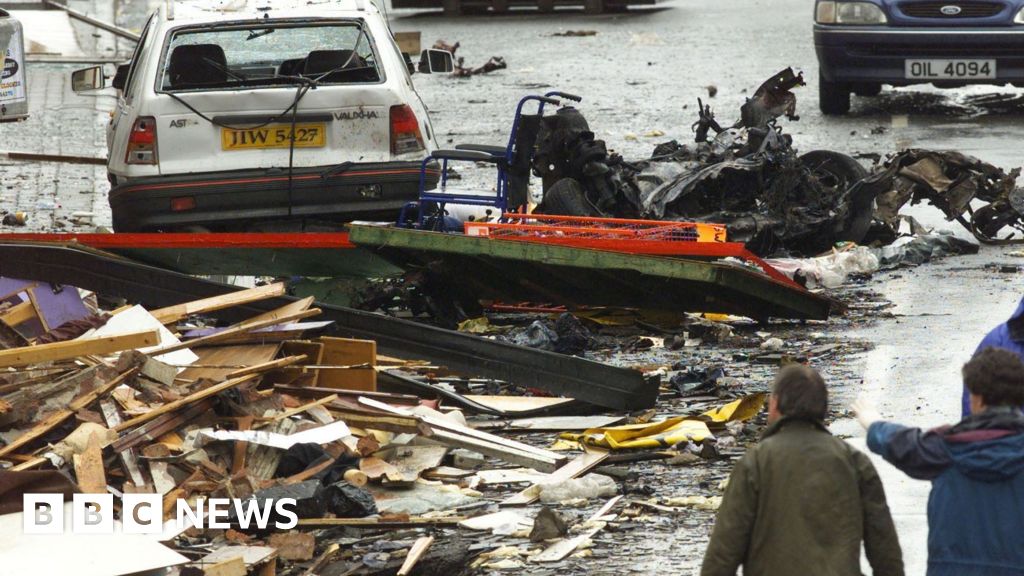
Twenty-nine people, including a woman pregnant with twins, died in the bombing in the County Tyrone town on 15 August 1998 - the biggest single atrocity in the Troubles.
Fourteen people have been linked to evidential activity in the days leading up to and on the day of the Omagh bombing, the inquiry into the explosion has heard.
Twenty-nine people, including a woman pregnant with twins, died in the bombing in the County Tyrone town on 15 August 1998 - the biggest single atrocity in the Troubles.
It came less than three months after the people of Northern Ireland had voted yes to the Good Friday Agreement.
The inquiry, which opened last year with 14 days of testimony from bereaved families and survivors, was established to determine if the bombing could have been prevented by UK state authorities.
Paul Greaney KC outlined the "working hypothesis" of the inquiry when it resumed its latest phase on Monday.
In 2009, a judge ruled that four men - Michael McKevitt, Liam Campbell, Colm Murphy and Seamus Daly were all liable for the Omagh bomb.
A fifth man, Seamus McKenna, was found not liable in the civil action and later died in a roofing accident in 2013.
In a statement to the inquiry, sitting at Bradford Court in Belfast, Greaney named McKenna, Daly and Murphy as among the 14 people linked to evidential activity.
Greaney told the inquiry: "The evidence suggests Colm Murphy sat like a spider in the centre of the web of the plan to detonate a bomb in Omagh."
Referring to the civil case, Greaney said that the fact that McKenna "was not found liable is not an outcome which binds this inquiry".
"Our working hypothesis is that, contrary to that finding, he played a key role," he said.
The use of telecommunications is a key part of the evidence in front of the inquiry and some of the most frequently referred to mobile phones have been assigned colours for ease of following their links.
The inquiry heard how it was "likely" that the Vauxhall Cavalier car used in the bombing was "stolen to order" in the days before the bombing.
Evidence was outlined that on 14 August 1998, the day before the bombing, a "test run" of the journey to the bomb site was carried out in a Volkswagen Golf car.
The inquiry heard about the time and locations of warning calls made ahead of the bomb exploding. Two calls were made to UTV, and one to the Samaritans.
The caller said a 500lb bomb had been left in Omagh and would explode in 15 or 30 minutes.
The call to the Samaritans said the bomb was in the centre of Omagh, 200 yards from the courthouse.
The warning calls were reported to the police within minutes. Royal Ulster Constabulary (RUC) officers were then deployed to the town.
The inquiry heard that the Army did not deploy to Omagh town centre before the detonation as the RUC did not ask it to.
Counsel for the inquiry set out the evidence that will be explored over the four weeks of the hearing.
It includes evidence from forensic scientists, DNA specialists, and handwriting experts.
Witnesses will include former PSNI chief constable Sir Ronnie Flanagan and Baroness Nuala O'Loan, former Police Ombudsman.
An Garda Siochana have also given evidence which will be shown to the inquiry as a pre-recorded video.
In closing the first day of chapter three of the inquiry, Paul Greaney KC said that the "devastating impact" of the Omagh bomb is at the heart of the inquiry.
"We know that there are very many people who have been waiting for those answers for nearly three decades. They have waited too long.
"They are entitled to those answers and we, the inquiry legal team, will play our part in delivering them."
The principal objective of this chapter of the inquiry is to understand how the bombing was carried out and by whom.
Among the witnesses this week will be a senior garda officer who is expected to provide initial evidence about the theft of the car used in the explosion.
It was stolen in Carrickmacross, County Monaghan, two days before the explosion.
The inquiry was established to determine if the bombing could have been prevented by UK state authorities.
The third phase is expected to last about four weeks.
The Omagh bomb exploded on 15 August 1998, killing 29 people including a woman pregnant with twins.
More than 200 people were injured in the blast.
No-one has ever been convicted of the atrocity.
Three days after the attack, the Real IRA released a statement claiming responsibility for the explosion.
It apologised to "civilian" victims and said its targets had been commercial.
No-one has been convicted of carrying out the murders by a criminal court.
In 2009, Michael McKevitt, Liam Campbell, Colm Murphy and Seamus Daly were all ordered to pay a total of £1.6m in damages to the relatives, but appeals against the ruling delayed the compensation process.
Omagh bomb: Timeline of families' bid for justice
Bomb changed my life forever, survivor says
Government announces inquiry into Omagh bombing
Topics in this story
Gathered from external sources. Rights to this text belong to whoever originally published it.