In WWII, one Scottish island became a secret British bioweapon site and stayed toxic for nearly 50 years; now it's safe to visit
For decades, Gruinard Island was a place most people were better off avoiding.
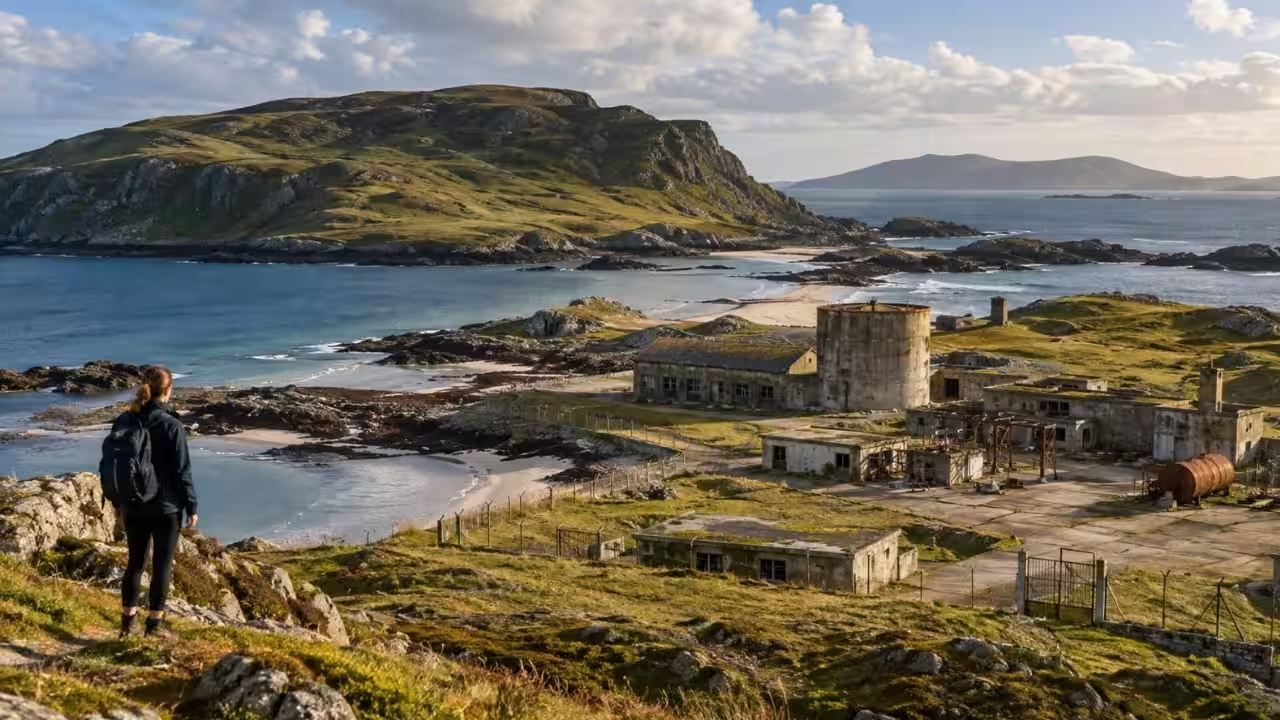
For decades, Gruinard Island was a place most people were better off avoiding. The small, uninhabited island off Scotland's north-west coast had acquired an unusual reputation during and after the Second World War, when stories circulated locally about dead animals, strange military activity and something dangerous left behind. The government eventually put up warning signs and kept people away. What had happened there was not fully understood by the public for years. Gruinard had been used for secret experiments involving anthrax, part of a British wartime effort to investigate biological weapons. The contamination proved remarkably persistent, leaving the island under quarantine for almost half a century before it was officially declared safe in 1990.How an isolated Scottish island became a biological weapons test siteGruinard lies in the waters of the north-west Highlands, separated from the mainland by a stretch of sea. Before the war, it was largely uninhabited and used for grazing. Its isolation made it suitable for military experiments that could not safely be carried out close to towns and populated areas.As reported by the BBC, in 1942, the British government acquired the 522-acre island and restricted access. The work was linked to Porton Down, the military research establishment in Wiltshire, where scientists were studying chemical and biological agents. Britain was looking at ways biological weapons might be used during the conflict with Nazi Germany.The project became known as Operation Vegetarian. Its proposed use of anthrax was tied to Germany's food supply. The idea involved contaminating cattle feed with anthrax spores so that livestock would become infected. Meat from infected animals could then spread the disease to people who consumed it.Sheep trials showed how far the anthrax weapon could spreadGruinard provided an open landscape in which those questions could be tested. Livestock were taken to the island and positioned at different distances from the planned releases. The experiments involved detonating devices that dispersed anthrax spores. Sheep exposed to the resulting clouds became ill and died. Their bodies were then dealt with on the island, including burial and incineration, in an attempt to contain the contamination.The work continued into 1943. By then, the tests had provided the military with evidence that anthrax could be used in the way scientists had feared. Millions of contaminated linseed cakes were subsequently produced as part of the wider Operation Vegetarian programme.The plan was never carried out against Germany. As the course of the war changed, including the Allied invasion of Normandy, the proposed attack was abandoned. The contaminated cakes were eventually destroyed.Why Gruinard became known as Scotland’s island of deathThe researchers left Gruinard, but the island did not simply return to normal. Anthrax spores can survive in soil for long periods, and the experimental area remained contaminated after the wartime work ended. There were reports of animals dying on the mainland near Gruinard Bay in the months after the experiments. The British government paid compensation to some affected people, while the public explanation for the deaths attributed them to a diseased sheep that had supposedly fallen from a passing ship.For local residents, the secrecy surrounding the island only added to the uncertainty. Access remained prohibited and warning signs were placed around the site. Gruinard became known locally as the island of death or the mystery island.As per the BBC, reporter Fyfe Robertson visited the area in 1962, he found that the military still regarded the island as too dangerous for ordinary visitors. The broadcast brought wider attention to the rumours surrounding the site, although much of the wartime story remained classified.A 1971 test revealed anthrax was still buried beneath GruinardKeeping people away was easier than removing the contamination. Early attempts to make Gruinard safe included chemical treatment and controlled burning, but these measures did not eliminate the problem.Tests carried out in 1971 found that anthrax was no longer detected on the surface but remained present deeper in the soil. That meant the risk had not disappeared. Disturbing the ground could potentially expose contaminated material again.The issue eventually drew the attention of campaigners. In 1981, members of the Dark Harvest Commandos travelled to Gruinard, collected soil samples and delivered some of the material to the area around Porton Down. The action was intended to draw attention to the continuing contamination and put pressure on the government to resolve it.A more extensive clean-up followed in the mid-1980s. Scientists treated the island with a mixture containing seawater and formaldehyde and removed contaminated soil from parts of the site for incineration.Gruinard was declared safe in 1990As reported by the BBC, on 24 April 1990, almost 48 years after the wartime experiments began, the British government announced that Gruinard Island was free of anthrax contamination. The declaration ended one of the longest-running environmental consequences of Britain's wartime biological weapons research. The island had spent nearly five decades under restrictions because of experiments that had taken place there during the Second World War.The episode also formed part of a much wider British biological weapons programme. Gruinard was the first site used for this type of testing, but it was not the only location associated with Britain's wartime biological warfare research.Britain later ended its offensive chemical and biological weapons programmes and ratified the Biological Weapons Convention in 1975, which prohibits the development, production and stockpiling of biological weapons.Gruinard’s wartime legacy outlasted the experiments that caused itThe old warning signs and the island's wartime reputation have given Gruinard an unusual place in Scottish history. What was once a restricted military testing ground is now accessible as part of the wider landscape of the north-west Highlands.Its history has also made the island a point of interest for visitors exploring the region. The landscape itself can appear unremarkable, which makes its wartime past easy to miss. There are no obvious remains of a battlefield or large industrial complex to explain why the island spent so long behind a quarantine barrier.The significance lies beneath the surface, both literally and historically. For much of the second half of the 20th Century, Gruinard was a reminder that the consequences of military research could persist long after an experiment had ended.You use AI every day. Now get your AI Quotient. Take the AIQ test.
Topics in this story
Gathered from external sources. Rights to this text belong to whoever originally published it.