A grand London mansion hid a secret WWII listening post; more than 70 years later, its hidden basement is now a museum
A grand mansion in north London once housed a secret wartime intelligence operation, and that history has now been opened to the public.
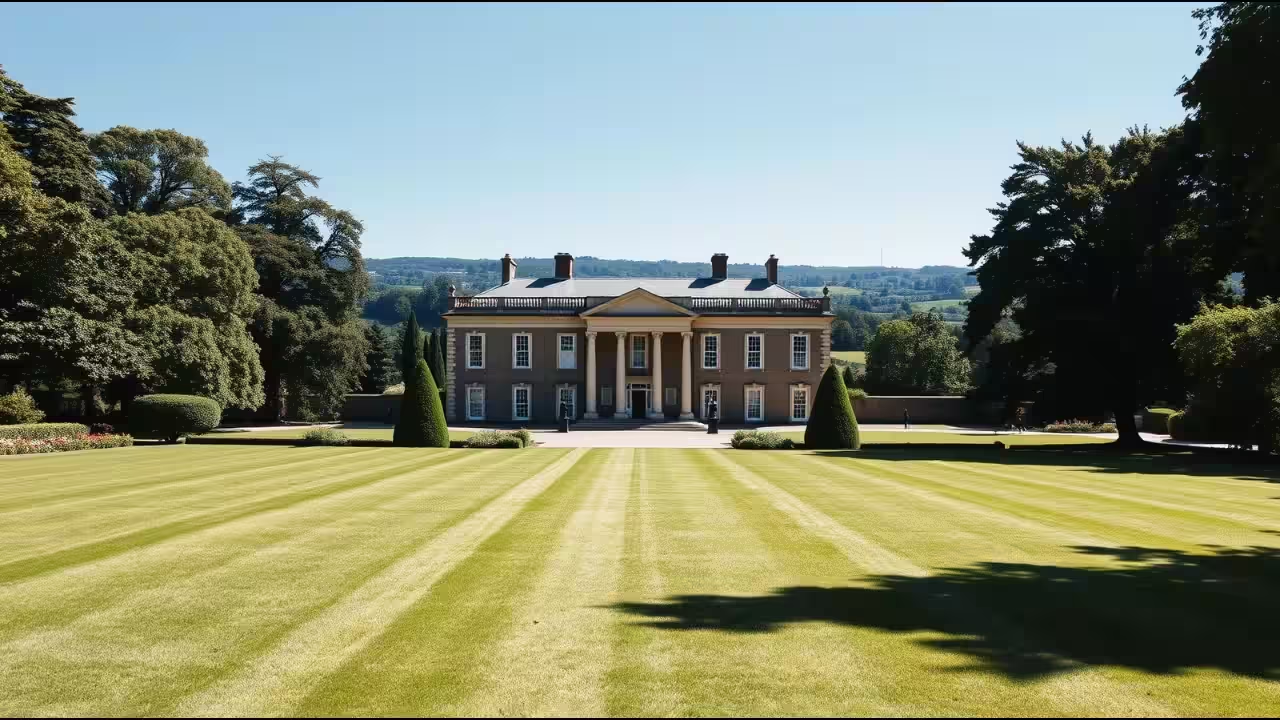
A grand mansion in north London once housed a secret wartime intelligence operation, and that history has now been opened to the public. Trent Park House of Secrets in Enfield, within Trent Country Park, opened on 21 July 2026, according to the museum's announcement of the opening date. During the Second World War, the house was requisitioned by the War Office and adapted for intelligence work. Senior German prisoners of war were kept at the estate while their conversations were secretly monitored from the basement. The museum says the operation involved German-speaking refugees, most of them Jewish, and produced intelligence on subjects including German weapons programmes and atomic research. The story remained hidden for more than 70 years. Visitors can now see the restored ground-floor rooms associated with Sir Philip Sassoon and the basement where the wartime listening operation was conducted.Trent Park House history: From a royal estate lease in 1779 to Sir Philip Sassoon's glamorous weekend partiesThe museum's history of Trent Park begins in 1779, when George III granted his royal physician Sir Richard Jebb a 99-year lease on 250 acres of the royal estate at Enfield. The lease was presented in recognition of Jebb's treatment of the King's brother, the Duke of Gloucester, in Trento, Italy. Jebb named the property Trent and commissioned architect Sir William Chambers to build a villa there. The museum says the house cost £19,000 to construct. After Jebb's death, the property passed through several owners before banker David Bevan acquired it in 1833. His grandson Francis Bevan later extended and rebuilt the house in the 1890s.The lease eventually passed to Sir Edward Sassoon in 1909. When he died in 1912, Trent Park went to his son Philip Sassoon. Philip bought the freehold in 1923 and undertook a major remodelling with architect Philip Tilden, creating the highly finished interiors for which the house became known. Sassoon used Trent Park as a weekend retreat and hosted prominent political, royal and cultural figures there, including Winston Churchill, Edward VIII, Charlie Chaplin, George Bernard Shaw and T.E. Lawrence. Sassoon was also a Conservative MP and served as Under-Secretary of State for Air from 1924 to 1929 and again from 1931 to 1937. He became First Commissioner of Works in 1937. The historical office listing records both periods as Under-Secretary of State for Air, while the Trent Park museum's history confirms his prominent 1931-1937 term and his move to First Commissioner of Works in 1937.How the Secret Listeners worked at Trent Park: Hidden microphones, basement M Rooms and acetate recordingsDuring the winter of 1939-1940, Trent Park was converted into a surveillance centre under Lieutenant Colonel Thomas Kendrick of MI19. The house was fitted with miniature microphones concealed in places around the building and grounds, allowing conversations among the German prisoners to be monitored from below. The prisoners were given considerable freedom within the estate and access to facilities intended to make them feel at ease. British intelligence also placed undercover operatives among them. Known as stool pigeons, these men posed as fellow prisoners or sympathetic members of the British aristocracy and tried to steer conversations towards subjects that could yield intelligence.The museum says the basement listening operation was divided into three M, or "Miked", Rooms, with six listeners working in each squad across two shifts. The recordings were made directly onto blank acetate discs, which could hold as much as seven minutes of conversation. Afterwards, the recordings were played back and transcribed. The written material went through further checking and translation before being prepared as Special Reports for intelligence agencies and government departments. The museum says officers from the Auxiliary Territorial Service carried out much of the editorial and translation work. By early 1943, the growing number of prisoners created a need for more German-speaking listeners. The museum says about 100 German refugees serving in the British Army's Pioneer Corps were subsequently recruited, almost all of them German-Jewish refugees who had fled Nazi persecution.One of those recruits was Eric Mark, born Erich Meyer Mark in Magdeburg in 1922. He arrived in Britain in 1935 after his parents sent him away to escape Nazi persecution. During the war, he served in the Pioneer Corps and later transferred to the Intelligence Corps. He was posted to Trent Park in 1944 as a Secret Listener. The museum says the intelligence collected at the house included information about German battle plans and the V1 and V2 weapons programme, as well as early accounts of the Holocaust. The museum's own "Story in Numbers" section records 3,000 German prisoner-of-war conversations bugged at Trent Park and 59 German generals held there. It also gives seven minutes as the maximum recording length and 100 as the number of German refugees from the Pioneer Corps recruited as Secret Listeners.Trent Park House of Secrets museum in Enfield: What visitors can see in the restored rooms and wartime basementThe museum grew from the Save Trent Park campaign, launched in 2014 by Jason Charalambous to secure a public future for the house. Following an agreement with Berkeley Homes, the Trent Park Museum Trust was established in 2016 to develop and operate the museum. In 2017, Enfield Council granted planning consent for the wider residential development, with a specific requirement that a museum be established on the ground and basement floors of Trent Park House.Those are the two floors now used by the museum. The ground floor contains restored and furnished rooms associated with Sassoon's period at Trent Park, while the basement tells the story of the Secret Listeners and the wartime intelligence operation. The exhibition combines reconstructed settings with original and reproduced equipment, archive material, photographs, film and recorded testimony. The museum says some films use AI to animate historical photographs, with voices performed by Helen Lederer and John Glover. The museum describes Trent Park House as being of national and international significance "on a level with Bletchley Park."Dr Giuseppe Albano MBE is the museum's director. The museum announced his appointment in April 2025, saying he would join in June, and Albano subsequently wrote that he officially began as director on 2 June 2025. The museum opened to the public on 21 July 2026. It is located within the 413-acre Trent Country Park, so visitors can combine the museum with the surrounding parkland.You use AI every day. Now get your AI Quotient. Take the AIQ test.
Topics in this story
Gathered from external sources. Rights to this text belong to whoever originally published it.