In 2017, a 16-year-old Polynesian surfer began growing coral fragments in underwater nurseries; his team later reported planting more than 221,000 corals across three countries
Rest of World News: Explore how a 16-year-old Polynesian surfer initiated a groundbreaking coral restoration project, resulting in the planting of over 221,000 corals across three countries, and learn about the impact of coral gardening on marine ecosystems.
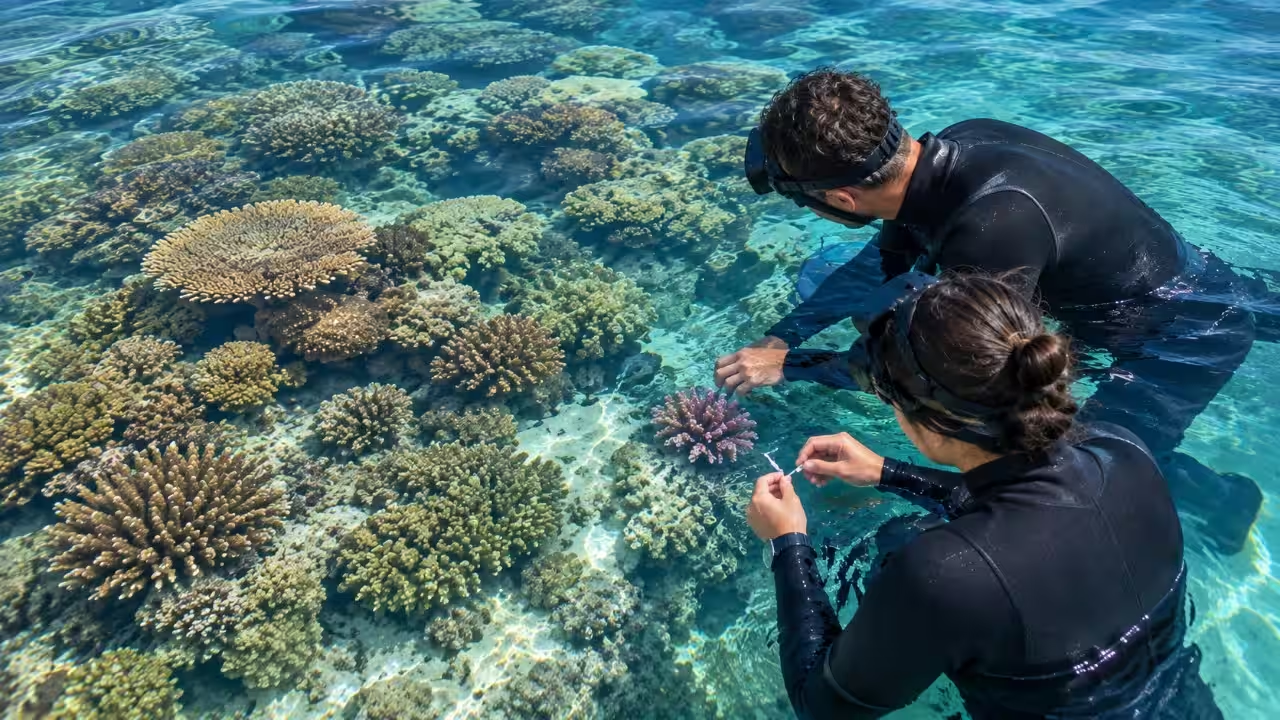
At just 16, a Polynesian surfer looked beneath the waves and saw a reef in trouble. Instead of simply watching corals disappear, he began collecting broken pieces, growing them in underwater nurseries and returning them to the sea. What started in 2017 as a small experiment in French Polynesia has since grown into an international coral restoration effort, with more than 221,000 corals reportedly planted across French Polynesia, Fiji and Thailand.According to UNESCO, Titouan Bernicot grew up on Moorea, French Polynesia, where he witnessed the gradual decline of the coral reefs around the island and became involved in reef conservation as a teenager. He founded Coral Gardeners in 2017 to help restore Moorea's damaged reefs. The organisation's approach involves collecting fragments from resilient corals, growing them in underwater nurseries and later transplanting mature corals onto degraded reef areas.From a surfer's idea to an underwater nurseryBernicot’s method drew on a restoration approach known as coral gardening. In this method, fragments taken from living coral colonies are grown in nurseries until they are large enough to be transplanted onto damaged reef areas. Many reef-building corals can reproduce through fragmentation, allowing broken pieces to survive and develop into new colonies under suitable conditions. Coral Gardeners adapted this approach in Mo'orea, beginning with small underwater nurseries before expanding its restoration work. The organisation now reports that its teams have planted more than 221,000 corals across French Polynesia, Fiji and Thailand.According to a global review published in PLOS One, coral gardening is one of the widely used approaches to active coral restoration. The review found that nursery-grown corals can survive and grow after transplantation, although results vary with coral species, nursery conditions, reef location and environmental pressures. The findings also show why growing corals in nurseries is not, by itself, a guarantee of long-term recovery: transplanted colonies must survive after being returned to the reef and cope with the conditions there.The science behind growing more resilient reefsCoral planting is only one part of restoration. A fragment that survives in a nursery must still cope with waves, predators, disease, warmer water and competition after it is returned to the reef. For this reason, restoration efforts increasingly focus not only on producing more corals, but also on identifying colonies that may be better able to withstand environmental stress. Coral Gardeners has incorporated this idea by collecting fragments from coral colonies that have survived difficult conditions and using them in its nurseries.Research on coral restoration also shows why survival after transplantation matters as much as the number of corals initially planted. A study in Restoration Ecology found that the survival of transplanted staghorn corals varied with factors such as colony size, location, habitat and the year of transplantation. The findings suggest that restoration outcomes depend on where and how corals are grown and planted, rather than simply on the number of fragments produced. This has encouraged greater attention to monitoring coral growth, disease, bleaching and survival after transplantation. Coral Gardeners has also adopted cameras and digital tools to track individual corals and document changes at restoration sites, reflecting a broader shift towards measuring how well restored corals persist over time.A race against a warming oceanHowever, the biggest limitation of the young conservationist’s work is that coral restoration cannot remove the pressures driving coral degradation. The growing threat is marine heatwaves, which cause corals to expel the microscopic algae that provide them with energy and colour. The consequences of coral bleaching can be fatal. Diseases, pollution, destruction of coastal areas, and mechanical damage are also contributing factors to these pressures. Eventually, even coral that is raised in the nursery will face the same problem of warming as wild colonies do.The goal of coral gardening is more ambitious than simply placing coral on the seabed. In order for the restoration to be successful, the final result should be coral colonies that are able to reproduce and rebuild the reef. For Bernicot and other members of Coral Gardeners, this nursery under the water surface becomes a tool instead of a goal. In this way, growing coral can help degraded reefs recover, while selecting colonies that are resilient to harsh conditions may help protect corals from extinction.While the project will not be able to reverse ocean warming or stave off the next marine heatwave on its own, it is an example of what can be accomplished when local communities, scientists, and environmental organisations combine their efforts to implement a relatively straightforward restoration method. What began in 2017 with a 16-year-old surfer examining a damaged reef has become a larger test of whether humans can restore a coral ecosystem before further damage sets in.Catch the latest World News and Live updates. Download the TOI app.
Topics in this story
Gathered from external sources. Rights to this text belong to whoever originally published it.