Trump’s nominee for Hostage Affairs envoy faces scrutiny on controversial Russia plan
President Trump is tapping his charismatic, straight-talking former lawyer, who has helped free hundreds of political prisoners from Belarus, to serve as the U.S. official charged with bringing home unjustly detained Americans abroad. John Coale, who serves as special envoy to Belarus, has detailed “vodka infused” negotiations with that country’s authoritarian leader, Alexander Lukashenko, to…
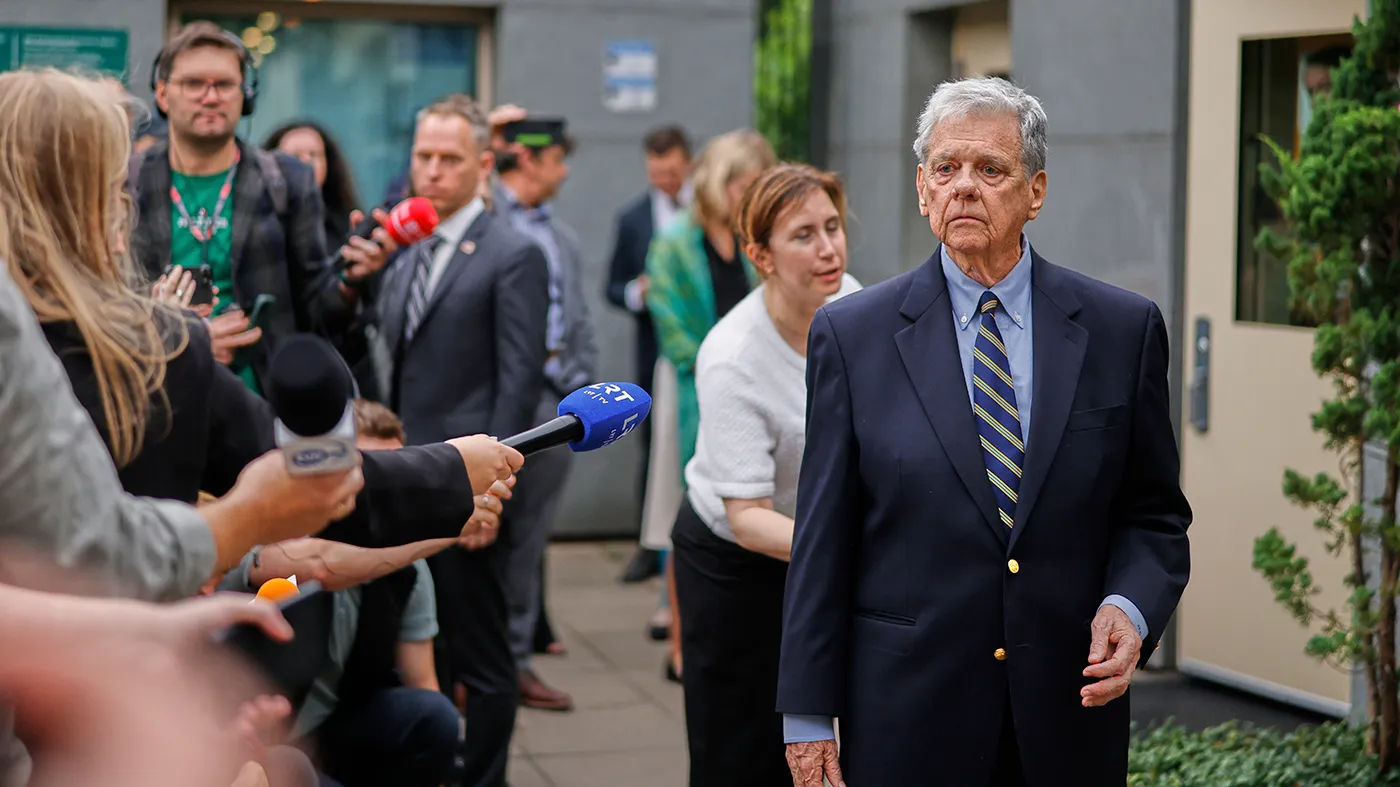
President Trump is tapping his charismatic, straight-talking former lawyer, who has helped free hundreds of political prisoners from Belarus, to serve as the U.S. official charged with bringing home unjustly detained Americans abroad.
John Coale, who serves as special envoy to Belarus, has detailed “vodka infused” negotiations with that country’s authoritarian leader, Alexander Lukashenko, to establish a back channel to Russian President Vladimir Putin and the release of high-profile political dissidents in the country. Coale’s diplomacy has included providing Lukashenko access to popular GLP-1 weight loss medication, as well as sanctions relief.
Trump nominated Coale for Special Envoy for Hostage Affairs (SPEHA) on Monday, a position carrying the rank of ambassador and requiring Senate-confirmation.
Coale is reportedly looking to replicate his Belarus strategy with Putin, proposing that the White House ease sanctions on Russia in exchange for releasing political prisoners.
It’s a controversial plan that will be at the forefront of an appearance before the Senate Foreign Relations Committee, which will consider his nomination.
“I think there are some tough questions that John Coale needs to answer,” Sen. Jeanne Shaheen (D-N.H.), the outgoing ranking member of the panel, told The Hill.
She commended Coale’s willingness to talk “to people on both sides of the aisle,” but called sanctions relief on Russia “unacceptable.”
It’s unclear, however if Shaheen, who is retiring after this Congress, will get the chance to question him about it.
The bureaucracy required ahead of a confirmation hearing, the panel’s workload and the scheduling of the lame duck Senate session after the midterm elections are all factors in whether Coale will come before the committee before the end of the year.
Sen. Bill Hagerty (R-Tenn.), a Foreign Relations member who said he was not familiar with Coale, rejected commenting on the strategy of easing sanctions on Russia, calling negotiations for people’s lives “extraordinarily sensitive.”
“I’m not going to comment in the media about this, or about undercutting him or supporting him, anything like that,” Hagerty said.
But Sen. Pete Ricketts (Neb.), the second-highest ranking Republican on the committee, rejected any sanctions relief on Moscow when asked for his reaction to the proposed strategy.
“I would advise keeping the sanctions on,” he said, calling Putin “a dictator.”
“We need to keep punching him in the nose.”
The White House says that Trump is committed to playing a constructive role in ending the war between Russia and Ukraine.
“The President wants this war settled so the senseless killing ends,” a White House official told The Hill.
Trump “remains optimistic that we’ll ultimately get a peace deal done.”
The Hill has also reached out to a representative for Coale for comment.
Coale, a former anti-tobacco litigator, earned Trump tens of millions of dollars in settlements from social media companies after the president was banned following the January 6, 2021 attack on the Capitol by his supporters.
Brought into Trump’s second term as a deputy envoy for Ukraine, Coale was instead dispatched to Minsk throughout 2025 to engage Lukashenko as a backchannel to Putin, amid early efforts to end Russia’s war against Ukraine.
The U.S. strategy marked a shift from what had been a campaign of isolation and maximum pressure through sanctions, imposed after Lukashenko carried out a violent crackdown on protesters and the political opposition following contested presidential elections in 2020.
Lukashenko’s release of political prisoners has earned Trump’s praise, with the president offering the chance for an in-person meeting and recently announcing a “massive Deal” to purchase potash fertilizer from the country as an alternative to Canada amid a trade war. Although Lukashenko publicly cast doubt on that agreement , regional experts view that as part of the Belarusian leader’s negotiating tactics.
Still, Trump delights in the high-profile acclaim of freeing Americans and others wrongly imprisoned around the world. The administration says the president has freed approximately 100 Americans unjustly detained, but Trump’s intervention has also secured the release of Israeli hostages held by Hamas in the Gaza Strip, a dual Israeli-Russian citizen held by an Iranian-backed militia in Iraq and a Chinese Christian pastor imprisoned in China, to name a few.
As SPEHA, Coale’s file would expand from Belarus to advocating the release of dozens of American hostages and wrongful detention cases globally, engaging authoritarian leaders and terrorist organizations around the world.
This includes Americans held by U.S. adversaries, such as Russia, China, the Taliban in Afghanistan and the Islamic Republic in Iran. Americans are also held by U.S. allies and partners: Turkey, Saudi Arabia, Egypt, the UAE, Syria and Cambodia, according to the Foley Foundation , a nonprofit organization that advocates for the release of Americans held abroad.
Coale’s ability to ingratiate himself with Lukashenko and get results signals a particular knack for sensitive diplomacy. Lukashenko is described as a cunning and ruthless authoritarian leader and tough negotiating partner.
Coale, in an interview with The New York Times published in August, said he was advised to “yuk it up” with Lukashenko and curried favor by egging a vulgar bashing of European leaders.
“I knew that’s what he wanted to hear, something like that, to lighten everything up,” Coale told the Times.
But a key part of Coale’s success is also tied to his close coordination with experts in the State Department, in particular Deputy Assistant Secretary in the Bureau of European and Eurasian Affairs Chris Smith, who spearheaded re-engagement with Lukashenko.
“John Coale managed to get more political prisoners released than any other, 500 people, that’s to his credit,” said Daniel Fried, a distinguished fellow with the Atlantic Council who has spoken with Coale and engaged with the Belarusian opposition in exile.
“The other thing to John Coale’s credit, and speaks well of him, he had not only the judgement, but the self-confidence, in a good way,” to work with experts and avoid Lukashenko’s traps, Fried continued.
Still, treating human lives as bargaining chips for sanctions relief is a controversial strategy.
There’s fraught debate among the Belarusian diaspora over the impact of the sanctions lifting regarding how much it empowers Lukashenko or benefits Russia in its war against Ukraine. And while activists celebrate the lives that were saved, Lukashenko is filling prisons at the same time he is emptying them out.
“Sanctions are leverage, and if limited, reversible steps can help bring people home, that leverage can be used strategically,” Svetlana Tsikhanouskaya, Belarus’s opposition leader in exile, said in a statement to The Hill earlier this month, responding to Coale facilitating the release of 25 more people from Lukashenko’s jails on Sept. 16.
“And we must distinguish between sanctions. Human rights sanctions can be discussed with a humanitarian track. Sanctions related to Russia’s war, military cooperation and threats to European security are different,” she said.
Replicating the Belarus strategy to Russia is even more controversial.
Ukraine opposes any sanctions relief on Russia and is advocating for the blacklisting of several more entities and individuals following Trump signing into law the Sanctioning Russia Act of 2026, said Denys Sienik, chargé d’affaires for Ukraine’s embassy in Washington.
“Russia’s strategy of missile and drone attacks and increasing number of civilian casualties show that the time for any sanctions relief in Russia hasn’t come,” Sienik said in a statement to The Hill.
A major feature of the Sanctioning Russia Act is providing Trump tariff authorities on the five countries purchasing the majority of Russia’s energy exports. But the bill also provides additional sanctions against individuals and entities supporting the Russian government and its shadow-fleet of oil and gas tankers. And it provides tariff authorities on countries helping Russia evade sanctions.
Trump faces a mid-October deadline to inform Congress whether he is imposing tariffs and sanctions or issuing a waiver, and why.
Fried, from the Atlantic Council, said the large bipartisan and bicameral coalition that supported the Graham sanctions bill would likely push back on the “dumb” idea of sanctions relief on Russia. Selective sanctions-lifting on Lukashenko is not the same as easing penalties on Putin that would have direct consequence on Russia’s ability to wage war in Ukraine, he argued.
“Coale did a credible job in Belarus,” Fried said. “Applying that to Russia does not work. I think that’s dumb.”
Topics in this story
Gathered from external sources. Rights to this text belong to whoever originally published it.