Scotland wiped invasive rats from Canna in 2005-06; a decade later puffin counts topped 2,000 while one shag colony climbed from 45 nests to 75
Explore how the eradication of rats from Canna has led to a dramatic increase in seabird populations, particularly puffins, and the challenges that remain despite this conservation success.
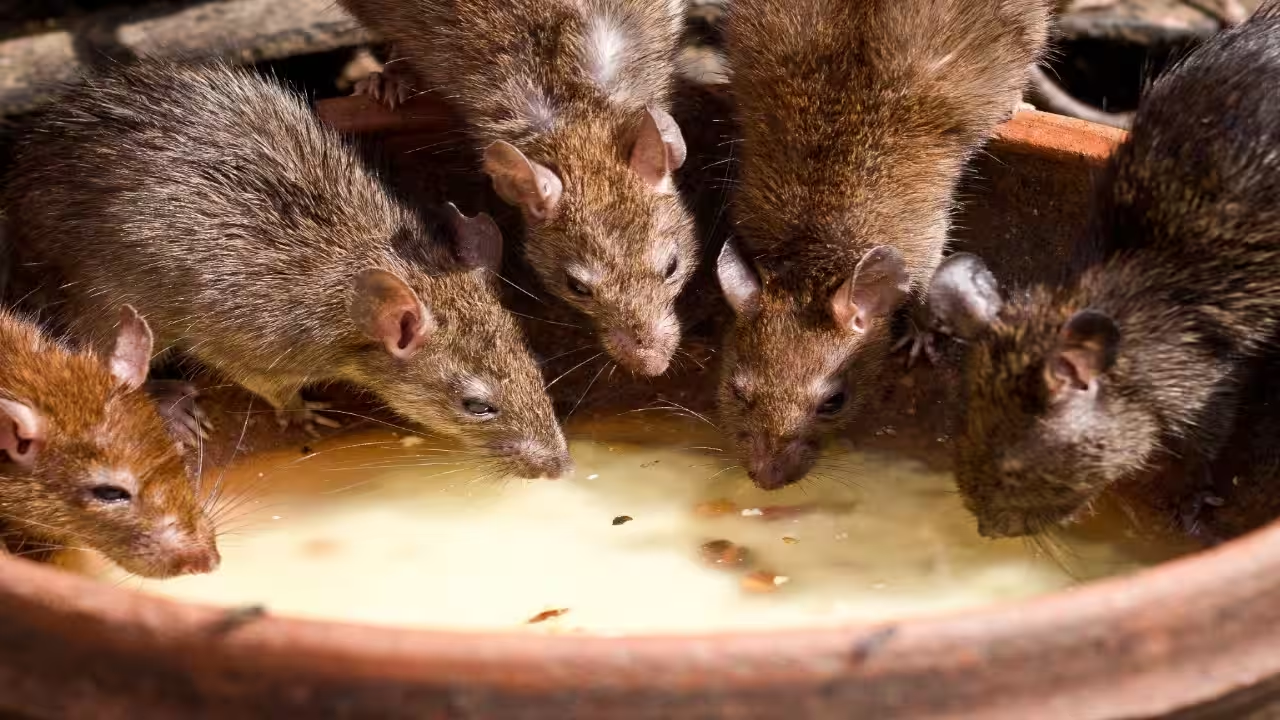
In a project that began in December 2005, rats were completely removed from Scotland's Canna and Sanday, and the last rat was exterminated in February 2006. The two islands cover 1,320 hectares and intensive monitoring over the following two years established that no rats remained. A decade later, seabird monitoring on Canna revealed that different species responded in unique ways, including an increase in Atlantic puffin populations, and one European shag colony experienced growth.Since Canna's seabirds had already been monitored for almost 50 years, researchers could easily compare the 11 years before rat eradication, from 1995 to 2005, and the subsequent 12 years that followed, from 2006 to 2017. The outcome didn't have a uniform response and varied by species. Some species recovered or declined more slowly, while others remained vulnerable to food shortages, storms and other regional pressures.Puffins expanded while shearwaters began a slow return Previously, Atlantic puffins were restricted entirely to two inaccessible offshore areas but after eradication they spread to sites along Canna's north coast and main island, including Guegasgor. In 1995, the recorded number was 1,190 individuals and by 2016 it increased to 2,050 which researchers found to be consistent with increased breeding numbers and expansion of the colony, although the count alone wasn’t conclusive.In contrast, Manx shearwaters showed a slower response with a population count that had fallen from about 1,500 pairs in the mid-1970s to no nests in the main Tarbert Road colony by 2000. After the removal of rats, nesting resumed but by 2017 at Tarbert Road only two nests were recorded followed by four accessible nests in the west. In addition, nighttime calls suggested that another 10 to 20 pairs lived at the inaccessible sites, concluding that the estimated population was below 20 pairs.Breeding productivity had also changed, it went from an average of 0.6 young per nest in the 1980s to a decline below 0.2 in the mid-1990s. Since 2009, 14 out of the known 19 eggs containing burrows produced a chick, an average of 0.74 young per nest as the researchers noted recovery would take time since shearwaters are long-lived and may not breed until around eight years old.European shags exhibited clearer change at colonies because of vulnerability to ground predators. The Lamasgor boulder colony increased from 45 nests in 2005 to 75 in 2016, although its boulder-colony productivity remained below 0.7 young per nest from 1999 to 2004, after the eradication it averaged 1.6. Being less exposed to rats, the cliff colonies had average productivity of 0.97 young per nest between 2006 and 2017, while the overall shag population never increased and its rate of decline slowed.Other seabirds continued to reflect wider pressuresFrom nine pairs at the time of eradication Mew gulls increased to 30 pairs in recent years, while lesser black-backed and herring gulls, which had declined sharply between 2000 and 2005, showed slight increases or stabilization after 2006. Guillemots continued to decline and were affected by severe storms in western Scotland in 2004, which saw its adult survival fall from a long-term level of 0.9 to 0.6 between 2004 and 2005. Through 2008, breeding success remained low owing to food shortages, before improving in 2009 and contributing to population growth.Conversely, in 2006 razorbills showed a sharp increase possibly because fewer eggs were lost to rats, but breeding success stayed low and the occupied breeding sites remained broadly stable through 2016. The removal of rats was also followed by a major increase in rabbits though researchers maintained it was unclear if the rat removal had caused the rabbit increase. By 2013, Canna’s rabbit population was estimated at 15,500, which led to agricultural and archaeological damage due to grazing pressure and erosion. A cull between January and March 2014 saw the removal of 8,200 rabbits and reduced the estimated population to about 7,000 by July. Further culling of roughly 5,000 rabbits a year was used to keep agricultural damage at acceptable levels.You use AI every day. Now get your AI Quotient. Take the AIQ test.
Topics in this story
Gathered from external sources. Rights to this text belong to whoever originally published it.