In 2025, France put eight wheeled solar panels directly on unused railway rails near Paris, testing whether the reversible setup could power maintenance sites without permanent construction
In a groundbreaking initiative, France has installed eight-wheeled solar panels on abandoned railway tracks to assess their potential as mobile power sources for railway operations, aiming for sustainability without permanent infrastructure.
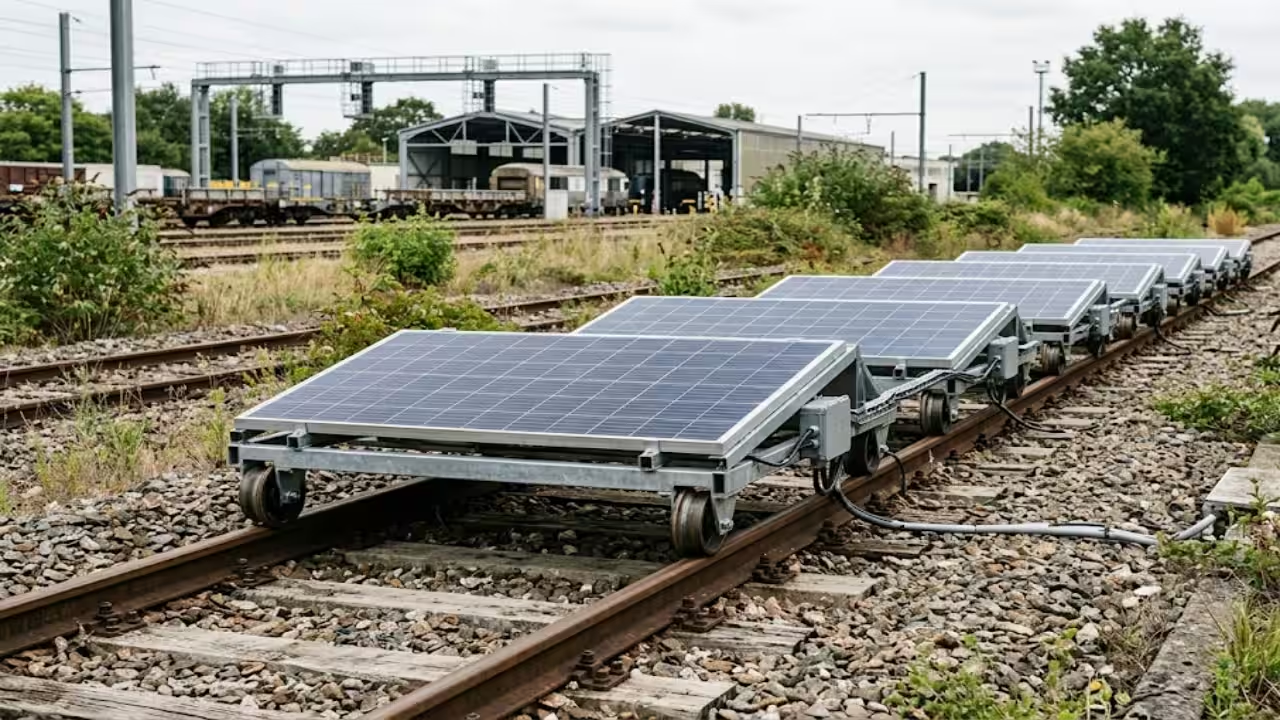
Railway companies own vast tracts of land, and some of it is track that trains no longer use. For a big electricity user, that raises an obvious question about whether those idle rails could earn their keep. SNCF, the national operator of France, has begun to ask whether they could serve as small power plants, and its engineers started answering in a very literal way in January 2025. At the Achères technical centre in the Yvelines department, west of Paris, eight solar panels mounted on wheels were installed straight onto an underused track and left to produce electricity for a six-month trial. The SNCF Group describes the system, called SOLVEIG, as fully reversible, with no groundwork or permanent anchoring, since the track itself serves as the foundation.How SOLVEIG workSOLVEIG was developed by AREP, SNCF’s multidisciplinary design agency, in partnership with the group’s technology and innovation departments and its renewables business, SNCF Renouvelables. According to PV magazine, the panels travel in a standard shipping container together with inverters and storage batteries, and a telescopic arm places them on the track. None of it is dug in, permanently anchored, or set in concrete, so the equipment can be removed from the track and moved elsewhere.Why reversibility mattersReversibility is the key feature. A traditional ground-mounted solar farm requires foundations and a lengthy approval process. AREP says its technology decreases the footprint on the land and the formalities needed to put it in place, which is important on a railway network that may want a dormant line back in service one day. AREP is also working on solar mapping of SNCF land, along with solar canopies and platform shelters. SOLVEIG is part of a broader effort rather than an isolated project.If the trial succeeds, the technology could be extended to underused lines across France to power nearby maintenance sites or support railway operations. The project manager, Astrid Parakenings, calls the broader concept ferrovoltaics. The long-term aim is to identify railway sites with high solar potential and turn idle tracks into sources of renewable energy.Why SNCF is trialling itSNCF, France’s biggest electricity consumer and second biggest property owner, is facing a high power bill and a lot of land. The SNCF Group is targeting 1,000 megawatts of peak solar capacity on its available land by 2030, enough to meet 15% to 20% of its current electricity needs. In July 2023, it launched SNCF Renouvelables to find appropriate sites for solar and ferrovoltaic projects, including derelict railway land. The eight panels at Achères are a tiny fraction of that goal, but they test an idea that could be replicated over many kilometres of inactive rail.The trial at Achères was due to run through June 2025, but detailed results were not available at the time of writing. That leaves open how much power the panels actually produced and how they coped with dust, weather and the tough conditions of a working rail site. Those figures will decide whether SOLVEIG moves beyond the prototype phase.A Swiss pilot on active tracksSOLVEIG is not the only version of this idea SNCF is following. Swiss company Sun-Ways is testing removable panels between the rails of a line that passenger trains still use, and the SNCF Group has joined as a partner to learn from the results. According to SNCF, the pilot will run until April 2028 while teams assess installation, glare, track inspection, maintenance impact, power output and dirt buildup. The setup uses 48 panels of 380 watts each, about 18 kilowatts peak in total, laid over a 100 metre stretch at Buttes in the canton of Neuchâtel since 24 April 2025. The two projects are testing different questions. SOLVEIG is installed on abandoned rail lines, while the Swiss design operates alongside active traffic.In short, France has placed a detachable solar plant on an unused railway track near Paris to test whether idle rails can power railway operations without permanent construction. The six-month test was scheduled to wrap up by June 2025, but detailed performance figures had not been made public at the time of writing, so ferrovoltaics remains a promising prototype rather than a standard way for railways to generate their own electricity.You use AI every day. Now get your AI Quotient. Take the AIQ test.
Topics in this story
Gathered from external sources. Rights to this text belong to whoever originally published it.