In 2017, two North Carolina anglers sank Christmas trees and 12 artificial “trophy trees” to replace degraded fish attractors; the plastic structures lasted longer than the trees at surveyed sites
US News: In a collaborative effort, North Carolina anglers partnered with fisheries biologists to rejuvenate Sutton Lake's fish habitats by sinking Christmas trees and long-lasting trophy structures. This project aims to provide shelter for fish and enhance local fishing experiences.
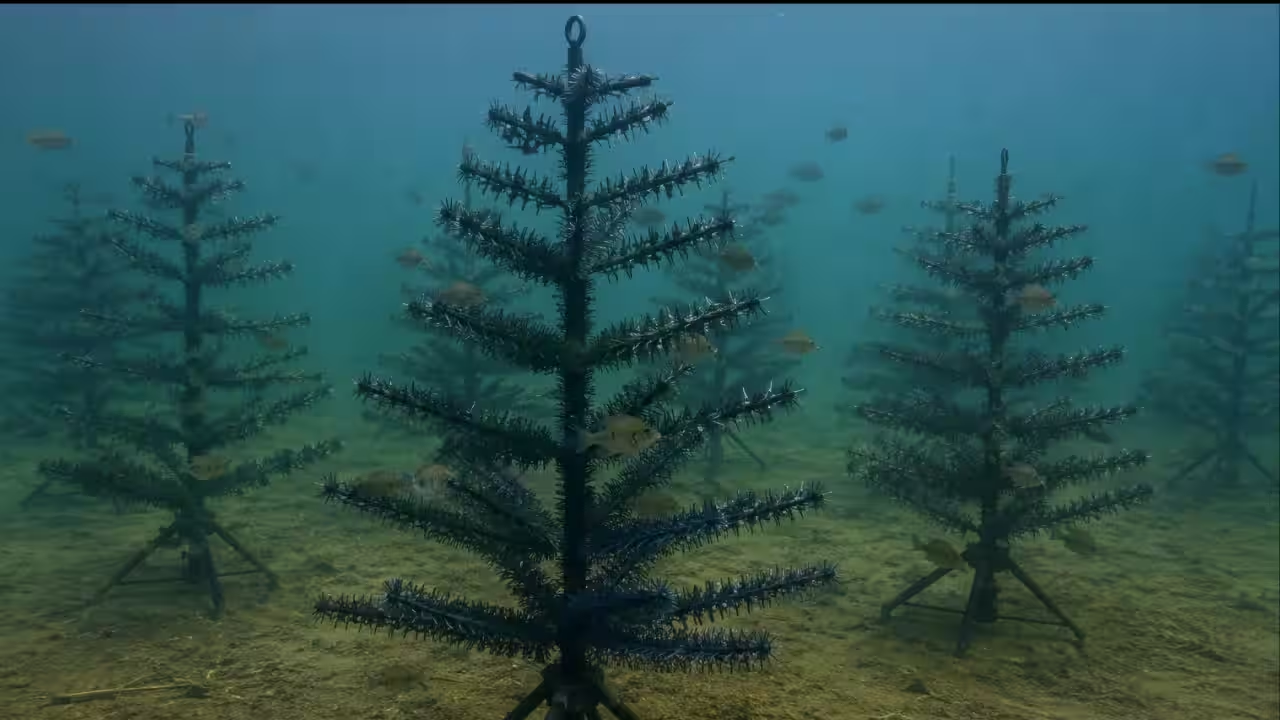
On February 25, 2017, members of a North Carolina bass fishing club spent the day on Sutton Lake placing Christmas trees and twelve plastic fish attractors in the water under the guidance of state fisheries biologists, helping rebuild habitat that had slowly degraded over time, according to a Bassmaster report on the project. The effort began with Coy Riggins, vice president of the Bass Angling Southern Style Fishing Club, a Jacksonville-based B.A.S.S. Nation chapter that was made up largely of active-duty and retired Marines and sailors. Riggins and club president Jeffrey Farmer proposed teaming up with the North Carolina Wildlife Resources Commission to sink Christmas trees in the lake, and Riggins contacted fisheries biologist Clint Morgeson to coordinate. It turned out the commission was already planning a habitat project of its own, so the two efforts merged into one.A Sonar survey found the existing fish attractor sites had broken downBefore installing any trees or attractors, biologists from the commission conducted a sonar test of the current fish attractor sites on Sutton Lake. The result was that the structures were in such a bad state that they needed replacement. This is usually what happens when submerged wood structures decay after a few seasons. Instead of using Christmas trees only as replacements, the commission decided to incorporate MossBack Trophy Tree attractors, which are plastic structures and more durable and lasting than Christmas trees. Twelve plastic structures were bought by the commission for the project.Riggins gathered Christmas trees from friends and from the Marine Corps base at Camp Lejeune. Placement was split by material: commission biologist Clint Morgeson chose specific locations for the 12 MossBack Trophy Tree plastic attractors, while club vice president Coy Riggins used his three years of experience on Sutton Lake to place the Christmas trees where he knew fish tended to stack up. Biologists from the commission provided one boat during the process while Riggins and the tournament director of the club, Scott Shaw, provided bass boats for sinking the structures.Why fisheries agencies are shifting toward plastic structuresThe selection of Christmas trees and plastic pipes is a result of a pattern noted by the research community in the southeastern region of the United States. The plastic pipe and juniper tree attractors used in a study conducted at Canyon Reservoir in Texas yielded, on average, 3.4 fish per plastic attractor and 30.3 fish per juniper tree, even though the plastic pipes were supposed to last longer than the junipers. The paper, Comparison of Plastic Pipe and Juniper Tree Fish Attractors in a Central Texas Reservoir, appeared in the 2008 Proceedings of the Southeastern Association of Fish and Wildlife Agencies and documented a sharp difference in fish counts between plastic pipe and juniper tree attractors, with far more fish using the natural wood despite the plastic units’ longer expected lifespan. Such a compromise between longevity and attractiveness was the main focus of North Carolina scientists at Sutton Lake. Meanwhile, plastic attractors are expensive initially but retain their form for many years and do not require regular replacement.Sonar imagery confirmed the same pattern in other North Carolina reservoirsIn another three-year study, North Carolina Wildlife Resources Commission biologist Jessica Baumann used a high-resolution imaging sonar device known as DIDSON, applying sonar methods similar to those used at Sutton Lake, to test four types of fish attractors. The survey was conducted in all four seasons from 2011 to 2013; the study found that artificial structures lasted much longer than Christmas trees, though how fish counts near the two compared should be verified against the original paper before publication.That project, Using the DIDSON to Evaluate the Effectiveness of Different Fish Attractors in Turbid Reservoirs, is reported to have won a national Sport Fish Restoration award from the American Fisheries Society, a claim that should be verified against the original source before publication; its findings led the commission to expand its use of synthetic attractors at reservoirs across the state, including nineteen fish reefs placed in Hyco and Mayo lakes near Roxboro the following year. As is pointed out in the study, the selection of the material influences not only the number of fish but also the life span of the structure; that is why the researchers at Sutton Lake decided to employ both short-life Christmas Trees and Trophy Tree structures in their experiment.A volunteer effort built around local knowledgeThe Sutton Lake project was successful due to the combination of agency planning along with fishing expertise in the area. Shaw provided the final link by placing his own material from his boat. It was the combined effort of three individuals over one day in February 2017 that continues to shape Sutton Lake's fish habitat today.Catch the latest World News and Live updates. Download the TOI app.
Topics in this story
Gathered from external sources. Rights to this text belong to whoever originally published it.