Isle of Wight fossil identified as new dinosaur species
Invictibellatrix would have been up to four metres long with feathers and had 20cm claws.
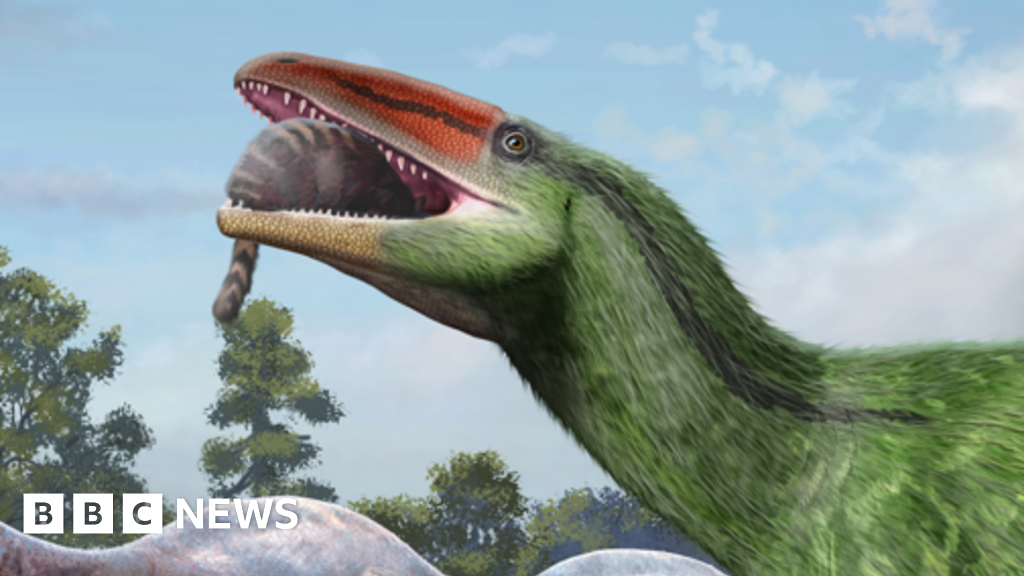
A new species of dinosaur - a long-clawed predator the size of a large tiger - has been identified from a fossil found on the Isle of Wight more than 100 years ago.
The dinosaur, named Invictibellatrix amberina, is described in a new paper in the journal Royal Society Open Science and belongs to a group of agile, two-legged carnivores called megaraptorans.
Megaraptorans were closely related to tyrannosaurs including Tyrannosaurus rex but had slender heads and attacked prey with their large arms and giant curved claws instead of their jaws.
Dr Cassius Morrison of University College London (UCL) said it was a "real mystery" why the fossil - a chunk of the back of a skull - had been overlooked in the Natural History Museum.
The fossil was originally found at the foot of a cliff on the south-west coast of the Isle of Wight by amateur palaeontologist Reginald Walter Tooley and was acquired by the Natural History Museum in 1924.
Invictibellatrix, meaning "unconquered female warrior", is one of the smallest and earliest of the group to be found, living in the Early Cretaceous period about 120 million years ago.
Researchers believe Invictibellatrix would have been three to four metres long and just over a metre and a half in height - about as tall as a human.
It would likely have had feathers and its claws might have been about 10cm to 20cm long.
It would have eaten small dinosaurs, lizards and mammals – occupying a similar role in the food chain to the hyena today.
Megaraptors are regarded as the most mysterious of the large, meat-eating dinosaurs, as few megaraptor fossils have been found.
Until now no megaraptorans had been found in Europe.
Lead author Dr Cassius Morrison (UCL Earth Sciences) said: "It is a real mystery that this fossil was overlooked for so long, sitting in a drawer for nearly 100 years.
"Lots of bones are found on the Isle of Wight – who knows what else is waiting to be discovered."
The researchers undertook a CT scan of the fossil, creating a 3D model of this part of the skull.
They compared the fossil with skulls and brain cases from tyrannosaurs, spinosaurs, raptors and other two-legged meat-eating dinosaurs.
The research team also used mathematical modelling to investigate how the spread of megaraptors around the world might have changed over time, based on fossils discovered so far, dinosaurs' evolutionary trees, geography and climate.
It was one of more than 1,000 specimens discovered by Tooley that were acquired by the Natural History Museum after his death.
Professor Paul Barrett, the study's senior author from the Natural History Museum, said: "Despite over 200 years of collecting, the Isle of Wight continues to surprise us with new dinosaur species.
"Work like this shows the exceptional value of working with historical museum collections where there are still many discoveries to be made."
The study did not explain why megaraptors likely died out in the north, but this may have been a result of shifts in climate or environment, or the presence of competing predators such as other tyrannosaurs.
More stories from Hampshire & the Isle of Wight
Listen to the latest news from Hampshire and the Isle of Wight
Doctor turned dinosaur hunter who rewrites history
'Most complete' dinosaur named in honour of finder
New dinosaur species discovered on Isle of Wight
Topics in this story
Gathered from external sources. Rights to this text belong to whoever originally published it.