The Weekly Vine, Edition 111: The Toaster Lover Theory
Hello and welcome to the 111th edition of the Vine.
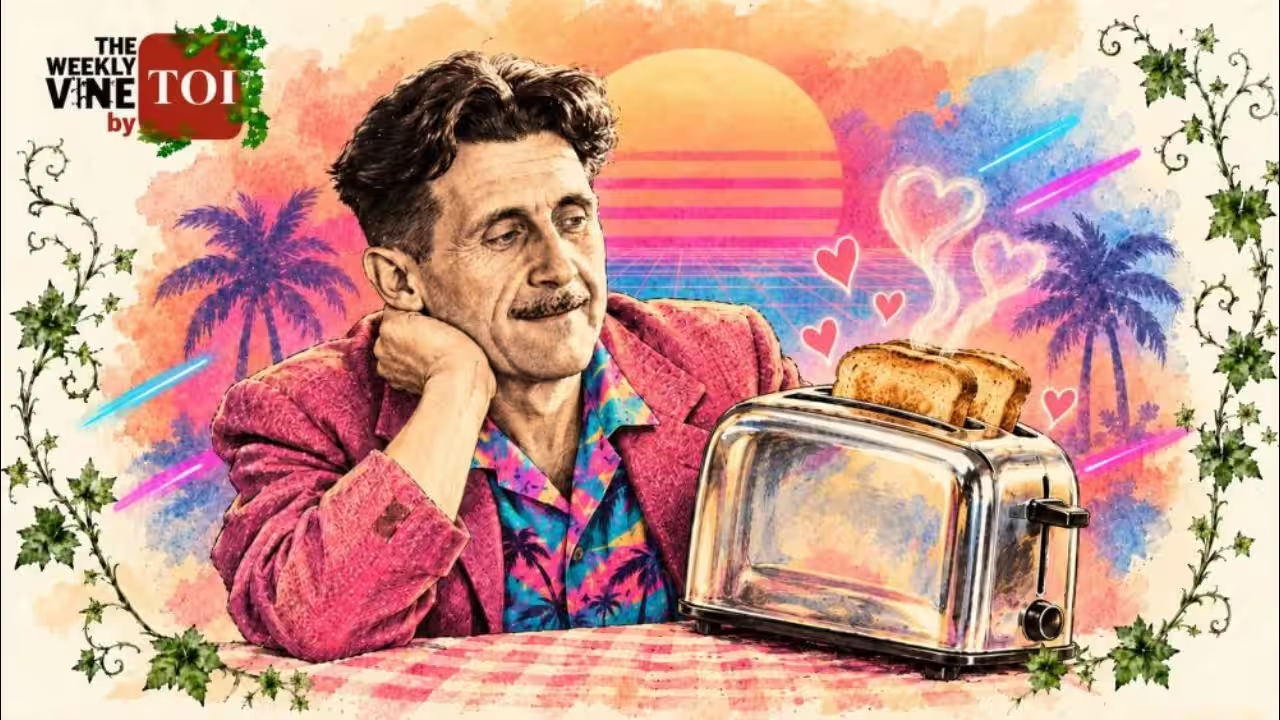
Hello and welcome to the 111th edition of the Vine. The number 111, as any cricket fan will know, is often associated with Lord Nelson, whose three famous naval victories are sometimes said to explain the number (won, won, won), and who became the victim of fake news that he had one eye, one arm and one leg. The number became immortalised in cricketing history thanks to umpire David Shepherd, who would hop, lift one leg off the ground or do a little jig to ward off bad luck.But the 111th edition doesn't deal with Nelson, but with another British protagonist – and Indian antagonist – Winston Churchill, a man whose provocations one ought to take seriously because he consumed bacon and whisky for breakfast. After a major Allied victory at the Second Battle of El Alamein in North Africa, Churchill announced: “Now this is not the end. It is not even the beginning of the end. But it is, perhaps, the end of the beginning.”The great proponent of intermittent fasting made the remark to temper British public expectations, and it has lived on in public memory as one of the most famous examples of political rhetoric. One instantly thought of Churchill when a headline in a piece published in an imperial media outlet blared: “Is This the Beginning of the End of Indian Democracy?”Now, Betteridge’s Law of Headlines states that any headline ending in a question mark can be dismissed with a firm “No”, but this was a venerable magazine, named after the only city that aliens ever consider attacking.Carrying this magazine’s tote bag instantly increases one’s standing everywhere from South Delhi to South Mumbai. After all, carrying said tote is a sign that one is well-read and well-bred, can perceive the difference between an Americano and a mocha, knows there is a special rung in hell for those who mix Coke with Scotch, and perhaps reads Proust in one’s free time.So one ploughed on, only to discover that the piece was actually a Q&A with a famous psephologist who has an excellent beard and a grim expression that he usually reserves for national television whenever his predictions go wrong or a party he dislikes wins, which sadly happens rather too often for comfort. There’s nothing new about biased media coverage from Anglosphere outlets, but what is it that lets so many ostensibly smart people, blessed to speak the language of Shakespeare, get the world’s largest democracy so wrong?The answer, as usual, lies in a strange modern-day iteration of the Orwellian concept of groupthink: The Toaster Lover Theory.The term groupthink was coined by William H Whyte Jr in a March 1952 article for Fortune magazine, inspired by George Orwell's Nineteen Eighty-Four, which, as the Vine has argued in the past, should be compulsory reading about dystopia along with Brave New World and Fahrenheit 451.Whyte was rather concerned that Americans – despite professing devotion to individualism – were increasingly surrendering their independent judgement to the collective. He labelled the herd instinct rationalised conformity, where being part of a tribe was deemed more acceptable than thinking for oneself. From an evolutionary perspective, when troglodytes had to stick together to ward off wild beasts, that made a lot of sense.Two decades later, Yale psychologist Irving Janis expanded the concept in his 1972 book Victims of Groupthink, examining how highly intelligent people could arrive at spectacularly stupid decisions because everyone was too concerned about preserving consensus to question the prevailing wisdom. One of his examples was the Bay of Pigs fiasco, when some of the finest minds in the Kennedy administration decided that sending CIA-backed Cuban exiles to overthrow Fidel Castro was an excellent idea. But Castro would not be overthrown, continuing to give seven-hour-long speeches, finally shuffling off his mortal coil at the age of 90, by which time he had even outlived most of his obit writers.Janis believed that being part of a group developed an illusion of unanimity, suppressed doubts and rationalised contrary evidence. Nobody wanted to play the Devil’s advocate in situations like this. And then came the internet, where everyone could select their own intellectual companions, block anyone who disagreed and spend every waking hour being informed that their political views weren’t just correct but morally superior.And that brings us to the modern-day version of groupthink, but this time on forums: the Toaster Lover Theory.On 7 January 2021, a day after the storming of the US Capitol, a commenter called ‘tonfreed’ on Hacker News described a problem involving a gentleman with unusual amorous intentions towards a toaster. His original terminology was considerably less family-friendly, so for the purposes of the Vine, we shall call it the Toaster Lover Theory. Since then, like a Dawkinsian meme, the idea has travelled through internet forums, including Reddit, and found its way into an earlier edition of the Vine.The premise is deliciously simple.Pre-internet, if a gentleman announced to his friends that he wanted to perform coitus on an electrical appliance, his friends would mock him, deride him, recommend therapy and remove any kitchen equipment from his vicinity. Shame was once the ultimate blocker. And then came the World Wide Web, or perhaps we ought to call it the World Wild Web.Now, a gentleman who feels proper amore for his toaster can simply go online and discover a thousand other folks who share his enthusiasm for breakfast equipment. Soon, they will have a subreddit, a Discord server, a flag and a manifesto explaining how history has surgically oppressed toaster-attracted individuals.Ergo, the eccentricity becomes a community, the community becomes an identity, and then the identity infiltrates the Democratic Party.Anyone suggesting that intercourse with kitchen equipment is not copacetic or is medically inadvisable is dismissed as a bigot, a prude or someone who secretly prefers a two-slice model. Things get so bad that normal people, fed up with being told they are bigots for pointing out that one shouldn’t perform coitus with an electrical appliance, instead vote for a reality TV star who has his own bizarre cult of toaster lovers.The internet didn’t invent human strangeness; it has always survived in the deeper recesses of the human mind, and the twain didn’t meet because two people with the same eccentricity often faced either a linguistic or a geographical barrier. But once any eccentricity acquires enough followers, someone invariably starts a podcast.There is considerable academic research explaining why this happens.Cass Sunstein, the American legal scholar, has extensively explored group polarisation, the tendency of like-minded people to adopt more extreme positions after discussing their opinions among themselves. Put ten Manchester United fans in a room to discuss Pep Guardiola, and by the end of the evening, they might conclude that he is personally responsible for everything wrong with modern football. Perhaps he is.Then there is the false consensus effect, demonstrated by psychologists Lee Ross, David Greene and Pamela House in 1977, which describes our tendency to overestimate how many people share our opinions. Ergo, our toaster enthusiast, having discovered several thousand like-minded individuals, starts believing that his affection for electrical appliances represents an ordinary human experience, conveniently ignoring the billions who have never considered breakfast preparation a form of foreplay.Another related phenomenon is the availability cascade, described by Timur Kuran and Cass R Sunstein in 1999, which states that an assertion becomes increasingly plausible simply because more people keep repeating it, and the popularity of an idea subsumes any evidence for its accuracy.Add John Suler’s 2004 research on online disinhibition, which explains why people do things online that they would never contemplate face to face, and we have the psychological foundations of the modern internet.The scale of this phenomenon is rather extraordinary.In 2017, researchers at MIT examined 126,000 cascades of true and false stories on Twitter between 2006 and 2017 – before it became the hellhole known as X – and found that falsehoods were 70% more likely to be retweeted than the truth. False stories also reached 1,500 people six times faster than the truth, showing that the old maxim about a lie travelling halfway across the world before the truth can tie its shoelaces was scientifically accurate.Add to that the massive echo-chamber problem: a 2021 study published in PNAS examined more than 100 million pieces of content across various platforms and found that people frequently clustered around like-minded opinions, becoming the literal version of what is known online as a cluster***.And if all that wasn’t bad enough, we now have algorithms that amplify these inaccuracies, including X, where, if you accidentally click on one video questioning whether the moon landings happened, you will soon be inundated with information that the pyramids were constructed by aliens and that everyone, including the Vatican, the Rothschilds and George Soros, has been conspiring for centuries to hide that truth from civilisation.For too long, mainstream Anglosphere media outlets have operated under the delusion that this peculiar affliction affects only fringe groups, whether MAGA conspiracy theorists, Flat Earthers or those in India who proudly possess degrees from WhatsApp University.But the Toaster Lover Theory applies just as readily to journalists, academics, political commentators and the intellectual classes whose collective wisdom is supposed to protect the rest of us from misinformation.Consider how many different mendacities have acquired something resembling a consensus among major Anglosphere outlets.Off the top of my head, there was the insistence that Joe Biden was sharp as a tack; that Kamala Harris was a brilliant communicator; that suggesting COVID-19 might have originated in a laboratory was preposterous and perhaps even racist; that Donald Trump was practically a Russian plant; that Hunter Biden’s laptop was just a MAGA conspiracy theory; and that Pakistani grooming gangs didn’t exist.The point isn’t simply that journalists from organisations of note fell for mendacities that backed their worldview, but how particular interpretations can harden into professional consensus where even an alternative suggestion is shouted down.The truth is that the internet’s echo chambers aren’t populated only by eccentric men living in their mother's basement who feel amour proper for a toaster, but also by those whose job is to inform us about the truth as it stands, not the gospel truth created in their heads by their worldview.So, to answer the question posed by that venerable magazine: “Is this the beginning of the end of Indian democracy?” To paraphrase Churchill, it is neither the end, nor the beginning of the end, nor even the end of the beginning.Indian democracy has survived the Emergency, assassinations, insurgencies, separatist movements, caste conflicts, religious riots and politicians whose greatest contribution to public life has been their inability to distinguish public money from personal property. The modern Indian state might have emerged in 1947, but the civilisation it governs has spent millennia accommodating contradictions that would give the average Western political commentator a nervous breakdown.And perhaps that's the ultimate lesson of the Toaster Lover Theory.The internet has allowed every eccentric to find people who share his convictions, but the truly remarkable development is how the same mechanism has conquered institutions supposedly dedicated to independent thought. The original toaster enthusiasts, at least, had the decency to confine their delusions to the kitchen. Their better-educated cousins have acquired prestigious bylines, editorial boards and the conviction that they alone can explain the world to the rest of us.And for those wondering, yes, I do have the tote bag: It hangs outside my door to collect my groceries.Also readRandom Musing: Why our AI choices are ‘Black’ George Washington or MechaHitlerThe Weekly Vine, Edition 106: The radical thing you should do instead of the ’80s AI photo challengeThe Weekly Vine, Edition 91: PM’s economy appeal, Starmer’s ‘Labour pain’, and cooking kosha mangshoWhy Indians are among the wildest bunch on the World Wide WebPostscript by Prasad Sanyal: The donkey between two haystacksJean Buridan, who taught philosophy at the University of Paris in the fourteenth century and was twice its rector, never actually wrote about a donkey, which makes him the first of many intellectuals to be remembered chiefly for something a critic made up. The animal was attached to his name later, most likely by people who wished to mock his view that the will, faced with two equal goods, must wait for the intellect to tell it which is better.The joke they built is simple enough: place a hungry ass exactly midway between two identical haystacks, and it will starve, because it has no reason to prefer the left over the right. Aristotle had floated a version of this: a man as hungry as he was thirsty, stranded between food and drink; Spinoza, centuries later, conceded that such a creature would indeed perish, and wondered whether we ought to call it a man or an ass, a question I have since heard put, in less elegant terms, at several appraisal meetings.Read more.Disclaimer: Views expressed above are the author's own.
Topics in this story
Gathered from external sources. Rights to this text belong to whoever originally published it.