Bradford's 'hidden gem' Pictureville Cinema hosts 30th film festival
Pictureville Cinema showcases film across a range of formats, including 70mm, 35mm and Cinerama.
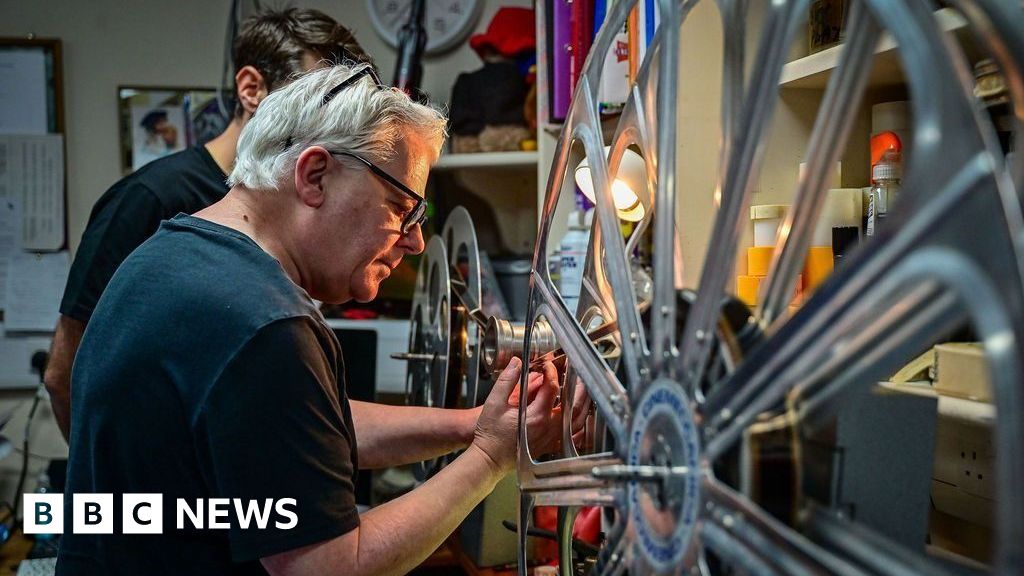
A Bradford cinema that offers screenings in a "unique" format is celebrating 30 years of its film festival.
Pictureville Cinema, based at the National Science and Media Museum, hosts its Widescreen Weekend each year, showcasing films in a range of formats, including 70mm, 35mm and Cinerama.
Cinerama technology, developed in the 1950s, uses three synchronised projectors to display images onto a deeply curved wide screen.
Jack Weedon, Screen Programme Producer for the festival, said: "We are kind of a hidden gem, because it is kind of a niche interest, so it kind of flies under people's radar."
Widescreen Weekend was first held in 1996 and only included six films.
Organisers said Pictureville was the last remaining place in the world to watch Cinerama following the closure of two other specialised cinemas in 2020.
"It is fantastic to see because a lot of cultural events are kind of plateauing or they are maybe dying off, especially with the increasing costs for running things like this.
"We have got people here from Australia, Poland, America, Canada, we've got France, we've got the Netherlands, Germany, and they come every year just for this and it is really, really great for the region."
One of the main attractions of the festival is the ability to showcase Cinerama.
"This requires three cameras to film it, three projectors to project it, and three projectionists working all together at once to create this huge, wide and curved image," said Weedon.
This year's programme includes a newly loaned print of 1962 film How the West Was Won, and a restored 70mm print of 1977 sci-fi classic Close Encounters of the Third Kind.
Other highlights include an Imax screening of Interstellar and a showing of Jurassic Park 3D.
"What we do here is we celebrate unique film experiences," said Weedon.
"It is so unique because we have lots of different ways that you can see film here and people are getting more and more familiar with them these days."
Weedon said the peak in public interest around cinema technology was likely a byproduct of the success of Sir Christopher Nolan's The Odyssey and the interest in the Imax format.
"Some of the best filmmakers around - Paul Thomas Anderson, Quentin Tarantino and Christopher Nolan - their passion projects are working with these increasingly rare technologies and they're reviving formats that have long since died.
"It is kind of being propelled by these people who are very influential in cinema."
Nolan's take on Homer's epic poem, which was released earlier this year, took $264m (£198m) at cinema box offices globally in its opening weekend, including $52m (£39m) on giant Imax screens.
Listen to highlights from West Yorkshire on BBC Sounds , catch up with the latest episode of Look North .
The Odyssey film fans inspired to go back to the source
Miles of film and a bulb as hot as the sun - projecting The Odyssey
Science and Media Museum unveils new galleries
Topics in this story
Gathered from external sources. Rights to this text belong to whoever originally published it.