Diana after Diana: How her story kept changing long after her death
Twenty-nine years ago, on August 31, 1997, a woman was ‘hunted’ to her death.
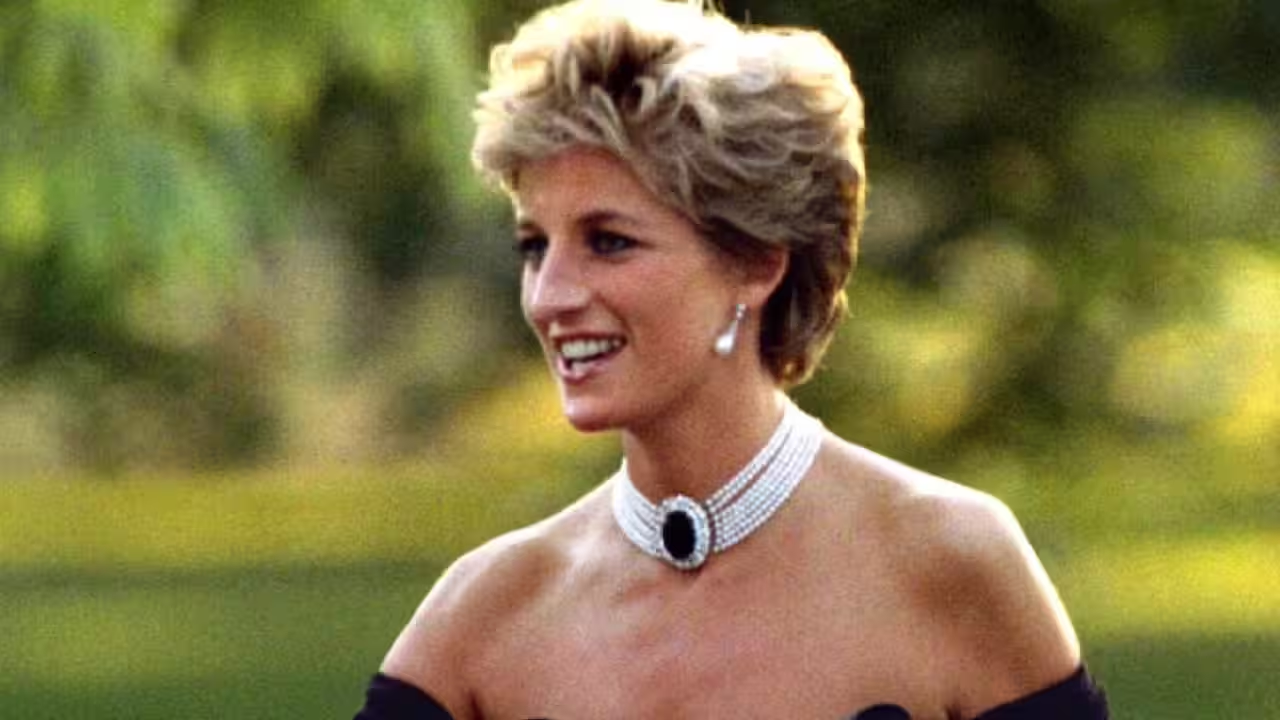
Twenty-nine years ago, on August 31, 1997, a woman was ‘hunted’ to her death.And yet her carcass still finds its way onto paper and television screens, every few years hollowed out, stuffed and reconstructed into whatever we think it is best for her to become.Diana Frances Spencer, who later became the Princess of Wales, has lived two lives but has been only allowed to die in one of them. There is the Diana who lived, and died as the paparazzi hunted her on a fateful night on the roads of Paris. And there is a Diana we keep after her death, one we constantly remake and eulogise.She now exists as versions – a princess, a wife, a mother, a fashion icon, a beguiled lover, a kind-hearted woman, a celebrity, a victim – but did all these versions truly belong to her or do we continue to impose her with a history we create in the present?This month, Diana’s younger brother, Charles Spencer, has painted his version of his sister onto the pages of a memoir titled, ‘Swan Song: Diana, My Sister’. And in an excerpt from the book he creates a portrait of the relationship the now-King Charles shared with his first wife.According to Spencer, in the days after Diana’s death, he and the then-Prince Charles argued over whether William and Harry should walk behind their mother’s coffin. Spencer recalls Charles ending the argument with the words: “Rest assured, we’ll forget her soon enough.” Buckingham Palace has disputed the recollection, saying that grief can cloud memory and affect judgement but Spencer has stood firm by his account.But is Charles right, have we forgotten Diana in her essence and replaced her with a mythologised version?To even pose this question is absurd, twenty-nine years from her death our eyes and ears still follow her. We stand pressed against the door hoping to eavesdrop onto another conversation she may have had.We cannot forget Diana given how good we have become at remembering her.Spencer remembers her as his Diana, his elder sister; the Palace has their version of her; and we, some who weren’t even born back then, have our version, constructed secondhand, through screens and pages.And in all this remembrance, the woman herself becomes harder to see.The remaking of DianaBut perhaps we should have seen this coming, Diana was being remade long before she died.Even when she was alive, the world was already busy deciding what she meant. Prescribing meaning onto her every move, making a photograph of her as a child evidence of her love for children. Her tears could become evidence of her sensitivity, her unhappiness could become a story about the woman trapped inside the institution.Diana and her story were growing alongside each other, very much in the public eye, devoid of the privacy it desired and deserved.Edward White, author of Dianaworld, describes her as a cultural “cut-and-shut” — a term borrowed from the practice of welding parts of different wrecked cars together to make something that looks whole from a distance. Diana, he argues, became a figure made up of very different, sometimes contradictory identities.Perhaps that is why there has never been just one Diana, she ended up becoming someone the public could take for themselves.Even her designers were not simply dressing a princess, they were helping construct one. Catherine Walker spoke of creating an “Arthurian Princess” for one of Diana’s Middle Eastern tours, while another dress deliberately invoked Elizabeth I. Even her image could be made to carry history, fantasy and national mythology.Diana’s ‘fairytale’ never had a textbook happy ending. She first became a princess, who won the hearts of whoever witnessed her. Then she became a victim of infidelity that supposedly stemmed from the heart of a jealous man. And all her years shaping up to be an icon, she may now have ended up becoming a reflection of herself.And eventually, the reflection starts to look more familiar than the woman herself.Diana becomes Diana jiEven in her death, Diana travelled, and as she travelled she changed. For some people in Pakistan, White wrote, she became something closer to the daughter-in-law that an Asian family might recognise. After her death, a reader writing in the Eastern Eye even imagined her as “Raj Kumari Diana ji of Southallpur”, giving the Princess of Wales an Indian honorific and, jokingly, an imaginary kingdom of her own.A woman arrives from somewhere else and, over time, becomes slightly less of the woman she was and slightly more of what the people looking at her need her to be.For some South Asian communities, Diana’s story came to carry their own tensions with family, tradition and individuality. She became the daughter-in-law who rebelled against familial expectations, young brides could identify with her. Women struggling for their own identity but adamant enough to have it, saw themselves in the Princess of Wales.But for these women she was alive, not a figure of the past. What happens when the person is gone but the story keeps travelling?Talking to TOI, Apoorva Jyoti, a young woman in her early 20s based out of Pune, shared what she felt about the late Princess. Someone so distant from the princess, in both place and time, still has pieces of her she remembers.The first words that came to her were “People’s Princess”. Then came the Diana who helped destigmatise HIV and AIDS, the Diana who worked with NGOs and charities, the Diana who cared for people at a ground level, the Diana who had a “very horrible” and “very tumultuous” marriage, the Diana who faced “a lot of patriarchy”, the Diana who was graceful, fashionable, empathetic and “very ahead of her time”.She called her an “amazing role model”, particularly for women, and described her as a “princess of dreams”, someone whose influence was remarkable precisely because she had been given a position that separated her from ordinary people and yet seemed able to reach them.And then there was the tragedy, which seemed to sit underneath all of it. Her death was “extremely tragic”, her life almost too extraordinary to have been real, more like something you would watch in a film or on television, a royal family, a disastrous marriage, a woman who became beloved by ordinary people, and then a death that made the story even harder to look away from.She had never met Diana, had not lived through the years in which Diana became Diana, and yet she had a very complete picture of her.But perhaps that picture tells us less about Diana than it does about what happens to Diana once she belongs to other people.For Apoorva, she is the woman who cared. For someone else, she may be the woman who escaped a marriage, or the woman who challenged the Palace, or the fashion icon, or the tragic heroine, or simply the princess who seemed to understand ordinary people.The pieces are all there, but Diana has become a jigsaw puzzle to the blind. The pieces fit each other, but if we could see, we would know that the picture was all wrong.This is what it means to be Diana, to never really be allowed to belong entirely to yourself, even in death. To be forced to perform for the public, while your body rests six-feet under, marked by a gravestone adorned with fresh flowers as your body wiltsWhen she was alive the cameras hunted her and in her death, we hunted for her. We become the paparazzi.You use AI every day. Now get your AI Quotient. Take the AIQ test.
Topics in this story
Gathered from external sources. Rights to this text belong to whoever originally published it.