In 1997, this Odisha man left his job and built a seed bank that hands out traditional rice varieties to farmers; years later, Debal Deb's effort is rescuing India’s rice diversity
In 1997, ecologist and conservation scientist Debal Deb established Vrihi, a seed bank created to conserve traditional rice varieties and revive the older
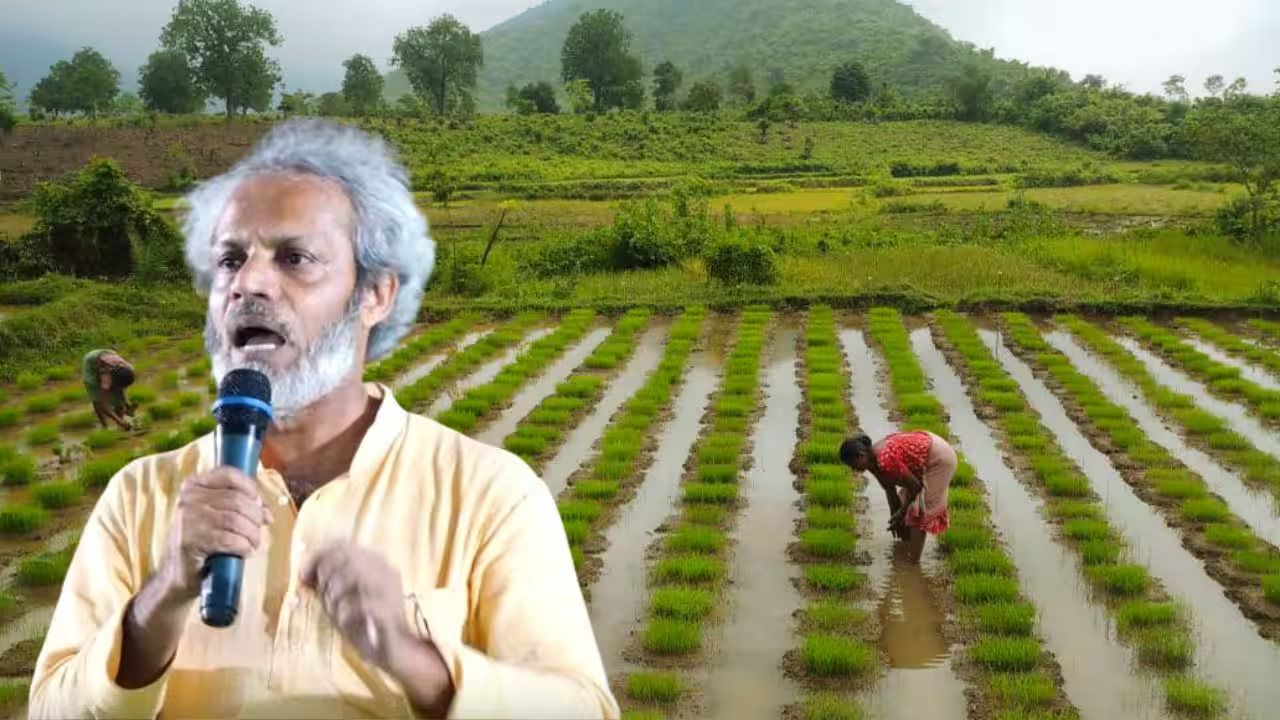
In 1997, ecologist and conservation scientist Debal Deb established Vrihi, a seed bank created to conserve traditional rice varieties and revive the older practice of exchanging seeds without treating them as a commercial product. Nearly three decades later, his collection has grown to 1,480 rice landraces collected from indigenous farmers in India and from farmers and conservationists in several other countries. At his 1.7-acre research farm in Rayagada district, Odisha, the varieties are grown every year so that their seeds can be regenerated and distributed. The Centre for Interdisciplinary Studies (CIS), which coordinates Vrihi, describes it as the first non-governmental rice seed bank for farmers. According to the official website of Vrihi, more than 8,000 indigenous farmers in 13 states had directly or indirectly received rice seeds from the seed bank as of June 2026. The seed bank is now located in Kerandiguda village in Bissamcuttack block of Rayagada district, Odisha.How Deb's seed bank beganThe search for disappearing traditional rice varieties began in 1995, according to the Vrihi website. Deb started looking in remote parts of western and northern West Bengal, where many tribal farmers were still growing locally adapted rice varieties. Vrihi was established in 1997 as part of the wider folk-crop conservation movement led by the Research Foundation for Science, Technology and Ecology. The name Vrihi comes from the Sanskrit word for rice. The project initially received support from the foundation until March 2000. Since then, according to CIS, Vrihi has operated through Deb's personal funding and donations from supporters.The rule: take a seed, give a seedVrihi's model is based on seed exchange rather than seed sales. According to its current seed-exchange protocol, any farmer can receive an indigenous rice variety free of cost from the seed bank. The farmer is expected to give around 1 kg of seed of at least one folk rice variety in exchange. That seed is then passed on to another farmer. If a farmer does not have a traditional variety to exchange, Vrihi allows the farmer to take a 1-kg packet after paying a security deposit. The deposit is refunded when the farmer returns 2 kg of that rice after harvest. The arrangement is intended to ensure that the seed is cultivated and multiplied rather than simply taken away and lost.Vrihi says traditional seeds were once treated as a community resource, exchanged among farmers, relatives and friends. The organisation argues that the spread of commercial seed systems and agricultural modernisation has contributed to the loss of many traditional crop varieties and local food cultures.1,480 varieties in the collectionThe scale of the collection is one of the most striking parts of Deb's work. As of April 2024, Vrihi listed 1,480 rice landraces in its seed stock. These were collected from indigenous farmers in India as well as from farmers and conservationists in countries including Bangladesh, Nepal, Pakistan, Sri Lanka, Korea, Italy and the Philippines. The collection contains rice varieties with unusual characteristics. One is Jugal, described by Vrihi as a double-grain rice variety. Another is Sateen, a triple-grain rice variety. Ramigali, from Chhattisgarh, has elongated sterile lemmas that resemble wings, while Kharah and Makhan have purple culms and leaves. Vrihi also lists Garib-sal, which it describes as the world's only landrace containing silver in its grains.The collection also includes varieties with different agricultural and nutritional characteristics. Vrihi says numerous landraces are rich in vitamin B complex, while around 30 contain two essential omega-3 fatty acids that it says are found only in mother's milk. The collection also includes varieties that can withstand drought, flooding or salinity, as well as varieties showing resistance to different pests and diseases.Every variety is grown, not simply storedThe work does not end with collecting seeds. Vrihi says all its rice varieties are cultivated at the Basudha research farm. Every year, samples of the varieties are taken from Vrihi and planted in small plots. Core sample panicles from each plot are then harvested and stored for the following season. Keeping hundreds of rice varieties close to one another creates the possibility of cross-pollination. To reduce that risk, the researchers use an approach based on asynchronous flowering, transplanting varieties with different flowering periods in neighbouring plots.More than 8,000 farmers in 13 statesThe organisation says its seed-exchange membership had grown from just 21 members in early 1998 to 1,680 by early 2015, covering eight Indian states. By April 2019, more than 7,600 farmers from 10 states had exchanged seeds of 910 rice varieties with Vrihi. As of June 2026, the Vrihi Seed Exchange Network had around 740 primary farmers who received seeds directly from the seed bank. Through these farmers and their subsequent exchanges, more than 8,000 indigenous farmers in 13 states had directly or indirectly received rice seeds from Vrihi. The farmers continue to grow and exchange the varieties among themselves.A national award and a long-term conservation effortVrihi received the National Plant Genome Saviour Award from the Plant Variety Protection and Farmers' Rights Authority, Government of India, in February 2009. Nearly three decades after Vrihi was established, Deb's system continues to work around the same basic principle: collect traditional seeds, grow them, document them and put them back into farmers' hands. The farmer can take the rice home, grow it and sell the harvest. The seed, however, is meant to keep moving from one farmer to another.You use AI every day. Now get your AI Quotient. Take the AIQ testGet the latest Lifestyle News and more. Download the TOI app.
Topics in this story
Gathered from external sources. Rights to this text belong to whoever originally published it.