In 2005, North Carolina researchers put recycled nylon carpet fibres into asphalt; lab tests gave the mix 85% higher fracture energy, helping fight cracks
Discover how North Carolina researchers are innovating road repair by blending recycled carpet fibers into asphalt, improving fracture energy by 85% and providing a sustainable solution to road maintenance.
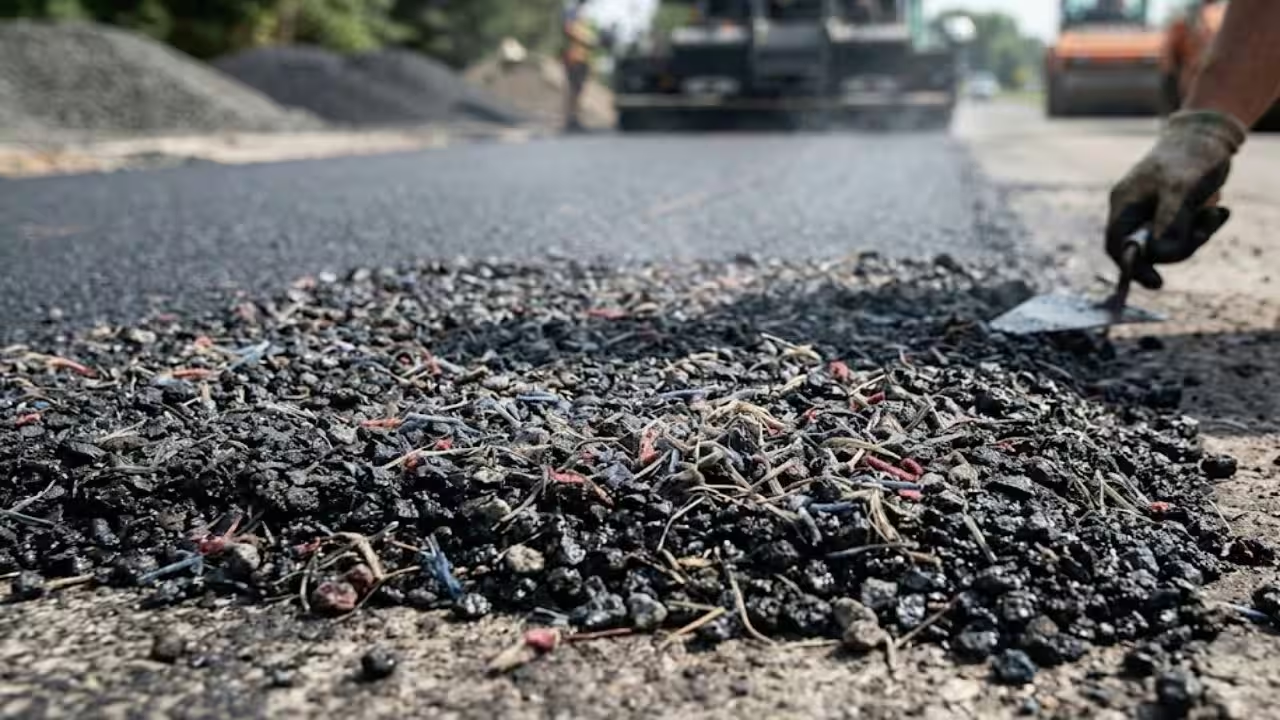
Road surfaces can develop cracks and potholes as repeated traffic, temperature changes and moisture gradually wear down asphalt. Water seeps into every crack, heat softens the surface, traffic pounds it all day, and tiny splits gradually enlarge. Engineers have spent decades investigating how to strengthen asphalt without driving up expenses because repairs are expensive and seldom last.A 2005 North Carolina State University study tested recycled nylon carpet fibers in asphalt to examine whether they could improve resistance to fatigue cracking. Published in the Textile Research Journal, the study found that samples containing the optimal fiber combination had 85% higher fracture energy than asphalt without fibers, indicating improved resistance to fatigue cracking.The study suggests that recycled carpet fibers could improve asphalt's resistance to fatigue cracking. It was a laboratory finding, not a live road result, and the fibres were nylon, the kind used on the face of carpets. Still, the results pointed to a feasible means to reuse tough waste and extend the life of roadways.What lab tests revealedNylon is a common yarn in carpets, so the team used it as a proxy for recycled carpet fibre. They started with a single fibre pull-out test on 15 denier nylon strands, which indicates how tightly asphalt grabs a fibre. The critical embedded length came out at 9.2 millimetres. That is the point at which a fibre is gripped firmly enough to snap before slipping out of the mix.The researchers, armed with this amount, prepared samples of asphalt with fibres of two lengths, 6 and 12 millimetres, added at 0.25, 0.5 and 1% of the mix by volume. Then they conducted indirect tensile strength testing, a routine procedure that slices a cylinder of asphalt across its breadth. The best performing sample was 12-millimetre fibres at 1% by volume, with 85% more fracture energy than asphalt without fibres.Fracture energy is just the amount of work a material can do before it breaks. Asphalt is fragile in tension, and as vehicles repeatedly bend the surface for years, fatigue cracking occurs. Fibres behave like small bridges over a new crack and slow its growth. The researchers said the higher fracture energy indicated potential for improving asphalt fatigue life through recycled carpet fibers.Why carpet waste is a big dealCarpet can be difficult to recover because it is a layered product made from fibers, backing and other materials. Carpets and rugs generated 3.4 million tons of municipal solid waste in 2018, according to the US Environmental Protection Agency. That represented 1.2% of total MSW generation that year. The EPA’s table shows the scale of the waste stream behind that figure: in 2018, carpets and rugs generated 3.4 million tons of MSW, or 1.2% of the total, and only 310,000 tons were recycled. Most of the material was landfilled, underscoring why carpet recovery remains a persistent disposal problem.Some of it naturally belongs on roads. A highway requires huge quantities of material, and in the North Carolina tests, the fibres were 1 per cent or less of the mix by volume. A tiny dose, repeated over kilometres of road, could therefore take in a great deal of discarded carpet without changing how the road is laid. Roads that crack less also need fewer repairs, and every repair means more bitumen, more stone and more traffic held up while crews work.There’s a cost aspect, too. Waste fibres are cheaper than fibres produced for a specific task and a contractor might in theory obtain the same crack-combating advantage at a lower price. It is a reasonable question whether that saving survives collection, cleaning and shredding, and it is one reason why a good test result is only the first step.Earlier research had already tested waste fibersIn a 2004 study published in Resources, Conservation and Recycling, Bradley Putman and Serji Amirkhanian examined waste tire and carpet fibers in stone matrix asphalt, a rut-resistant mix used on heavily trafficked roadways. In such a mixture, adding fibres generally prevents the thick binder from draining off the stone, allowing waste fibres to perform the same function as manufactured ones. The authors noted that people commonly dump waste fibres in landfills and that using them would ease the load on those sites.More fibre is not necessarily better than less. Studies of various types of fibre show that resistance to cracking rises to an optimum level and then diminishes. The 2005 experiments used nylon carpet fibers, while a separate 2004 study had already examined waste carpet and tire fibers in stone matrix asphalt. Nor can a lab sample replicate years of traffic, heat and rain; thus, field trials on real roads remain the only honest test.The 2005 North Carolina study found 85% higher fracture energy at the best fiber setting. Later work on waste fibres in asphalt suggests the concept is viable. What’s missing is long-term proof on real roads. Until then, reclaimed carpet is a sensible, low-cost idea worth watching and not yet a ready-made fix.You use AI every day. Now get your AI Quotient. Take the AIQ test.
Topics in this story
Gathered from external sources. Rights to this text belong to whoever originally published it.