An anti-American president seeks a fourth term in Brazil
A victory for Lula would strengthen authoritarian regimes, undermining democracy and the United States’ strategy under the new Monroe Doctrine.
In recent years, the radical left has lost almost every election in Latin America. However, in Brazil, President Luiz Inácio Lula da Silva — an ally of China , Russia and Iran — is attempting to win a fourth term in Sunday’s election.
Some 160 million Brazilians will head to the polls to elect a president, governors and legislative representatives. Sen. Flavio Bolsonaro — son of former President Jair Bolsonaro, who was unjustly imprisoned — is in a virtual dead heat with President Lula, and a runoff election is considered likely.
These are no ordinary elections. Brazil is the largest country in Latin America and plays a pivotal role bridging the Western democracies of the G20 and the so-called Global South within the BRICS group featuring Brazil, Russia, India, China and South Africa. A victory for Lula would strengthen authoritarian regimes, undermining democracy and the U.S. strategy under the new Monroe Doctrine .
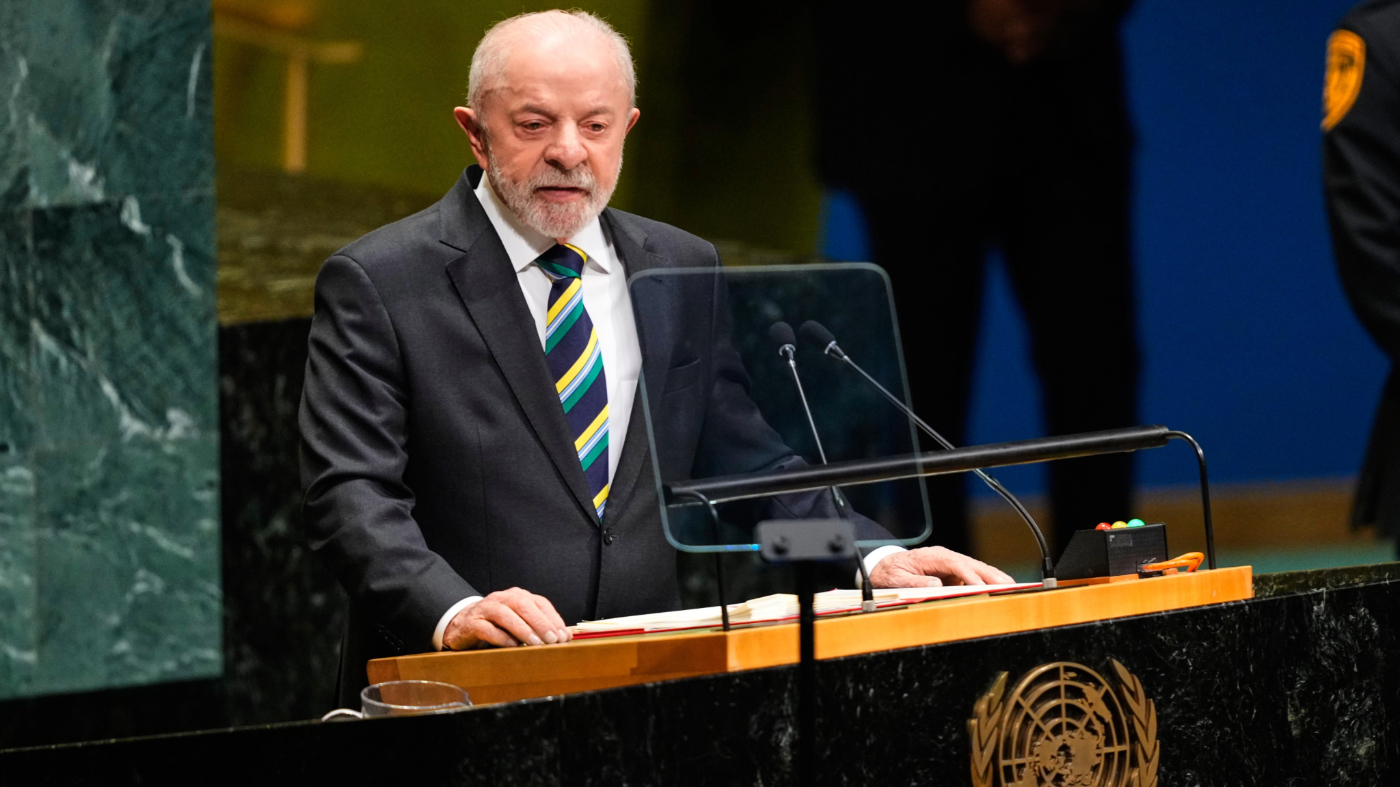
During an address to the U.N. General Assembly last week, Lula stated that Brazil was too big to fit into anyone’s “backyard” and that the country would not tolerate interference in its electoral process. He also condemned the alleged blockade against Cuba, defended Palestine and accused the Israeli Prime Minister Benjamin Netanyahu of committing genocide.
His remarks at the U.N. were praised by Khaled Qaddoumi, political representative in Iran of the terrorist group Hamas. In a statement published by Metropolis, Qaddoumi said the Brazilian leader was on the right side of history.
Lula has also used his anti-American sentiments to fuel his electoral campaign and has called Secretary of State Marco Rubio a frustrated Latin American and a “ mortal enemy ” for the region. The leftist leader’s response follows the U.S. announcement of 25 percent tariffs due to unfair trade practices and the designation of the criminal gangs Primeiro Comando da Capital and Comando Vermelho as terrorist organizations.
Lula has also insisted that the U.S. dollar should not be the hegemonic currency. He asks that Nicolás Maduro be tried in Venezuela and assures that Cuba is the victim of a massacre fueled by U.S. speculation.
In his efforts to distance himself from the dollar and the U.S., Lula has increased his dependence on China. He also announced that Brazil is moving forward with issuing panda bonds using yuan as currency. In other words, Brazil already sells most of its iron ore , soybeans and oil to Beijing, but now it also wants to borrow using Chinese yuan, limiting its financial freedom to the communist power.
Lula has gone above and beyond. Earlier this year Brazil received with arms wide-open the military hospital ship Silk Road Ark owned by the People’s Liberation Army Navy. Members of the naval forces of both countries conducted a joint maritime exercise on search and rescue. China also made a demonstration of a combat and rescue operation.
In the telecommunications sector, Brazil continues working together with Huawei . The controversial company has been accused of alleged espionage by several European countries and the United States.
Lula has also shown little commitment to combating drug trafficking by declining to join the “Shield of the Americas” initiative and refusing to designate criminal gangs like the Primeiro Comando da Capital and Comando Vermelho as terrorist organizations.
Four more years of Lula would put at risk the crucial relation with America. Brazil is one of the world’s largest economies, and the U.S. is its second-most important trading partner. In 2023, U.S. exports of goods and services to Brazil totaled $37.9 billion, while imports from Brazil amounted to $36.9 billion, representing a total trade value of $74.8 billion.
Brazil needs and deserves a change, and a new leadership that defends democracy, freedom and the rule of law. On Sunday, there is a great chance for a historic resurrection of the largest nation in South America.
Arturo McFields is an exiled journalist, former Nicaraguan ambassador to the Organization of American States, and a former member of the Norwegian Peace Corps. He is an alumnus of the National Defense University’s Security and Defense Seminar and the Harvard Leadership course.
Topics in this story
Gathered from external sources. Rights to this text belong to whoever originally published it.