Two more people rescued in Nepal 10 days after devastating floods
Rescuers pulled a Chinese man from a hydropower tunnel and found a 60-year-old woman alive in a four-story building following flash floods on the border with China. Follow for live updates.
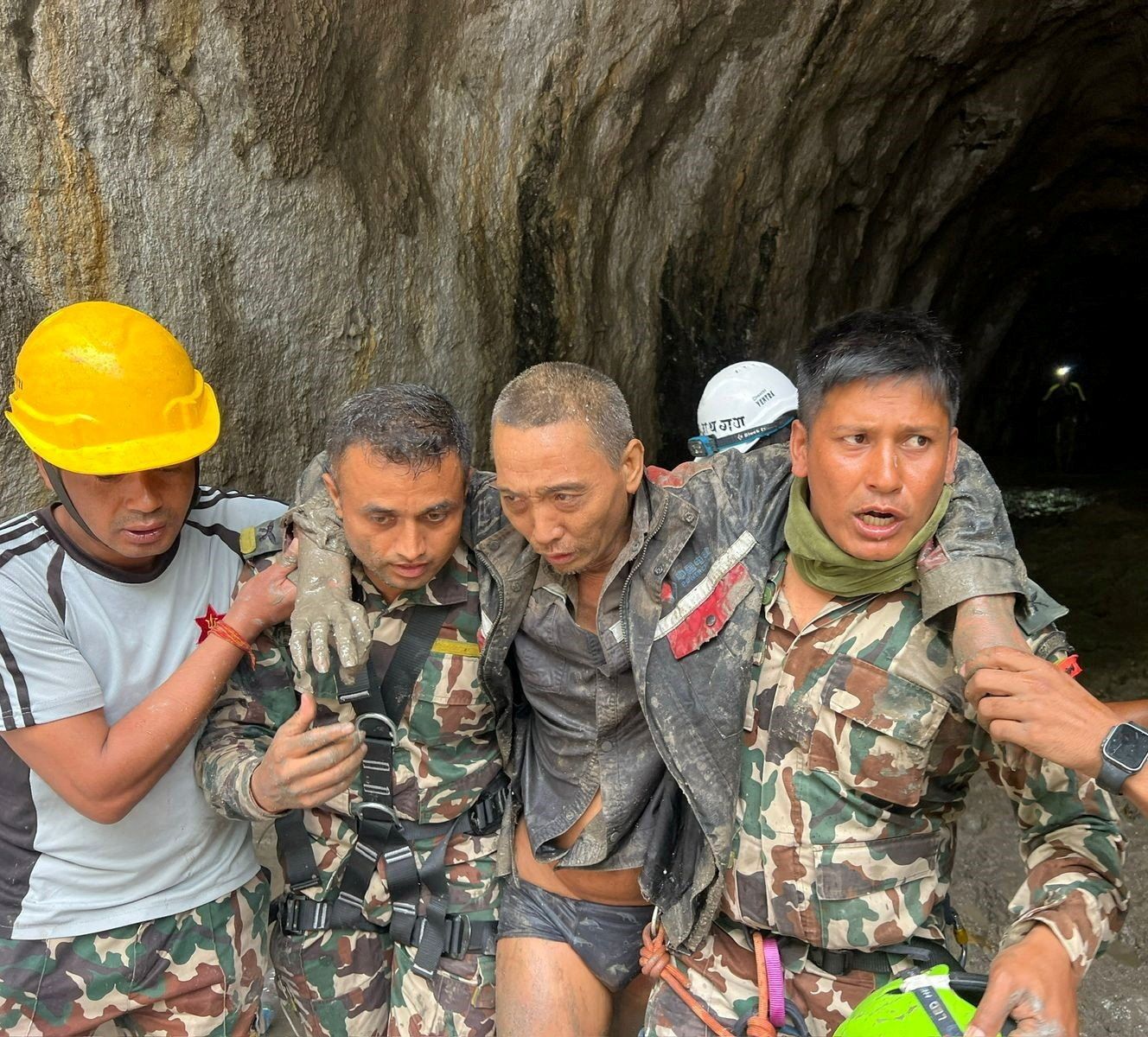
• Dramatic rescue: Two more people have been rescued in Nepal, 10 days after devastating flash floods on the border with China. A Chinese man was pulled alive from a tunnel at a hydropower plant and a 60-year-old woman was rescued from the upper floor of a four-story building.
• Second in as many days: Two men were dramatically pulled alive from another hydropower tunnel in Nepal yesterday. Rescuers had to use satellite pictures to find the tunnel below the mud. Hundreds of tunnel workers remain missing following the disaster.
• Death toll climbs: The number of people killed in last week’s catastrophic flash floods has now risen to 1,375, according to a CNN tally of figures published by Nepali and Chinese authorities.
Rescue efforts have focused on the various hydropower projects dotted along the Trishuli River where hundreds of workers are trapped after last week’s flash floods encased the facilities in mud.
Around 900 workers were still recorded as missing, the Nepali Army said on Thursday, two-thirds of whom were at the Upper Trishuli-1 Hydropower Project.
That is the plant from where Lu Haitao was rescued today.
Each hydropower project presents its own challenges to rescuers who are trying to find the safest way in. Some have internal tunnels stretching several kilometers, meaning any surviving workers could be a long way from the portal.
Rooms and resources inside the tunnels could theoretically help any trapped workers to survive – potentially for weeks, though air supply could be another problem.
Teams are using all sorts of technology to help locate any survivors. They’ve used satellite data, drawings of the power station and topographic information to find a way into the tunnels, according to Arnold Dix, a geologist advising the operations, as well as thermal cameras on drones to search for survivors.
Nine days after flash flooding washed away valleys and buried entire villages, rescue workers in Nepal had started to shift their operations from finding survivors to recovering bodies.
But then on Friday morning, at the Trishuli 3A hydropower plant, they heard an unmistakeable sound: “Okay.”
In a dramatic breakthrough for what has been a desperate, round-the-clock rescue effort in treacherous conditions, two men were pulled from an underground chamber of the hydropower plant, where Nepali rescue crews had been boring in search of 42 missing workers.
Rescuers had earlier reported hearing voices after days of a complex search and clearing mission, according to Bipin Regmi, police chief in the flood-hit district of Nuwakot.
Through a patchwork of grey debris, the two men emerged.
Carried out on a rescuer’s back, Sanjay Sah raised his hand in a wave before resting his head on the Nepal Army rescuer’s helmet. His first question was: “What day is it?”
The second man, Kabir Maharjan, was placed on a stretcher with an oxygen mask over his face.
That moment was the culmination of nine days of work that started with almost nothing to go on. After the August 26 disaster, the Trishuli 3A power station was unrecognizable and initially Nepali rescuers had no idea where to start digging.
To find a way in, the team had to work off satellite data, as-built drawings of the power station and topographic information, according to Arnold Dix, a geologist advising Nepali rescuers on the ground.
That’s how they narrowed down the location of the tunnel least likely to have collapsed – an area Dix calls the “Goldilocks zone.”
Rescue efforts in the hydropower tunnels where hundreds of workers are feared missing are underway and will continue for a “few days,” according to Suresh Raut, a deputy manager at the Nepal Electricity Authority.
Joint teams from Nepal’s police, army and other officials are scouring the tunnels in different power stations along the Trishuli River for survivors with the help of emergency lights, Raut said.
With today’s rescue, three workers in total have been found alive in the past 48 hours days on from the catastrophic floods.
The death toll from last week’s catastrophic flash floods in Nepal and China has risen to 1,375, according to authorities on both sides of the border, with more than 5,000 people still missing.
Rescuers today found two survivors, 10 days after the flooding wrought havoc on the border between the two countries.
Rescuers in Nepal have pulled a Chinese national alive from a hydropower tunnel. The Nepali army has said he is named Lu Haitao and that his health is being assessed.
A woman, 60, has also been rescued from a building in the Nepali district of Nuwakot, according to the Nepal armed police force.
At least 1,344 people have died in Nepal and 4,898 people are still missing because of the flooding, Nepali police said in an update this morning.
Meanwhile in China, at least 31 people have been killed and another 531 are unaccounted for in the autonomous region of Tibet, according to state news agency Xinhua.
58 people were rescued in Nepal yesterday, the army said, with the help of seven army aircrafts and six civilian aircrafts.
Dozens of Nepali villagers who were stranded by the floods lined up for days to return home via a makeshift zip line yesterday.
CNN’s Bhadra Sharma, Kathleen Magramo, Kosh Raj Koirala, Charlotte Reck, Sarah Hutter and Zahid Mahmood contributed to this reporting.
A team of South Korean rescue workers helped the Nepali Army rescue Chinese national Lu Haitao from inside a hydropower tunnel earlier today, Nepal’s Prime Minister’s Office just said.
Rescuers have been working for days to find any survivors from the catastrophic flash floods which tore through the country last week, leaving at least 1,000 dead and thousands more missing.
It has now been 10 days since catastrophic flooding hit the Nepal-China border, killing at least 1,375 people, according to authorities in both countries.
Rescuers are still working to find survivors, with more than 5,000 people still missing, as locals grapple with the destruction left in the wake of the floods.
Here’s a look at the latest from the ground:
A woman has been rescued from a building in the Nepali district of Nuwakot ten days after devastating floods swept through the area, according to the Nepal armed police force.
The 60-year old woman had been trapped on the upper floor of a four-storey building.
In their statement, the Nepali Army named the Chinese national they rescued as Lu Haitao and said his health is being assessed.
“A joint rescue team comprising the Nepali Army and foreign rescuers has rescued a Chinese national, Lu Haitao, alive from inside a tunnel at the Upper Trishuli-1 Hydropower Project,” the army said following the rescue on Saturday afternoon local time.
“Lu Haitao was rescued from a point approximately 225 meters inside the tunnel. His health is currently being assessed, while search and rescue operations are continuing.”
Rescuers in Nepal have pulled a Chinese national alive from a hydropower tunnel 10 days after floods caused devastation on the border, according to the Nepali army.
We’ll bring you more on this developing story as we get it.
Topics in this story
Gathered from external sources. Rights to this text belong to whoever originally published it.