IISc eco-friendly foam moves from lab to market; TOI story drew industry
India News: BENGALURU: An eco-friendly bio-based foam developed by researchers at the Indian Institute of Science (IISc), is moving from the laboratory towards co.
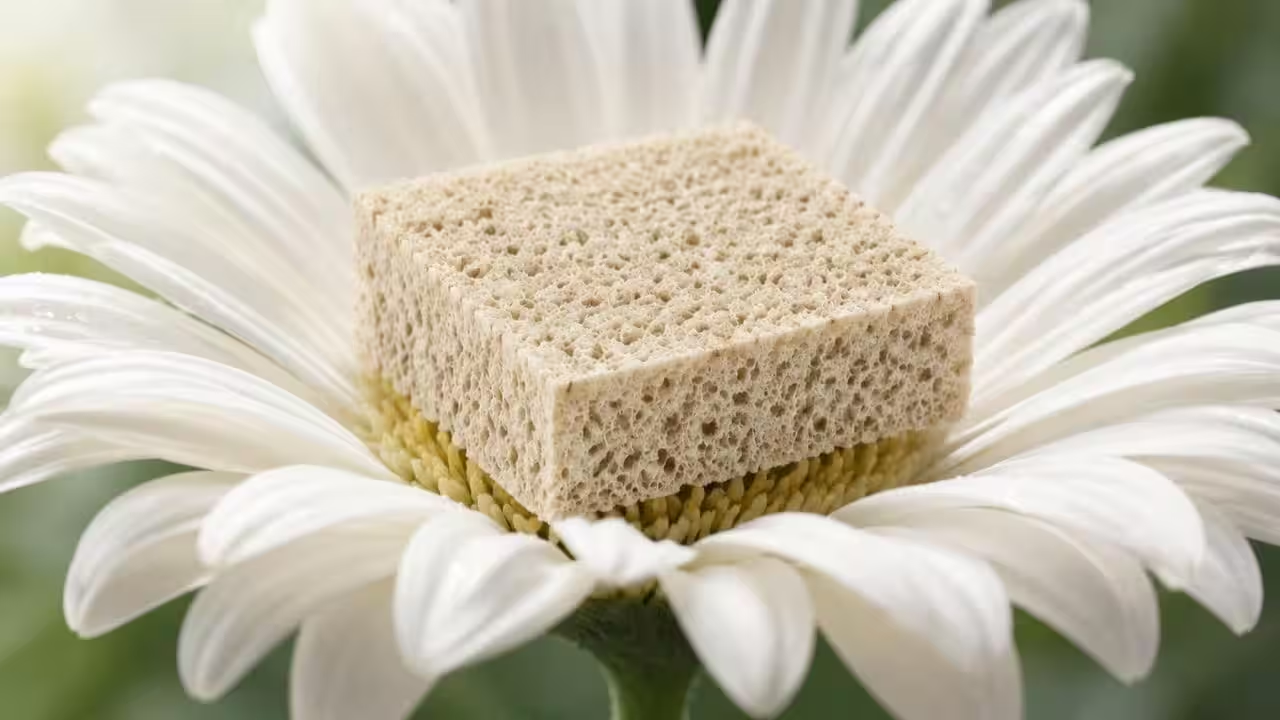
BENGALURU: An eco-friendly bio-based foam developed by researchers at the Indian Institute of Science (IISc), is moving from the laboratory towards commercialisation, with Absolute Cold LLP working on its use in cold-chain and temperature-controlled packaging.The foam, developed by Prof Suryasarathi Bose and Prof Subodh Kumar, along with the team comprising Sampath Parasuram, Akshay Sunil Salvi, Supriya H, Sandeep Kumar Singh and Amit Malakar, is an alternative to conventional polyurethane (PU) foam, which is widely used for insulation but is difficult to recycle after use.The IISc material was designed to combine the properties needed for insulation with a more sustainable approach to what happens to the material at the end of its life. The journey from laboratory to industry also had a link to TOI.Bose said a report on the development published by TOI on Nov 11, 2024, helped bring a potential industry partner on board. “Your [TOI] article brought in a potential licensee on board and helped take the technology to market. Absolute Cold director saw your story and reached out to us,” he said.The original IISc work involved making the foam using epoxidised fatty acids derived from non-edible oils and polyphenol-based materials derived from tea leaves. The researchers also incorporated a chemical structure that allows the material to be reprocessed, rather than simply being discarded after use.Absolute Cold, which works in the cold-chain and temperature-controlled logistics sector, subsequently became interested in the technology. The company is now working towards translating the laboratory material into a product for applications where maintaining temperature during storage and transport is critical.This could include packaging used to transport pharmaceuticals and other temperature-sensitive products. Such packaging needs to provide insulation while also being lightweight and strong enough to withstand handling and transportation. Its environmental impact after use is an increasing consideration as well.The move is the latest step in Bose’s broader work on more sustainable polymeric materials. His research has included efforts to find ways of reusing or upcycling plastics that are otherwise difficult to recycle, with the aim of keeping materials in use for longer rather than sending them to waste.For IISc, the foam's progress also shows the less visible part of academic innovation: getting a material developed in a laboratory into a form that industry can manufacture and customers can use. The licensing and scale-up process can require changes to the formulation, manufacturing process and product design even after the underlying research has been demonstrated.The next test, therefore, is whether the foam can be produced at commercial scale while retaining the insulation, strength and durability demonstrated during development. Its performance in actual cold-chain applications will ultimately determine whether the IISc innovation can become a practical alternative to conventional foams.For a material conceived around the problem of what happens to foam after its useful life, that commercial journey is as important as the laboratory breakthrough itself.Also read: IISc-Bengaluru creates eco-friendly packaging foamGet the latest India News and Live updates. Download the TOI app.
Topics in this story
Gathered from external sources. Rights to this text belong to whoever originally published it.