In 2025, UAE researchers placed two solar panels back to back with mist cooling between them; outdoor tests produced 26% more energy than a standard uncooled panel
In 2025, researchers from UAE University and the University of Sharjah discovered an innovative method to enhance solar panel efficiency by 26.05% using mist cooling technology between bifacial panels. This breakthrough could significantly boost energy generation in hot climates, paving the way for more sustainable solar energy solutions.
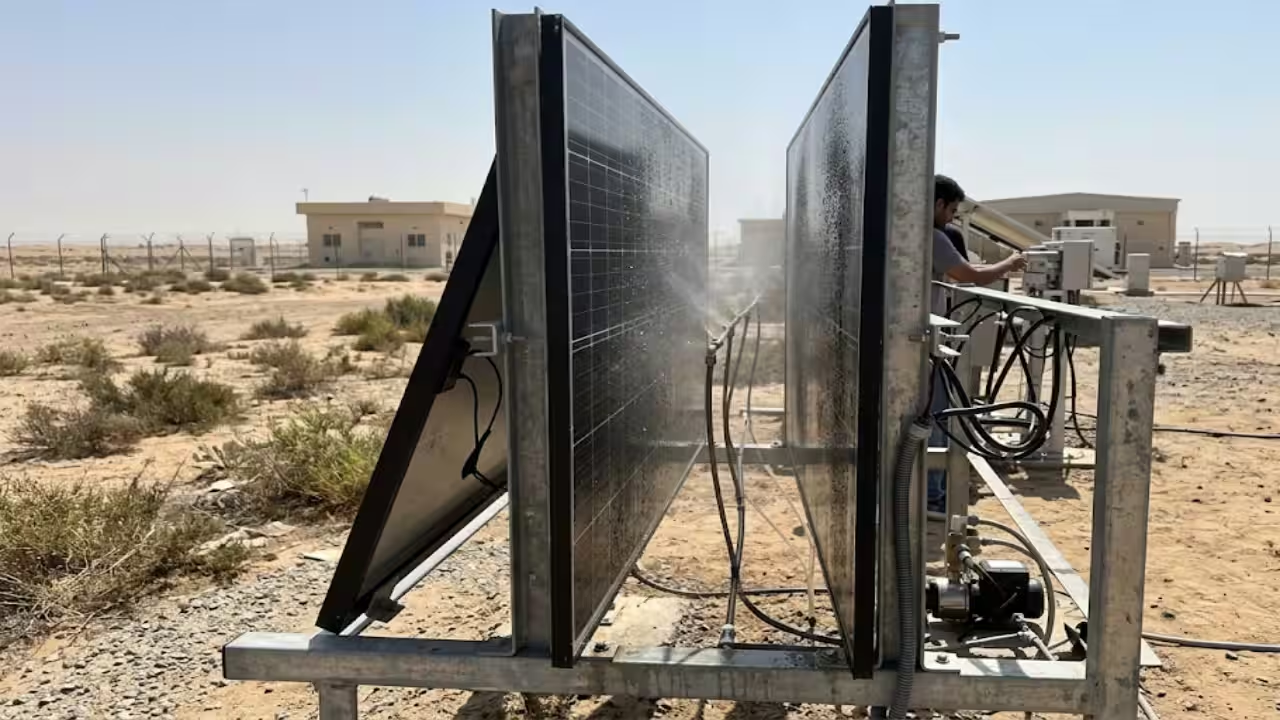
After a few hours in the sun, a solar panel can feel hot to the touch. The fuel is sunlight, but the heat it brings with it quietly erodes the panel’s output. Engineers cannot overlook that heat penalty in a country like the United Arab Emirates, where rooftops and desert solar farms bake for most of the year. Usable space is also limited, especially on rooftops, and cooling devices that waste energy or water can quickly offset any savings.Researchers from United Arab Emirates University and the University of Sharjah tackled both difficulties at once. In 2025, they reported that two solar panels placed back to back with a fine spray of water between them produced 26.05% more energy in outdoor tests than a standard single-sided panel with no cooling. The design is called a mist-cooled sandwich bifacial panel, and the aim is to get more electricity out of the same area while keeping the panels cooler.Why heat hurts solar outputSolar panels are rated at 25°C, but a panel sitting in direct desert sun can run far hotter than that. Silicon cells lose efficiency as they warm up, and researchers have studied the effect for decades. A 1996 survey by scientists at the National Renewable Energy Laboratory looked at how cells, modules and complete systems respond to temperature, and other researchers have cited it widely ever since. Published measurements for silicon modules usually land between 0.25% and 0.5% of power lost for every degree above the rating temperature. That sounds tiny until the maths is done. A module running 35 degrees above its 25°C rating and losing 0.4% of its power per degree would lose 14% of its rated output. Spread across thousands of panels and a long hot summer, the loss becomes real money.Bifacial panels are good at wringing out extra energy because they capture light on both sides, including sunlight bouncing up from the ground. They run hot, too. The UAE team’s twist was to create the bifacial effect by mounting two standard single-sided panels back to back and cooling the gap between them. Each panel was a 60 W monocrystalline unit, and the mist system used 16 nozzles behind the front panel and 16 behind the back one, according to PV Magazine.What the field test demonstratedThe tests were conducted outdoors in the extreme heat of the UAE. The results were published in July 2025 by Zafar Said and Fahad Faraz Ahmad in the journal Energy Conversion and Management. The sandwich panel generated 26.05% more energy than a standard monofacial panel, the type that collects light only from the front, running without cooling.The mist also kept the cells cooler, which is where the higher numbers come from. Corresponding author Zafar Said told PV Magazine that in extremely hot conditions the mist-cooled sandwich panels generated up to 37% more electricity on sunny days and up to 46% more on cloudy days than standard single-sided panels. These are best-case daily gains, while the study’s headline result is the 26.05% gain in energy yield. The larger cloudy-day figure is a little surprising, and the published summary does not explain it, so the full paper should be read before drawing conclusions. Stretched over a whole year, the team calculated that the system would deliver 45.34 kWh more per square metre than a single-sided setup. That works out to an annual gain of about $5.48 per square metre.Water and scaling problemsIn a desert environment, the most obvious problem is water. It is vital for mist cooling, and the UAE has little to spare. Said the next steps involve fine-tuning the mist system to reduce both water and energy use, and testing second-life solar panels inside the sandwich design for improved sustainability. He added that the technique has been patented.Another open question is scale. The prototype used two 60 W panels, which is minuscule next to a utility solar farm, and all the numbers come from a single climate. The annual gain of $5.48 per square metre is small, so the cost of pumps, nozzles, piping and water would have to stay comfortably below it for the idea to make commercial sense. The open question is whether the concept survives real-world water prices and broader testing. If it does, hot countries could get more power from the solar sites they already have, rather than needing to build more of them.You use AI every day. Now get your AI Quotient. Take the AIQ test.
Topics in this story
- UAE solar panels
- solar energy efficiency
- mist cooling technology
- renewable energy innovation
- bifacial solar panels
- mist-cooled bifacial solar panels
- UAE solar energy research
- solar panel cooling technology
- sustainable solar technology
- energy yield increase solar panels
- bifacial solar panel efficiency
- UAE University solar research
Gathered from external sources. Rights to this text belong to whoever originally published it.