The human cost of surging US air strikes in Somalia
Families recount deaths, injuries and displacement as Trump accelerates US strikes against armed groups in Somalia.
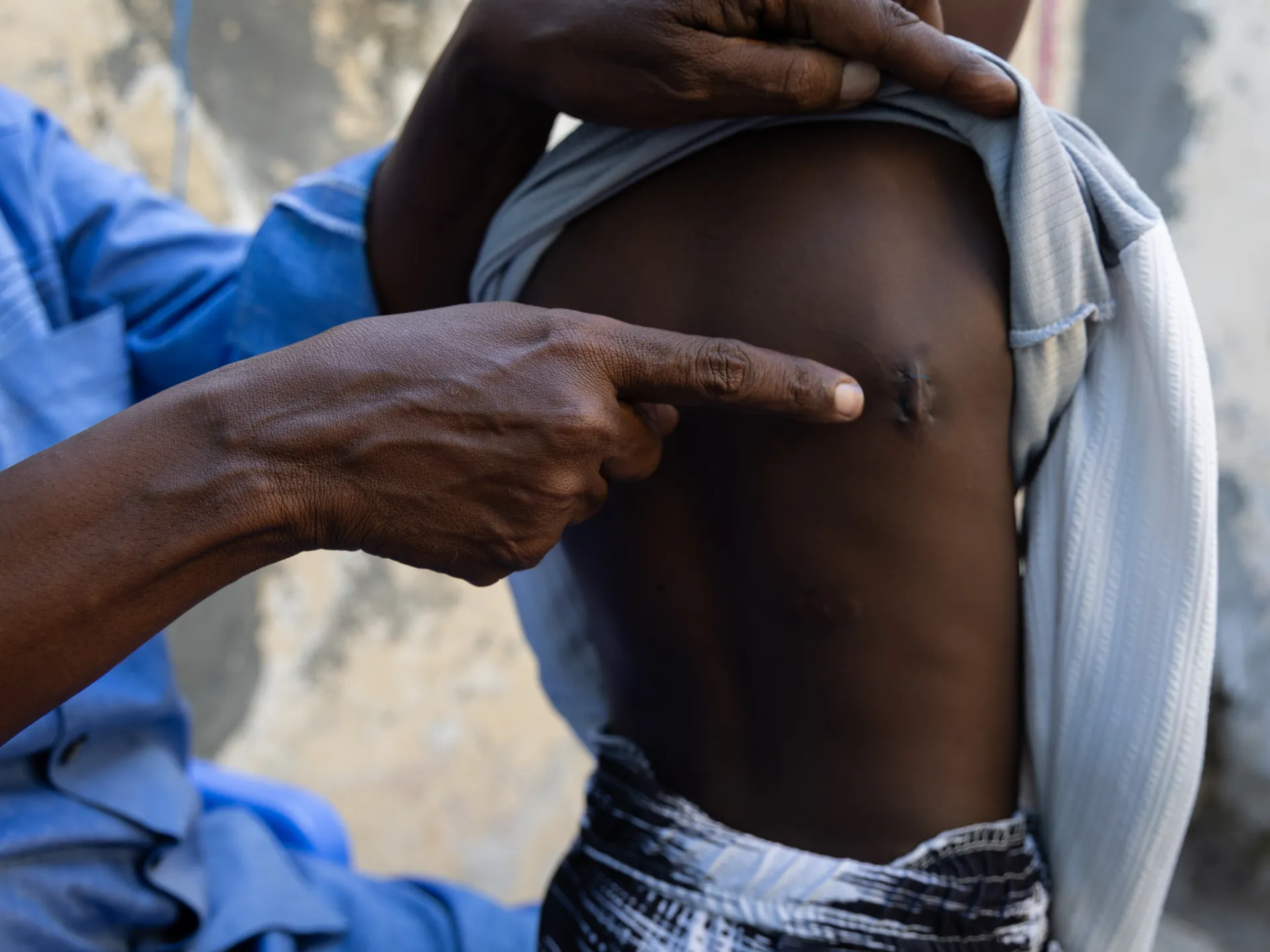
Mogadishu, Somalia – Nearly a year after a suspected US strike in southern Somalia left shrapnel embedded in her son’s body, Maryam Haji Abdi Guled still feels compelled to accompany him to school.
She fears another child might push him while playing, disturbing a fragment of metal lodged near his hip. Doctors have warned that removing it could leave him paralysed.
“I hold his hand, take him to school, and I bring him back myself. I watch over him,” she told Al Jazeera.
Her son, Abdiqadir Salah, was seven when he was injured during a November 2025 military offensive involving United States air strikes and Somali ground forces around Jamaame, in Somalia’s southern Jubaland state.
Maryam is among several survivors interviewed by Al Jazeera in recent months who say family members were killed or seriously injured during the offensive. Their accounts describe deaths, displacement, lost livelihoods and injuries that continue to shape their lives.
Their testimonies come as US air operations against armed rebel groups in Somalia have intensified sharply under President Donald Trump.
Public records from the US Africa Command (AFRICOM) listed 84 strikes in Somalia through September 2026, while the New America Foundation, which independently tracks the campaign, documented 88 over the same period.
The US military has acknowledged conducting air strikes in the area on November 14 and 15, 2025. But it disputes allegations that its aircraft caused civilian casualties.
AFRICOM told Al Jazeera it had completed an assessment of reports that US operations killed between 10 and 12 civilians and destroyed homes and businesses in Jamaame. It concluded that the information reviewed did not meet the military’s “more likely than not” threshold for determining that US air strikes had caused the reported harm.
That finding does not establish that US strikes caused no harm. Rather, AFRICOM said the evidence did not establish that US operations were more likely than not to have caused the reported casualties and damage.
Al Jazeera asked whether investigators had spoken to survivors, relatives of those killed, hospital staff, local authorities or other witnesses. AFRICOM did not say whether they had done so.
The command said the assessment could be reopened if new information emerged that might change its findings.
The conclusion contrasts with accounts from families who say they witnessed the bombardment and with independent monitoring reports documenting civilian deaths and mass displacement during the offensive.
For those who lost loved ones or were left caring for seriously injured relatives, whether they will ever obtain justice remains unresolved.
Maryam remembers the morning aircraft appeared over Jamaame. She was preparing breakfast after her children returned from school when they heard a roar overhead. Aircraft had become so common that the family no longer regarded the sound as unusual.
“The aircraft never leave us, night or day, and we have become accustomed to them,” she said.
Her children ran outside towards the noise. Maryam followed, intending to bring them back inside before the family fled. Then a munition struck nearby, followed by another explosion near the front door. More bombardment followed around the house.
Maryam believes the attack on her home was carried out by US drones that had been circling over the town before the bombardment.
Ugaas Ahmed Ugaas Said Ali, a Bimaal clan chief who remains in regular contact with families affected by the attacks, said the suffering extended far beyond those who had managed to leave Jamaame.
“Maryam is one of the fortunate people who has been able to obtain medical care. There are many injured people left in the town from that offensive who haven’t been able to make it to Mogadishu,” he said.
Maryam recalled one munition hitting the ground without exploding, while other strikes killed people nearby. Amid the explosions, she became separated from her children. Three of her six children were wounded, including Abdiqadir, who suffered the most serious injuries.
It took her a day and a night to reach medical care in Mogadishu. During the journey, which lasted more than 24 hours, her son bled and struggled with pain.
Her experience was one of several reported during days of fighting in and around Jamaame.
According to Jubaland authorities, Somali government and regional forces, including the US-trained Danab commando unit, launched operations against positions held by the armed group al-Shabab in villages surrounding the town.
The authorities said at least 56 al-Shabab fighters were killed and 20 captured. Al Jazeera could not independently verify those figures.
AFRICOM declined to disclose how many strikes were conducted or which munitions were used, citing operational security.
Witnesses interviewed by Al Jazeera said the bombardment came without warning. Three people – two who said they had lost family members, and another whose home was destroyed – declined to speak on the record, citing concerns about their safety.
Ali said residents were afraid to discuss losses caused by air strikes and government offensives because they feared reprisals.
A monitoring network led by the United Nations High Commissioner for Refugees (UNHCR) documented 12 civilian deaths during fighting and air strikes around Jamaame between November 16 and 18, 2025.
The figures cover different phases of an offensive involving both air strikes and ground fighting, making it difficult to establish which forces were responsible for individual deaths.
The UNHCR-led network also recorded 22,800 people fleeing Jamaame and surrounding villages between November 16 and 18, describing the displacement as “rapid and widespread”.
It reported damage to shops and storage facilities, restrictions on civilian movement in al-Shabab-controlled areas, and signs of psychological distress among those who had escaped.
For Ali Aden Borrow, a 52-year-old farmer from Jamaame, the offensive devastated his family. He was away from home when he received a telephone call telling him that his wife had been hit.
She was nine months pregnant and trying to gather their children to escape the fighting when debris from what Ali described as an air strike struck her neck. She and her unborn child died.
Their three surviving children, two girls and a boy, eventually went to live with their grandmother. Ali has since moved between villages and Kismayo, Jubaland’s de facto regional capital, searching for work and trying to support them.
The cost of food, transport and other necessities has left him in debt. He said the family had received little outside assistance.
Another farmer, Nuur Ali Nuur, was working his land when his wife was injured during the same period of fighting. He told Al Jazeera that debris from an air strike struck her lower body and right hand, leaving her paralysed from the waist down.
Their youngest daughter, who was still breastfeeding, was also slightly injured. Neighbours helped transport his wife to hospital while Nuur struggled to care for their five children.
He said he could not afford to take her promptly to better-equipped medical facilities and still owed money for her treatment. Even the journey towards Kismayo depended on persuading a driver to accept payment later.
Anna Zahn, the US-based archive lead at Airwars, said the consequences of air strikes could last for years. Injuries were often under-reported in Somalia, where treatment could be costly and prolonged.
“In fact, the medical care that is needed may not even be available because the very same strikes that caused the injuries could’ve damaged the infrastructure needed – roads, cars, hospitals, factories – to provide advanced and sustained medical care,” Zahn said.
Earlier research in Jubaland by the peace organisation PAX documented chronic injuries, lost livelihoods, displacement and psychological trauma following alleged US air strikes. Researchers said they could not establish the target status of those involved in most of the cases examined.
What did the US investigation establish?
Al Jazeera presented AFRICOM with the accounts of Maryam, Ali and Nuur, including the reported deaths of Ali’s pregnant wife and unborn child, the injuries that left Nuur’s wife unable to walk, and the shrapnel wounds suffered by Maryam’s children.
AFRICOM did not provide the underlying evidence supporting its assessment. It said its investigations draw on intelligence and operational reporting, much of which is not publicly available. It also did not say whether investigators had obtained testimony directly from the affected families.
Zahn said some strikes announced by AFRICOM generated no local reporting that researchers could find. In other cases, witnesses described harm that could not be confidently attributed to a particular force.
She added that AFRICOM had largely stopped routinely disclosing the number of fighters killed or injured in individual strike announcements from early 2025, reducing the information available for independent comparison.
AFRICOM has previously revised its findings on civilian casualties in Somalia, acknowledging deaths caused by its operations after initially reporting that no civilians had been harmed.
The command said that when an assessment establishes that US military operations more likely than not caused civilian harm, it considers appropriate and feasible responses, alongside measures intended to prevent similar incidents.
Those responses may include acknowledgement, an apology or compensation, depending on the circumstances. US legislation makes up to $3m available annually for discretionary payments to people killed or injured, or whose property was damaged, during US or coalition military operations.
Decisions also take account of factors including advice from the host government and potential risks associated with distributing payments.
Speaking in Mogadishu in July, AFRICOM commander General Dagvin Anderson said there had been occasions when US forces made mistakes and “provided reparations”. He also said the command investigated all credible reports of civilian harm.
On September 13, 2025, AFRICOM carried out a strike near Badhan in northern Somalia that it said killed Omar Abdullahi, a local clan elder travelling as part of a convoy. The command later identified him as an al-Shabab arms dealer.
Puntland’s Criminal Investigation Department subsequently said Abdullahi had no criminal record and was not under investigation.
Somalia’s Defence Ahmed Moallim Fiqi contested the killing in parliament, saying Abdullahi could have been questioned rather than targeted.
AFRICOM told Al Jazeera that its civilian-harm assessment of the strike did not meet the “more likely than not” threshold for attributing civilian harm to US operations.
Asked whether it still considered Abdullahi an al-Shabab arms dealer, what evidence supported that claim and whether the targeting decision had been reviewed, AFRICOM did not directly answer.
AFRICOM distinguishes between deliberate strikes, which are subject to multiple layers of review, and defensive strikes against imminent threats.
Its broad definition of combatants includes people deemed to provide material support for hostilities. This raises questions about how such determinations are made and how the criteria affect the risk of civilians being targeted.
The US says its strikes are conducted in coordination with Somalia’s federal government. Somalia’s Defence Ministry did not respond to Al Jazeera’s request for comment.
That cooperation has become increasingly important as Washington expands its air campaign against al-Shabab and the ISIL (ISIS)-affiliated armed group in northern Somalia.
Zahn said the number of strikes during Trump’s second presidency had nearly reached the total carried out throughout his first term, at roughly four times the rate recorded under former US President Joe Biden.
Airwars data analysed for a separate investigation documented at least 216 civilians killed or wounded in US strikes in Somalia between 2007 and the end of May 2025.
That figure represents only the casualties the organisation was able to document, not an estimate of the full toll. It also predates the offensive around Jamaame.
US air operations in Somalia date back nearly two decades, when Washington began conducting strikes against suspected al-Qaeda-linked fighters in 2007. The campaign has since expanded into sustained military support for Somali forces fighting al-Shabab and, more recently, the ISIL affiliate in Somalia.
Under Trump, the US has loosened restrictions on who can authorise air strikes. The administration’s 2026 “counterterrorism” strategy says greater approval authority was returned to military commanders shortly after Trump took office, reversing the more centralised procedures used under Biden.
Anderson has welcomed the increased operational flexibility, saying it allows faster responses and more rapid air strikes as additional US military assets become available.
Somalia’s President Hassan Sheikh Mohamud also acknowledged the change during an appearance at the Council on Foreign Relations in September 2025.
“During the era of President Trump, it is bigger and much easier than before,” he said of US military support.
US officials argue that al-Shabab remains a direct threat to American interests. During his US Senate nomination process in 2025, Anderson described the group as al-Qaeda’s largest, wealthiest and most lethal affiliate. He said both al-Shabab and Somalia’s ISIL affiliate aspired to attack the United States.
Yet the expansion of US air operations has not eliminated al-Shabab, which has repeatedly regained territory after offensives by Somali and allied forces.
David Sterman, a senior policy analyst at the New America Foundation, said US operations under Trump initially concentrated on the ISIL affiliate in northern Somalia in early 2025, but gradually shifted back towards the south during 2026, historically the main focus of the campaign against al-Shabab.
Ahmed Suleiman Hussein, a national security official, wrote on X in May that government research had found that civilian harm from air strikes could generate grievances that al-Shabab and the ISIL affiliate might exploit for propaganda and recruitment.
Somalia has since adopted a national civilian-protection policy, which Hussein said needed to be consistently incorporated into “counterterrorism” operations.
For Maryam, the Jamaame offensive has reshaped almost every part of her family’s life. After her children were injured, she initially fled into the countryside, but there was no hospital capable of treating Abdiqadir.
She eventually made the roughly 24-hour journey to Mogadishu, at times carrying him against her body because his injuries left him unable to sit or stand without severe pain.
“He was bleeding in the car and it was a rough road,” she said.
Once in the capital, Maryam moved between hospitals, searching for treatment. Doctors warned that removing the shrapnel lodged near Abdiqadir’s hip could kill him or leave him paralysed, she said.
At several hospitals, she was asked to sign documents absolving medical staff of responsibility if surgery caused further harm.
“I said, ‘No, I will not sign. Bring my son out to me,’” she recalled.
At another hospital, doctors recommended amputating his leg, which she also refused. In September 2026, after a fundraising campaign by the British newspaper The Guardian helped cover his treatment, Abdiqadir underwent surgery in Mogadishu.
Doctors removed two pieces of shrapnel but left another in place because of the risk of paralysis.
“He is currently able to play and move, and we can’t take this risk,” Maryam said.
She has remained in Mogadishu to keep him close to medical care, unable to resume the farming and livestock work that once supported her family in Jamaame.
“I cannot return there now. This child will not get medical care there, and the situation that we fled yesterday is still there, it is even possible that something worse could happen,” she said.
Topics in this story
Gathered from external sources. Rights to this text belong to whoever originally published it.