In 2004, Missouri rebuilt 2.36 miles of deteriorating roads with recycled asphalt and fly ash; an EPA estimate put the project’s cost at about one-third less than full replacement
Discover how Jackson County, Missouri, transformed 2.36 miles of deteriorating roads using recycled asphalt and coal fly ash to reduce costs by a third and promote sustainability in highway construction.
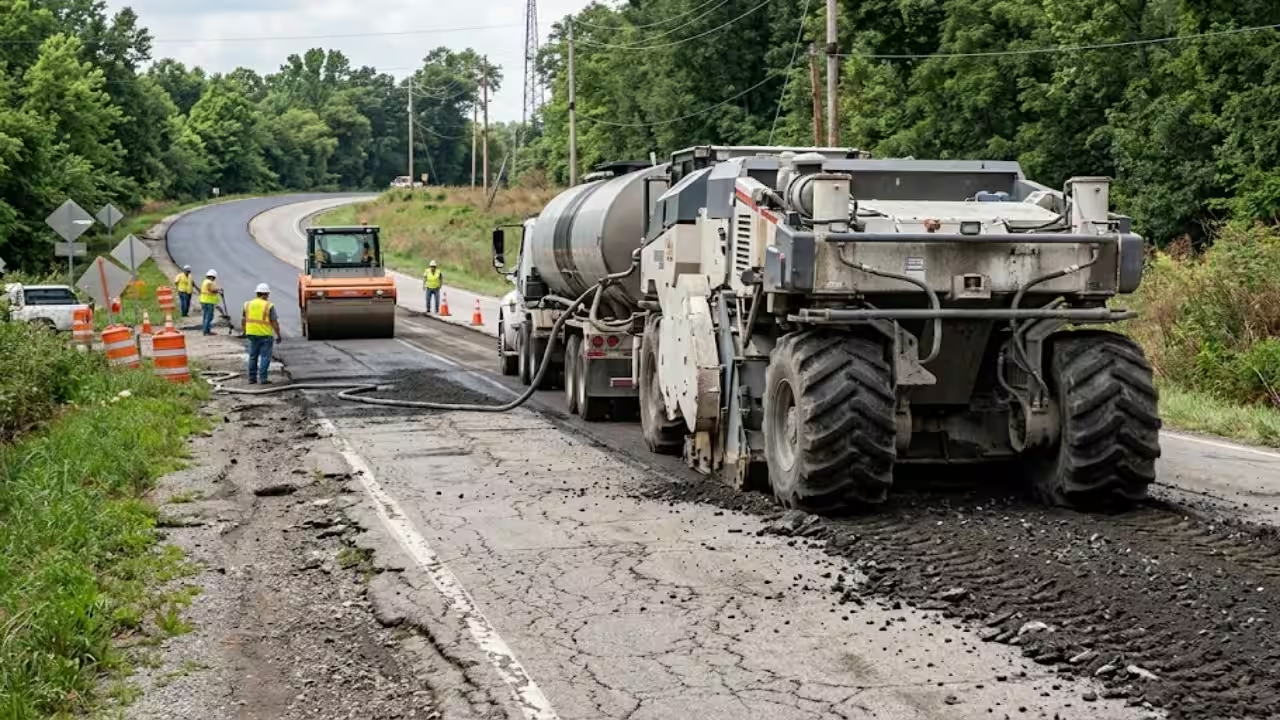
It may be necessary to remove the old pavement, remove the debris, and install new materials in order to replace a severely degraded road. An alternative strategy was attempted by engineers in Jackson County, Missouri. The road itself was repurposed, and the ground pavement was combined with water and coal fly ash to create a new base for an asphalt surface. The project covered 2.36 miles of rural roads and used nearly 1,700 U.S. tons of Class C fly ash, a byproduct of coal-fired power generation. The U.S. Environmental Protection Agency’s case study documents the project’s length, donated materials and reported cost savings.The project was conducted in partnership with Jackson County’s Department of Public Works, Kansas City Power & Light, Lafarge North America and the University of Missouri–Kansas City. It was a realistic test of whether an existing pavement could be used as a structural layer or if it was viewed as material to be scrapped.Old path to new baseThis is called full-depth cold in-place recycling. Rather than tear out the old asphalt and transport it to a processing factory, crews pulverise the current pavement and underlying base material in place. The recovered mixture is then processed, compressed and overlaid with a fresh surface course. For the Jackson County project, engineers employed Class C fly ash, which is self-cementing. The addition of this sort of ash to water might cause binding reactions that assist in stabilising granular material. Combined with the crushed asphalt and base material, it produced a more durable basis for the new surface.The process also affected the amount of material that had to be added to or removed from the road. The fly ash was used to stabilise the recycled base, and the old pavement was kept as part of the restored construction. Then, as a fresh asphalt layer, the finished driving surface was laid on top. In a 2008 technical paper, Anil Misra and coauthors described the Jackson County demonstration as an August 2004 project covering approximately 2.5 miles across two road segments. That is a rounded figure; the EPA lists the exact length as 2.36 miles. The study examined construction procedures, field strength tests and follow-up measurements to assess the performance of the fly ash-stabilised recycled base.What the strength tests revealedA recycled road base needs to look solid after compaction and be more than that. It must withstand frequent deformation by vehicles and variations in temperature and moisture. One of the tests utilised in the Missouri project was the California bearing ratio, or CBR. The test assesses the material’s resistance to penetration and aids engineers in determining appropriateness for pavement construction. The EPA case study reports that the fly ash-stabilised material reached an average California bearing ratio (CBR) of 52 after 24 to 48 hours of curing. That early strength allowed engineers to employ a thinner asphalt wearing surface, lowering the quantity of new pavement material required.The investigation did not end with the initial construction results. Engineers returned to the road sections and measured structural response using a falling-weight deflectometer. The device exerts a controlled stress on the pavement and measures the resulting deflection, which can provide information on the stiffness of the layers underneath. The follow-up work was conducted on two road sections, J.W. Cummins Road and Cummings Road. Researchers made many measurements along the pavement, at several points, so they could compare the structural behaviour at the different reconstructed parts, not just one measurement.Misra and his coauthors estimated structural layer coefficients of 0.18–0.26 for the stabilized base, above the 0.14 reference value for a typical granular base. They recommended a more conservative design range of 0.18–0.20 when calculating pavement thicknesses with the recycled material. Those statistics are important because the structural layer coefficient allows engineers to gauge the contribution of a pavement layer towards the strength of the entire highway. The results revealed that the recycled, fly ash-stabilised base might give considerable structural support, rather than simply compacted fill.Why the project was cheaperThe EPA attributed the project’s cost advantage to several factors. Crews processed the existing pavement on site, reducing the need to haul away old asphalt, transport replacement aggregate and dispose of waste in a landfill. Reusing the existing road material also reduced demand for newly quarried stone and sand.The project additionally used nearly 1,700 U.S. tons of Class C fly ash donated by Kansas City Power & Light and Lafarge North America. The stabilised base was strong enough to support a thinner, less expensive asphalt wearing surface. Because the fly ash was donated, the reported savings should not be attributed solely to the recycling method or assumed to apply to projects where equivalent materials must be purchased.There was also an environmental benefit in terms of fewer truck trips. Hauling old pavement away and hauling fresh aggregate to a construction site uses fuel and emits pollution. That activity was decreased by the reuse of material already on the road and limited the requirement for newly mined stone and sand. The one-third reduction was an estimate for this specific project, not a guaranteed saving for every road. Results can vary with pavement condition, ash composition, transport distances, equipment costs and the thickness of the replacement surface.Limits to reusing a roadThe Missouri test proved that recycled pavement and self-cementing fly ash could be blended into a viable base, but it did not eliminate the necessity for engineering checks. The existing road material had to be processable; the mixture had to have the right moisture, compaction and curing. Fly ash can also vary by source. The chemical composition of ash determines how it reacts with water and other materials; therefore, results from one project cannot be immediately transferred to every supply of coal ash. Engineers must determine the appropriate mix proportions and verify that the finished material meets the specifications for its intended use.Then there is long-term performance. Initial bearing strength and pavement stiffness measures assist in determining if a road can handle loads, but they are no substitute for years of monitoring under traffic and weather conditions. Design guidance was developed from the Missouri experiment, although the authors warn that field measurements and material attributes should be evaluated with care.The Jackson County project demonstrated an alternative to complete road replacement. Crews recycled 2.36 miles of deteriorating pavement, stabilised the reclaimed material with nearly 1,700 U.S. tons of Class C fly ash, and applied a new asphalt surface. The EPA reported that the project cost about one-third less than removing and replacing the entire road. The broader lesson is that worn pavement does not always need to be discarded. When the existing material is suitable and engineers design the mixture correctly, recycling and fly ash stabilisation can reduce the need for new materials, hauling and landfill disposal.You use AI every day. Now get your AI Quotient. Take the AIQ test.
Topics in this story
Gathered from external sources. Rights to this text belong to whoever originally published it.