In 1983, rhino champion Anna Merz spent her savings to secure 5,000 Kenyan acres; the sanctuary she started grew into Lewa, now sheltering about 245 rhinos across the greater Lewa Borana environment
Rest of World News: Explore the remarkable journey of Anna Merz, who transformed her savings into a sanctuary for rhinos in Kenya. Discover how her efforts led to the revival of the black rhino population and established Lewa Wildlife Conservancy as a leader in conservation.
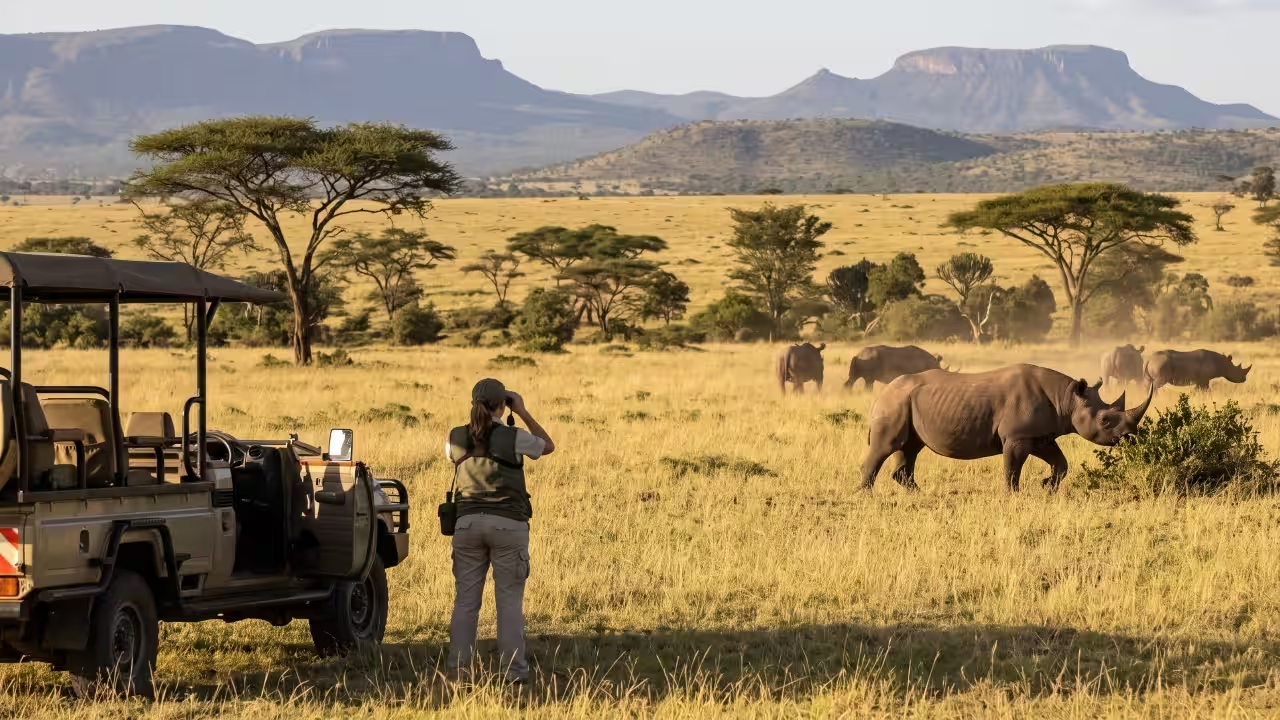
By the early 1980s Kenya's black rhinos were disappearing at a rate that would have made even the most jaded naturalist shudder. In 1970 an estimated 20,000 animals roamed the country's savannas, but continuous poaching for their horns, prized in traditional medicine markets in Asia and for dagger handles in areas of the Middle East, had reduced that number to under 400 by the time the newly formed Kenya Wildlife Service took over rhino protection in 1989, according to a population history published in Pachyderm, the journal of the African elephant, rhino and lion specialist groups. Rangers watched national parks empty of an animal that had shaped the landscape for millions of years, with many of the survivors left wandering alone in remote hills with almost no chance of finding a mate. Against that backdrop, a British woman who had planned a tranquil retirement in Kenya used her resources to gamble on a bet that would transform the course of rhino conservation in East Africa.A retirement interrupted by dead rhinosAnna Merz had already lived several lives before she turned her attention to rhinos. She travelled widely before settling in Kenya, where she and her husband planned to retire. That changed when she found the carcasses of poached rhinos, each one with its horns chopped away. Her reasoning for what came next was disarmingly simple. Explaining her decision, Merz said, "The rhinos are in Kenya, and I am in Kenya, and the rhinos are in terrible trouble," a line the sanctuary she founded still quotes today. Merz needed land safe enough to protect the remaining animals, and after being turned down several times she found willing partners in David and Delia Craig, who owned the Lewa Downs cattle ranch in the shadow of Mount Kenya.Five thousand acres became a fortress for rhinosIn 1983, the Craigs agreed to set aside 5,000 acres of their ranch for the project, with Merz funding the fencing and the guards herself, according to the Lewa Wildlife Conservancy. The result was the Ngare Sergoi Rhino Sanctuary, a tightly fortified enclosure at the western side of Lewa Downs that started life with just 15 rhinos, some of them carefully darted and trucked in from isolated, vulnerable locations nearby. Merz poured herself into the daily labour of the refuge, at one point hand-raising an orphaned black rhino calf named Samia after discovering her abandoned as a baby, an animal that stayed by Merz's side for years and became something of a local legend on the ranch. That initial handful of animals marked the beginning of what would become one of the most closely watched rhino recovery programmes in Africa.Ngare Sergoi grew into Lewa, home to hundreds of rhinosOver the following decade, Ngare Sergoi grew steadily and absorbed the remainder of the Craig ranch, and in 1995 it was formally reorganised as the Lewa Wildlife Conservancy. When Merz died in 2013, Lewa had about 70 rhinos. But barely a decade later that figure has increased to around 245 rhinos across the greater Lewa Borana environment, with the reserve now home to a sizeable share of Kenya’s total rhino population, according to Lewa’s own recent reporting. Lewa is one example of how a well-guarded sanctuary can support a species' recovery across a region, according to conservation groups working with Kenya's government. Kenya's black rhino population alone has grown from around 240 animals in 1984 to roughly 1,000 today, according to the Kenya Wildlife Service, a figure that covers black rhinos specifically and sits apart from the country's white rhinos, which bring the combined national total higher still. Merz used her savings to fence off 5,000 acres, and forty years later the sanctuary she constructed is the anchor for a landscape more than ten times that size.Catch the latest World News and Live updates. Download the TOI app.
Topics in this story
Gathered from external sources. Rights to this text belong to whoever originally published it.