Audio recordings reveal decisions made moments before deadly train crash in Spain
What we know about the deadly high-speed train crash in Spain
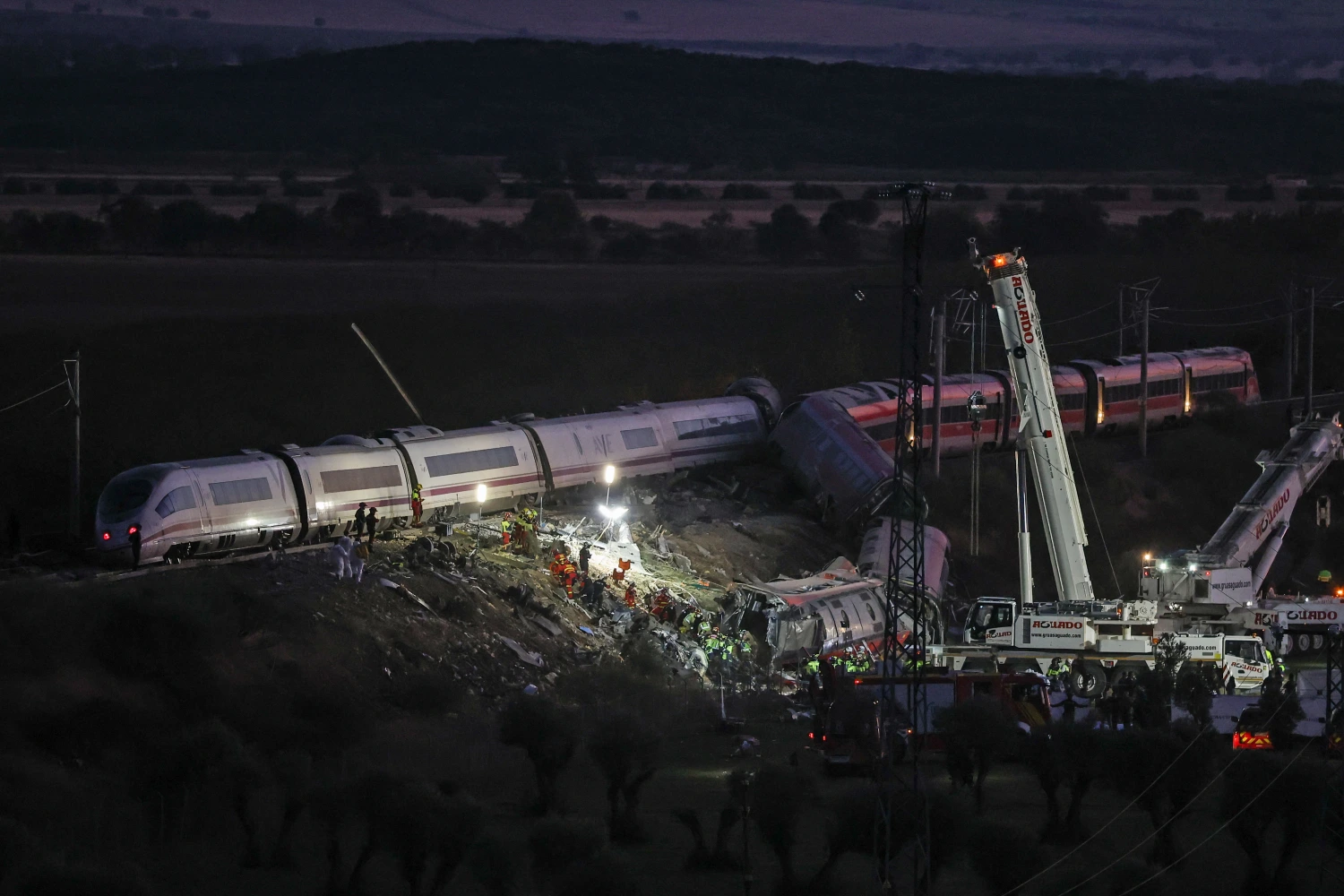
New audio obtained by Spanish media reveals that the operator of a stopped train called a control center to say she could not restart the train as another behind it sped ahead in its direction. The resulting crash of the two high-speed trains Wednesday killed at least 69 people and injured dozens more. As of Thursday, 67 passengers remained missing, according to Spanish officials. Many questions remain about the failures that led to one of Spain’s worst transportation disasters in decades and whether something could have been done to prevent it. Audio recordings of communications between the train operators and staff members at a control center in Madrid shed light on the decisions made in the minutes before the trains collided. Spain’s transportation minister, Óscar Puente, said Wednesday that a security system stopped working because of a computer malfunction, causing multiple trains on the line to stop at about 8:30 a.m. local time. With the computer system down, rail traffic was then handed over to the control center in Madrid. At about 8:36 a.m., the control center authorized a state-owned Renfe high-speed train to resume its journey, without speed limitations, even though a stationary train from the private rail company Iryo was on the tracks ahead, Puente said. An erroneous decision was made to restart the Renfe train, breaking protocol, he said. Audio obtained by Spanish media of the conversations between the operators of both trains and the control center sheds light on the series of decisions leading up to the collision at about 8:53 a.m., near the train station in Urda. NBC News has not been able to independently verify the authenticity of the audio. After the computer system went down, the control center told the Renfe train operator to resume its journey “at normal speed,” according to an audio clip. “At normal speed? OK,” the operator responded. “OK, we’ll talk later,” the controller said before signing off. Several minutes later, someone from the control center called the Iryo train to authorize it to also continue on its normal journey, according to an audio clip. The operator of the Iryo train, which was ahead of the Renfe train, called back seven minutes later to say she had been unable to restart it. “I’m still stopped at the entrance signal,” she said, according to the audio clip. The control center told her to restart the train when she could and to call back if she had further problems, according to the audio. Several minutes later, the Renfe train ran into the back of the Iryo train. The crash, the second deadly high-speed rail train collision this year in Spain, sent shock waves across the country. Until recently, the high-speed rail network was considered one of Spain’s crowning achievements. The crash came just weeks ahead of a major election in Spain, and it has led to criticism of the government and protests. In January, a separate disaster on the same rail line killed 46 people. Several days later, a commuter train near Barcelona derailed, killing the driver and injuring dozens of other people. Hundreds of emergency workers, firefighters, police officers and soldiers responded to the scene of Wednesday’s crash to rescue survivors and recover bodies. Cranes were brought in to move parts of the damaged trains later in the day. Spain has the largest high-speed rail network in Europe for trains moving at more than 155 mph, with more than 1,900 miles of track, according to the European Union. The identities of victims have begun to emerge. Fátima Báñez, a former minister, was among those killed in the collision, according to the leader of Spain’s opposition Popular Party. “She was a tireless woman, a loyal friend, and always committed to improving the lives of Spaniards,” Alberto Núñez Feijóo wrote in Spanish on social media. Antonio Acedo, the driver of one of the trains, was also killed, according to the Izquierda Española political party. “Antonio was an exceptional person, a kind, prudent, and dedicated man,” the party wrote on social media. The country is observing three days of mourning after the crash. Dirk Llorens, an American who lives in Madrid, said he and his wife were on the stopped train when, suddenly, “I was thrown just violently, just over my table.” “Then the train started sliding, and I could see that the roof had opened, and there was dust flying out of the back,” he said. People were panicking and did not know what had just happened, he said. Llorens thought the train had derailed somehow. He turned and saw that “everything was destroyed.” Llorens said that as he and his wife tried to escape from the train, he saw people who had “smashed their face” during the impact, with bloody noses and cuts on their heads spewing blood. He said that the crash occurred on a hill and that “we were all just trying to get out because we thought the train would roll on the hill and kill us.” As more injured people escaped from the train, Llorens saw a man “come out completely full of blood, and he was just sitting on a tree, just completely collapsed.” “I think people were so in shock. We were all in shock,” he said. Those who were less injured began trying to help one another, he said, adding that soon afterward, a large group of paramedics and police arrived. “You really never know what can happen in life — that makes you appreciate life but also understand that some things can happen at any time,” Llorens said. He called for transparency from the Spanish government about what happened. “The Spanish government really needs to put all their effort in making sure that something like that doesn’t ever happen again,” he said. “I don’t think I’ll take a train in Spain unless I see that they’re having big improvements in what they’re doing.”
Topics in this story
Gathered from external sources. Rights to this text belong to whoever originally published it.