In 1985, Georgia buried coal ash beneath two sections of State Route 22; monitoring found the ash bases held up well and met strength requirements
Discover how Georgia's 1985 use of coal ash in State Route 22 set a precedent in sustainable road construction, yielding impressive strength and cost benefits while addressing environmental concerns.
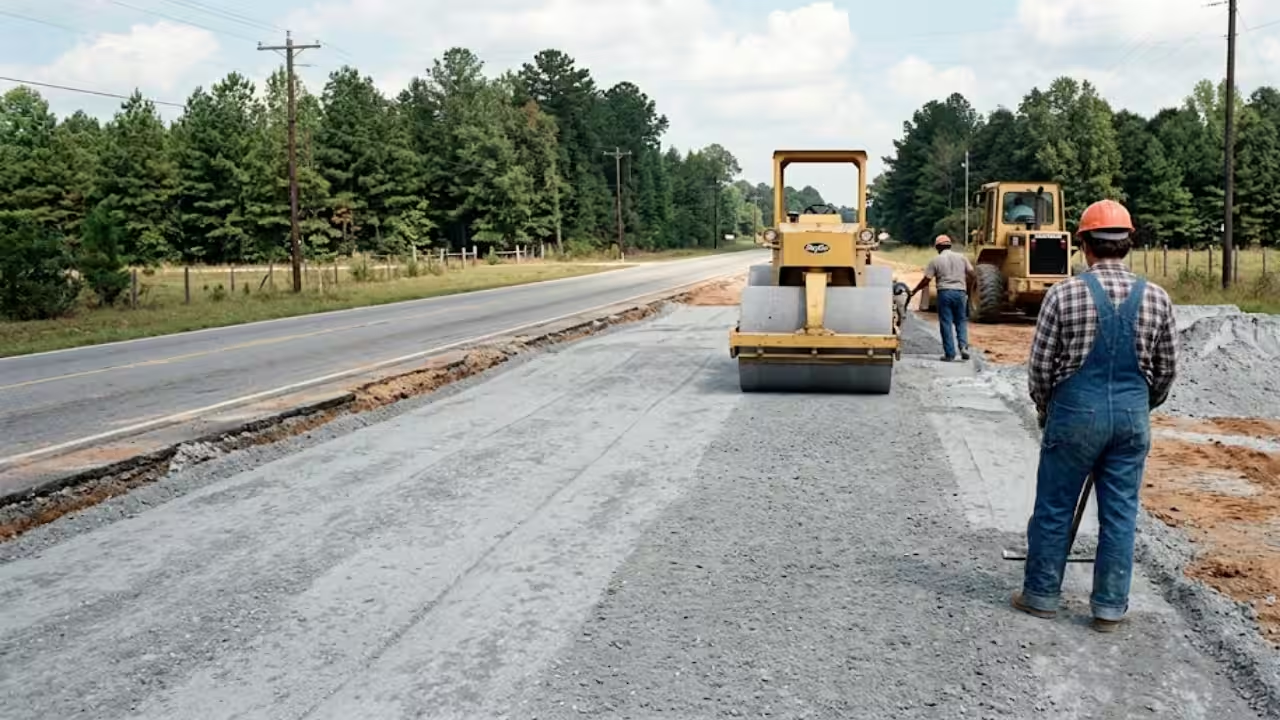
Every tonne of fly ash, a fine grey powder, or bottom ash, a coarser substance, produced when coal is burned for power generation needs to be disposed of. Georgia conducted one of the first field tests, and road builders, who require large quantities of inexpensive material, have been a clear customer for decades. In 1985, the Georgia Department of Transportation built a 2.6-kilometre relocation of State Route 22 west of Crawfordville, including a 1,000-foot cement-stabilized pond-ash base section and an 800-foot cement-stabilized fly-ash base section. Pond ash was used in one portion, which was about 305 metres (1,000 feet) long, while fly ash was used in another, which was about 244 metres (800 feet) long. Each layer was around 215 mm thick, and the strength results from the experiment indicate that it held up well.The FHWA lists the project in its user guidelines for waste and by-product materials in pavements where it is cited as a demonstration funded by the Electric Power Research Institute (EPRI). EPRI sponsored three such projects in the mid to late 1980s in Georgia, Kansas and Michigan and hired the utility that supplied the ash to check material properties, construction performance and longer-term pavement and environmental performance over three years.Why Ash was wanted by engineersAsh road bases are older than most people realise. The method dates back to the 1950s when a patented mixture of lime, fly ash and aggregate was invented. Variations on it proliferated once the patents lapsed in the early 1970s. A 1992 survey of state transport agencies showed at least 22 states have experimented with fly ash in stabilised base or subbase work, and engineers believe at least 25 to 30 million tonnes of the material have gone into American roads since the 1970s. Most were in Illinois, Ohio and Pennsylvania, with 33 to 50% of pre-1990 deposits in and around Chicago.The largest single project of its kind occurred at Newark International Airport in the early to mid-1970s. A base of lime, cement, fly ash and sand was created under runways and taxiways to support jumbo planes. The pavements were still working well after twenty years, or more. It is both economically and environmentally attractive because the ash can replace some crushed rock, hardens over time and has often produced base materials that cost less than conventional alternatives. Against that backdrop, the project provided a controlled field test of ash-based road materials.The Georgia testIt's the numbers that make them compelling. One year after installation, the pond ash portion had an average strength of 14,570 kilopascals, or about 2,115 pounds per square inch, while the fly ash section had an average strength of 5,990 kilopascals, or about 870 pounds per square inch. If you are not familiar with the word, pond ash is fly ash that has been swept into a disposal pond, often together with some bottom ash. The FHWA data show a seven-day laboratory strength of 494 pounds per square inch for the pond ash mix, above the 450-pound-per-square-inch minimum cited in the article for cement-stabilized bases.The FHWA describes the Georgia project as a demonstration, while an EPA guide says post-construction testing found negligible environmental impacts and sustainable high performance for the coal-ash base. Georgia also had earlier experience, because in the early 1980s Georgia Power built a lime stabilised bottom ash base with a thin asphalt surface near Rome, Georgia, which is described in the same terms. Early test results can also understate the eventual strength. FHWA guidance notes that Class F fly-ash mixtures can reach two to three times their seven-day strength over the longer term. None of that makes ash a free lunch, and the caveats deserve equal space.Cracks and safeguardsShrinkage cracking is a known vulnerability of cement stabilised bases. As the cement and ash react, the base contracts, and the fissures can show themselves through the asphalt above. Sealing the cracks keeps out the water and protects the layer. A 1988 Federal Highway Administration technical advisory noted that there was no commonly approved technique at the time for preventing such shrinkage cracking.And there’s the environmental matter of coal ash leaching heavy metals and salts. Federal Highway Administration, Technical Advisory, May 1988. Only a small percentage of coals produce ash with hazardous leachate. Recommended are chemical analysis and leaching tests before ash goes into an embankment, groundwater monitoring wells on both sides of the site, and a five-year evaluation of pavements using ash in bases, with cores, deflection tests, traffic counts and crack surveys. In 1987, Congress authorized a 5-percentage-point increase in the federal share for highway and bridge projects using significant amounts of coal ash, a temporary incentive that applied through 1991.The Crawfordville project showed that coal ash could serve as a road base when the material was tested, stabilized and monitored. The concerns over cracking and leaching are precisely why those initial parts were constructed as measured experiments and not just another ordinary paving project, and they are the same issues engineers currently pose whenever industrial waste is presented as a construction material.You use AI every day. Now get your AI Quotient. Take the AIQ test.
Topics in this story
Gathered from external sources. Rights to this text belong to whoever originally published it.