Drought devastation: How to save London's parched trees
Heatwaves and drought make planting native trees and maintaining the existing canopy more and more difficult.
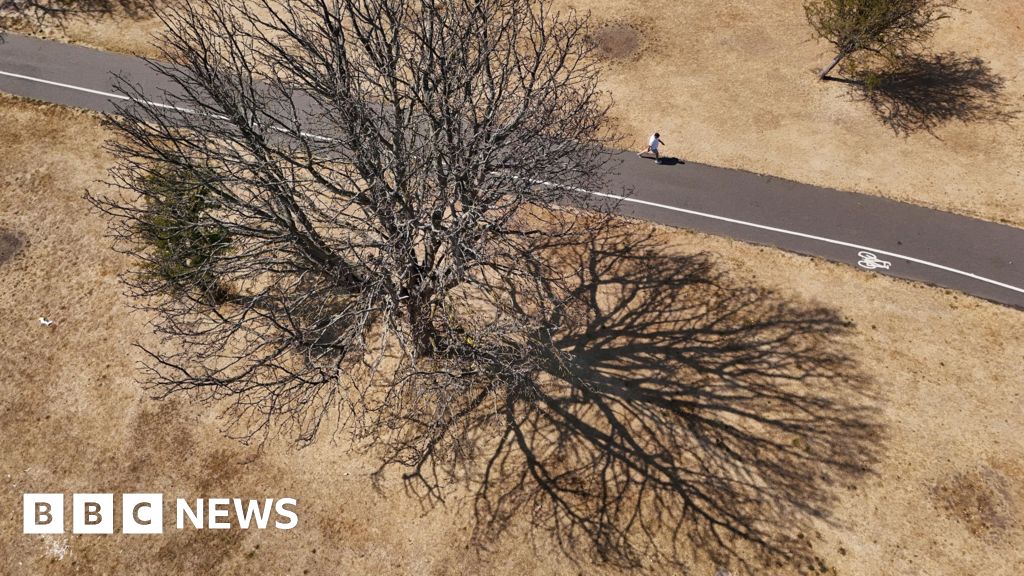
In The Closes park in West Drayton, we are surrounded by withered saplings of newly planted trees. It has been a bad summer for the capital's trees - the challenge is significant.
A recent report from the Greater London Authority (GLA) concluded that, if nothing changes, over 72% of London's current public realm tree population will struggle under future climatic conditions.
Trees are on the front line in the fight to combat man-made climate change in London.
Trees are meant to make the city more resilient. We need them for shade and protection against extreme heat.
More heatwaves and drought makes planting native trees and maintaining the existing canopy more and more difficult.
The summer may be over, but London's trees are still under threat.
Georgie Power, senior coordinator at Trees for Cities (a charity that plants thousands of trees and looks after them) has said this summer had been unlike any other she has experienced.
There has also been a wildfire in the park that has killed many of the saplings.
"Last summer was bad. I think we had three heat waves, kind of back to back, but this summer has been a different level.
"It's just been relentless. No rain for over 50 days. Every single site has struggled, and our team has really been put under massive pressure because of that."
She and her team have been trying to water more trees more frequently, and giving them more water when they do it.
"We're giving them from 50 to 60 litres, which might seem small for one tree, but for hundreds of trees, that means much more work.
"We've really worked hard to try and encourage volunteers to come in and help us with the mulching, because that's something that really saves the trees' lives."
At Chiswick House and Gardens it has also been a tough summer, involving extra watering and mulching.
Rosie Fyles, head of gardens, said many of the trees had started to drop their leaves ahead of autumn in response to the drought and heat.
"It is really reminiscent of autumn - but in fact they're dropping them because they can't support them from a water point of view any more.
"The trees that seem to be having the most difficult time are the trees that we really associate with an English garden or an English landscape.
"Trees will have their lives shortened and over time more trees will die which sounds like a terribly depressing thing to say, but I think there's only so much stress they can withstand."
The aim of the mayor of London is to increase tree canopy cover in London by 10% from 2016 levels.
But trees weakened by heat and drought are often more vulnerable to pests and diseases.
Research is now being done by the Greater London Authority into what trees are the best to plant and will be more resilient to climate change. The results should be available next spring.
CEO of Trees for Cities Kate Sheldon described the summer as "incredibly challenging" for London's trees.
"Imagine standing out here all summer yourself. We've been able to go inside or hide under the shade, and they've been withstanding prolonged heat, prolonged drought for months now. So, we're seeing a mixed reaction response in the tree species that we're planting.
"They really need a huge amount of extra help this year, and they will do for future years."
All of that puts pressure on funding and resources at the charity.
Watering: Give young trees at least 50 litres of water each week during warmer periods
Donate a drink: Support our emergency watering efforts, to help a thirsty urban tree
Sponsor a tree: There are ten London boroughs where residents c an sponsor a new tree in their neighbourhood
Encourage your friends and family to water trees too or share the message on social media.
Every litre helps. Every tree matters. Every share could inspire someone else to act.
The challenge now is working out which trees will survive in a warming London, Sheldon said: "We're working really closely with the Greater London Authority and Kew Gardens who are doing some fantastic groundbreaking research into species selection.
"We can trial different species and also species from different provinces as well that are more used to the hotter and drier effects that we've seen.
"We're going to have hotter drier summers, we're also getting warmer wetter winters.
"The real challenge comes into selecting species that are going to be able to withstand both of those changes, and that's complex."
The charity has also launched a campaign to get Londoners to help by watering trees close to them.
Workers on the ground are already replacing native species like Alder with Italian Alder which seems to be more resilient to climate change, along with Ginko and European nettle trees.
Georgie Power said she was "very, very, very nervous" about it the future.
"I've studied climate change, and I've been working in the environmental field for a while, but you know what's coming when you study climate change. We've known it for decades. But this is really the first summer where I've seen climate change on our doorstep, and it's not going anywhere."
"This is the new norm, this is going to happen again next year. So we have to figure out what our infrastructure's going to be like, how do we engage with the public?
"What do the public need to do in their own private gardens as well and in our community spaces with the trees we've planted?
"The only option we have is to adjust for the future."
Listen to the best of BBC Radio London on Sounds and follow BBC London on Facebook , X and Instagram . Send your story ideas to hello.bbclondon@bbc.co.uk
Topics in this story
Gathered from external sources. Rights to this text belong to whoever originally published it.