In 1934, a New York collector bought a Fabergé figure tied to Russia’s imperial court; nearly 80 years later it resurfaced in a family attic and sold at auction for a record $5.2 million
US News: A tiny figurine connected to Russia’s last imperial family spent nearly eight decades hidden from public view before emerging from a New York attic an.
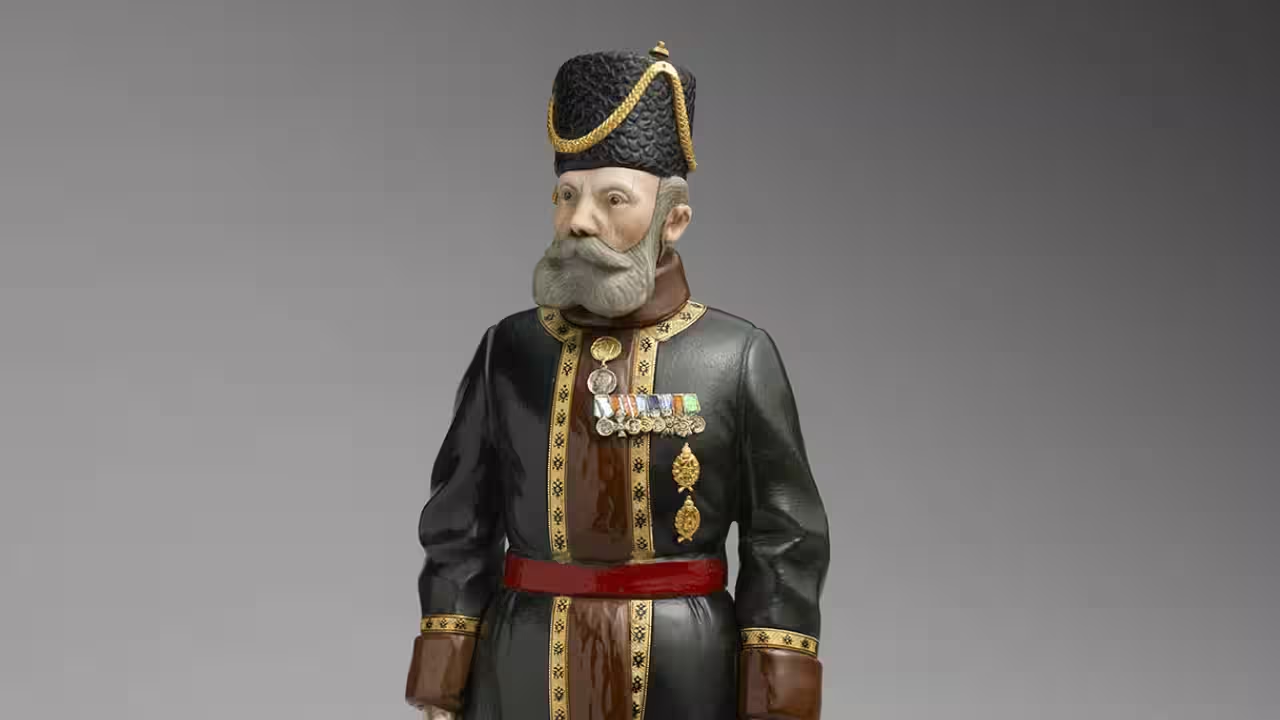
A tiny figurine connected to Russia’s last imperial family spent nearly eight decades hidden from public view before emerging from a New York attic and selling for $5.2 million at auction. The hardstone figure, created by the Fabergé workshop in 1912, depicts Nikolai N. Pustynnikov, a personal Cossack bodyguard to Empress Alexandra Feodorovna, wife of Emperor Nicholas II. It was discovered in 2013 in an attic in Rhinebeck, New York, decades after it had been purchased by an American collector in 1934.When the seven-inch figure was finally offered at Stair Galleries in Hudson, New York, on October 26, 2013, it had an estimated value of between $500,000 and $800,000. After around 15 minutes of intense bidding, however, the hammer price reached $5.2 million, setting a record for a Fabergé hardstone figure at auction at the time. Including the buyer’s commission, the total was reported at about $5.98 million.From Russia’s imperial court to a New York atticThe figure dates to the final years of the Russian Empire, when Fabergé produced highly detailed hardstone portraits of people and character types associated with imperial Russia.Pustynnikov served as a Kamer-Kazak, or Chamber Cossack, for Empress Alexandra Feodorovna. The bodyguards were non-commissioned officers taken from the Cossack regiments. Pustynnikov was born in the Cossack city of Novocherkassk, northeast of the Black Sea. He began his military service in 1876 and faithfully served Empress Alexandra from the time of her marriage to Emperor Nicholas II in 1894 until the Russian Revolution. Being appointed to attend a member of the Imperial family was a great honour and brought tremendous privileges. He was a highly esteemed servant who was closely identified with the Empress.In 1912, Emperor Nicholas II commissioned the figure of Pustynnikov for his wife, together with one of his brother's Cossacks, Andrei Kudinov, Kamer Kazak, as a gift to his mother, the Dowager Empress Maria Feodorovna. Henry Bainbridge, Fabergé’s agent in London and biographer, wrote: "The Tsar Nicholas II commissioned Fabergé to make stone models of these guards. They were to be portraits from life, the two Cossacks attending at the Fabergé studios where they were modelled in wax."Fabergé says the figure was one of an exceptionally rare group of lifelike hardstone figures that attracted the attention of Emperor Nicholas II. The company says estimates have placed the number of such figurines produced at between 60 and 80, although Tatiana Fabergé, in 'Fabergé: A Comprehensive Reference Book', considered the actual number to be considerably lower.Portrait figures showing identifiable historical people are rarer still. Fabergé notes that these works are considered comparable in rarity to the famous Imperial Easter Eggs.The Pustynnikov figure itself is particularly distinctive. The design for the figure of Pustynnikov dated 31st January 1912 is contained in the design album of Fabergé’s Chief Workmaster Henrik Wigström. Although the production of the figure was supervised by Wigström, it was probably carved by either, Derbyshev or Kremlev, the master lapidaries. Theyworked from a wax model produced by the sculptor Boris Frödman-Cluzel. According to an art-market report, the seven-inch statuette features a coat made from nephrite and jasper, with gold and enamelled orders and medals. The boots bear Cyrillic inscriptions identifying Fabergé, the year 1912 and Pustynnikov’s position as a Kamer-Kazak dating back to 1894.Nearly 80 years out of sightThe figurine had already travelled a remarkable distance before reaching the attic. After the 1917 Revolution, the Imperial family's possessions were confiscated and the two Chamber Cossack figures ended up at Pavlovsk Palace. By 1925, the Pustynnikov figure had been sold to American industrialist and art dealer Armand Hammer, who later brought it to the United States. Hammer later sold it to George H. Davis, a Fabergé collector, in New York in 1934. After that transaction, the object eventually disappeared from public view.For decades, its whereabouts remained unknown. The trail was finally picked up when the piece was found in the attic of a deceased descendant of the collector in Rhinebeck. Importantly, the discovery was accompanied by documentation, including receipts that helped establish its history and connection to the 1934 purchase. That provenance helped transform what could have appeared to be an old decorative object into an important piece of Russian imperial art.A record-breaking auctionThe discovery came at a time when Fabergé’s rare hardstone figures were already attracting major interest from collectors. The previous auction record for a hardstone figure was $1.8 million, achieved at Sotheby’s in New York in 2005 for a figure depicting a boyar.The Pustynnikov figure more than doubled that price. The $5.2 million hammer price also demonstrated the premium attached to works that combine rarity, craftsmanship and a documented connection to the Romanov court. The figure was eventually purchased by London jeweller and Russian art dealer Wartski, which has a long history of dealing in Imperial Russian works of art.What began as a forgotten object in an Upstate New York attic therefore turned out to be a surviving fragment of the final years of Imperial Russia, carrying with it a trail that stretched from Fabergé’s workshop and the imperial court to a 1934 New York sale and, nearly 80 years later, one of the most remarkable antique discoveries to reach auction.You use AI every day. Now get your AI Quotient. Take the AIQ test.
Topics in this story
Gathered from external sources. Rights to this text belong to whoever originally published it.