After Denmark dismantled the world’s first offshore wind farm in 2017, some blades were cut up and reused in roadside noise barriers
Rest of World News: Discover how Denmark repurposed dismantled offshore wind farm blades into eco-friendly noise barriers, highlighting the urgent need for sustainable solutions to impending wind turbine blade waste.
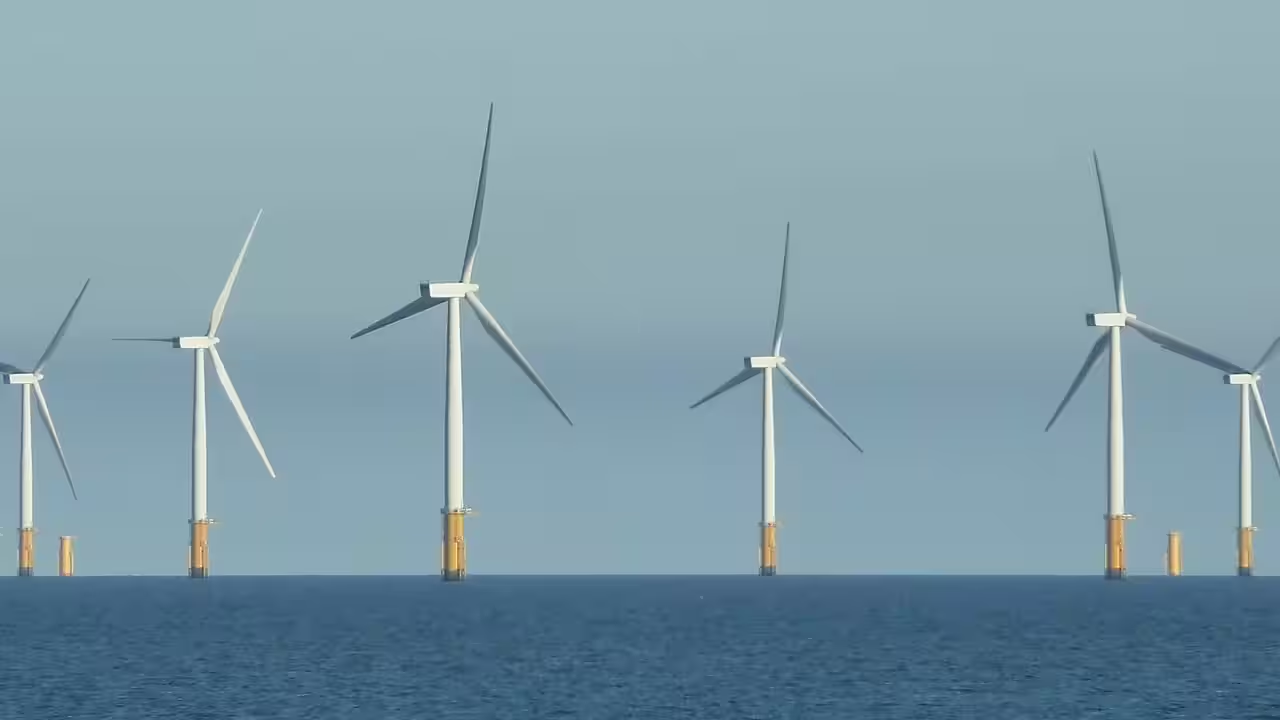
Initially, when wind turbines were built offshore, there was no strategy for disposing of them at the end of their useful life. The solution to this issue came up in 2017, when the country shut down its first offshore wind farm named Vindeby, which had been operational in the Langelandsbælt, one of the Danish straits linking the Baltic Sea to the Kattegat, near Lolland Island, for about 26 years.Vindeby's 11 turbines were decommissioned between March and September 2017The Vindeby plant began operation in 1991 off the coast of the island of Lolland. This project featured 11 turbines, each having a power of 450 kW and manufactured by Bonus Energy, which later became Siemens. Vindeby was managed by Elkraft and later by Dong Energy, which became Ørsted. By February 2017, after nearly 26 years in service, the wind farm had reached the end of its lifespan. According to Ørsted, decommissioning began that March and was completed by September, marking the retirement of the world's first offshore wind farm. Utilizing a jack-up vessel along with a mobile crane, the blades, nacelles and towers were disassembled individually, while the concrete foundations were demolished using hydraulic shears. All equipment, including cables, was brought to Nyborg Harbour for further recycling rather than direct disposal into a landfill.Miljøskærm turned shredded blades into noise barriers near AalborgOf the 33 blades stripped from the turbines at Vindeby, some have been provided for research on how decades of seawater exposure and mechanical loads have affected the composite materials of the blades, while other blades have been assigned to the novel noise barrier technology project. A second batch of blades was used in the construction of noise barrier structures; in Denmark, Miljøskærm, a company recycling turbine blades into noise-reducing materials for road barriers, has been working on such projects ever since founder Jakob W. Nielsen first encountered the blade-disposal problem in 2011, as he told State of Green in a 2017 interview.Miljøskærm describes its process as simple. The blades are reduced to granules of fibreglass that are good absorbers of road noise due to their high density. Noise barriers using the granules were constructed on the roadside, while some of the blades were returned to the supplier, LM Wind Power, for analysis.Global blade waste is projected to reach 43 million tonnes by 2050The tale of Vindeby is a neat one, but the magnitude of what is approaching is not. Fibreglass turbine blades are difficult to recycle because they are designed to withstand decades of bending and harsh weather. Pu Liu and Claire Barlow, researchers at the University of Cambridge’s Institute for Manufacturing, presented these projections in their 2017 paper, “Wind Turbine Blade Waste in 2050”, published in Waste Management. They estimated that annual blade waste could reach 2.9 million tonnes by 2050, amounting to a cumulative total of close to 43 million tonnes. In their estimation, out of the total 43 million tonnes of blade waste accumulated by 2050, China will be responsible for 40%, Europe 25%, the US 19%, while the rest of the world will constitute 16%. This is precisely why a small experiment from Denmark counts. If only a portion of these blades can be reused as noise barriers, insulation or research material, the pressure on the 43 million-ton projection will be reduced significantly.Reuse can cut a blade's environmental impact by up to 44 percentHowever, in a follow-up study conducted after two years, the same group of researchers from Cambridge has considered the fate of a blade after it stopped rotating in a paper titled "Wind turbine blade end-of-life options: An eco-audit comparison," which was published in the Journal of Cleaner Production. They concluded that reusing a blade could reduce its overall environmental footprint by 14% to 44% compared with landfill disposal. These figures align with Vindeby's example: retired blades can be reused as noise barriers or studied for what they reveal about material durability. As more wind farms from the 1990s and 2000s reach the end of their lives, the question will be how quickly others can catch up with this small Danish company.Catch the latest World News and Live updates. Download the TOI app.
Topics in this story
Gathered from external sources. Rights to this text belong to whoever originally published it.