Japan removed 1.5 million cubic metres of mercury-tainted sediment from Minamata Bay, but decades later the mercury remains buried beneath reclaimed land
Rest of World News: Japan’s most infamous mercury disaster left behind an unusual environmental legacy, instead of destroying the contamination, engineers dredged it from.
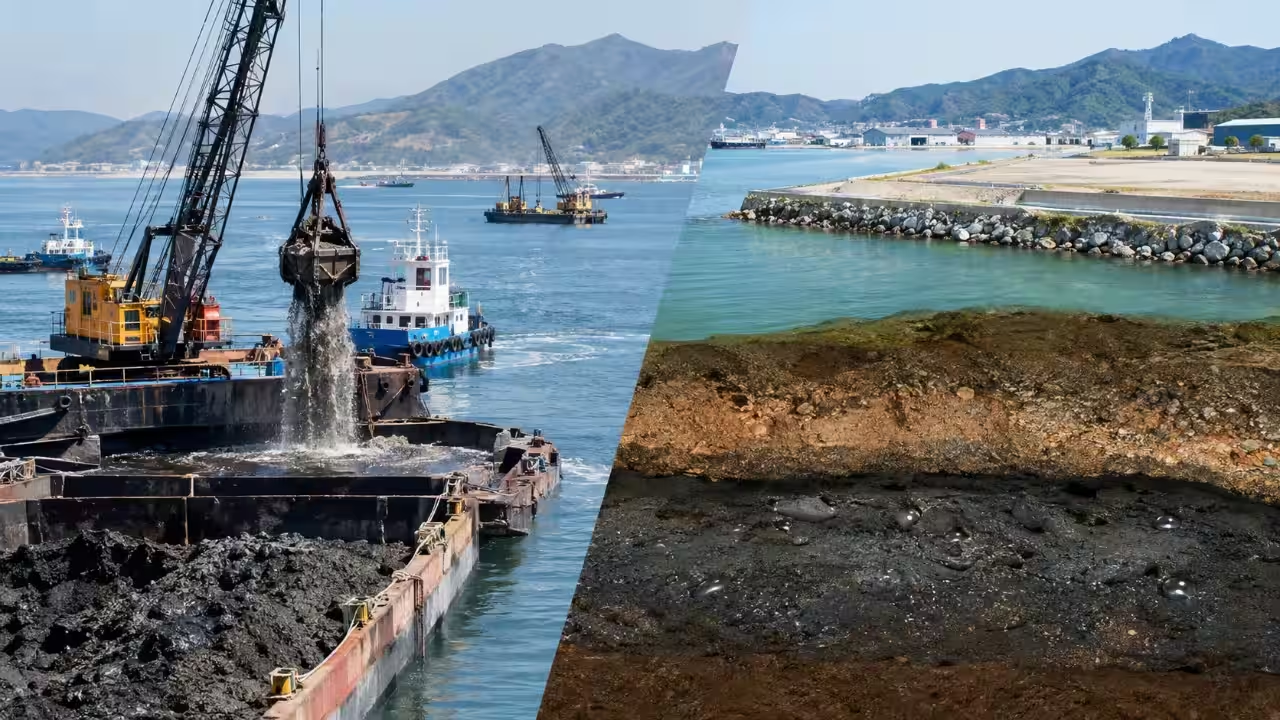
Japan’s most infamous mercury disaster left behind an unusual environmental legacy, instead of destroying the contamination, engineers dredged it from the seabed and sealed it beneath newly reclaimed land. From 1974 to 1990, Kumamoto Prefecture dealt with about 1.5 million cubic metres of Minamata Bay sediment containing more than 25 parts per million of mercury. The project created a 58-hectare landfill at a cost of about ¥48.5 billion. Decades later, the reclaimed ground has become a public park, but the mercury itself remains buried beneath it.Minamata Bay carried the legacy of a mercury disasterMinamata disease was officially identified in 1956 after people around Minamata Bay began suffering severe neurological symptoms. The Japanese government concluded in 1968 that the disease was caused by eating fish and shellfish contaminated with methylmercury discharged by Chisso Corporation. The company's factory had used mercury as a catalyst in acetaldehyde production, with methylmercury forming as a by-product and entering the bay through wastewater.Stopping the discharge did not remove what had already accumulated. Mercury-containing sediment remained on the floor of the bay, where it could continue to affect marine life. The National Institute for Minamata Disease estimates that nearly 150 tons of mercury had accumulated in the seabed before the dredging and landfill operation began. Much of the mercury in the sludge was believed to have been present as inorganic mercury, including mercury sulfide.Japan removed sediment containing more than 25 ppm mercuryAfter the discharge of methylmercury was stopped, a major problem remained beneath Minamata Bay, large quantities of contaminated sediment still held mercury at potentially dangerous concentrations. Japan therefore set a provisional removal standard of 25 ppm total mercury and launched a huge dredging and landfill project to remove sediment exceeding that level.According to the Ministry of the Environment, Government of Japan, Kumamoto Prefecture carried out the project from 1974 to 1990, dealing with about 1.5 million cubic metres of bottom sediment containing mercury above the 25 ppm removal standard. The material was dredged from the bay and placed in a controlled landfill, creating approximately 58 hectares of reclaimed land. The total project cost was recorded at ¥48 billion, of which the responsible company, Chisso, bore ¥30.5 billion.The scale of the operation was extraordinary. Government records put the total treated sediment at roughly 1.51 million cubic metres, while the reclaimed landfill covered about 582,000 square metres. Rather than attempting to eliminate the mercury itself, Japan's strategy was to remove the contaminated material from the marine environment and isolate it on land.The contaminated sludge was sealed rather than destroyedThe Minamata cleanup was ultimately a massive containment project. Mercury is an element and cannot simply be destroyed through ordinary environmental treatment, so the immediate goal was to prevent mercury-laden sediment from remaining in contact with the bay's ecosystem.Dredging therefore transferred the contamination from the seabed into a controlled landfill. The Ministry of the Environment records that about 1.5 million cubic metres of sediment were handled through dredging and landfill between 1974 and 1990. The reclaimed area effectively became a permanent physical repository for material that had once formed part of the bay floor.The project also had to be considered alongside restrictions on fishing and seafood consumption that had continued for decades. According to the ministry, restrictions on taking fish and shellfish from Minamata Bay remained in place, with interruptions, until October 1997, when the dividing nets in the bay were completely removed.The reclaimed land later became associated with Eco Park Minamata, transforming part of the former bay into public land while leaving the contaminated sediment contained beneath it.Minamata Bay eventually reopened to fishingRemoving the sediment was only part of the recovery. Japan continued monitoring fish, shellfish, water and bottom sediment to track whether mercury contamination remained at levels capable of causing further exposure.The Ministry of the Environment notes that Japan's provisional regulatory standard for fish was 0.4 ppm for total mercury and 0.3 ppm for methylmercury. Monitoring of methylmercury concentrations in fish and shellfish around Minamata Bay continues.The restrictions on fishing were eventually lifted in 1997. In October of that year, the dividing nets that had separated the contaminated area from the rest of the bay were completely removed. This followed years of monitoring and marked a major step in restoring the bay to normal use.Yet the reopening did not mean that the historical mercury contamination had disappeared. Instead, a substantial portion of the pollution had been physically relocated from the seabed into an engineered landmass.The landfill leaves a question for the futureMinamata's cleanup illustrates the complicated nature of dealing with persistent pollutants. Japan succeeded in removing vast quantities of mercury-contaminated sediment from the marine environment and preventing it from continuing to circulate through the bay. But the mercury itself was not destroyed. It was contained, that distinction matters.The reclaimed land therefore became a lasting part of Minamata's environmental legacy. What had once been contamination spread across the bay floor was concentrated into a defined area that could be monitored and managed. The approach helped make the bay usable again, but it also meant that future generations would inherit responsibility for the site.Catch the latest World News and Live updates. Download the TOI app.
Topics in this story
Gathered from external sources. Rights to this text belong to whoever originally published it.