Olusola Olonade: Meet the Nigerian woman who became first-time mother at 50, welcoming quadruplets: ‘I never knew I would have four at once’
For a lot of women, there’s a ticking clock attached to marriage and motherhood: it’s a sense that if you don’t follow the schedule everyone expects,
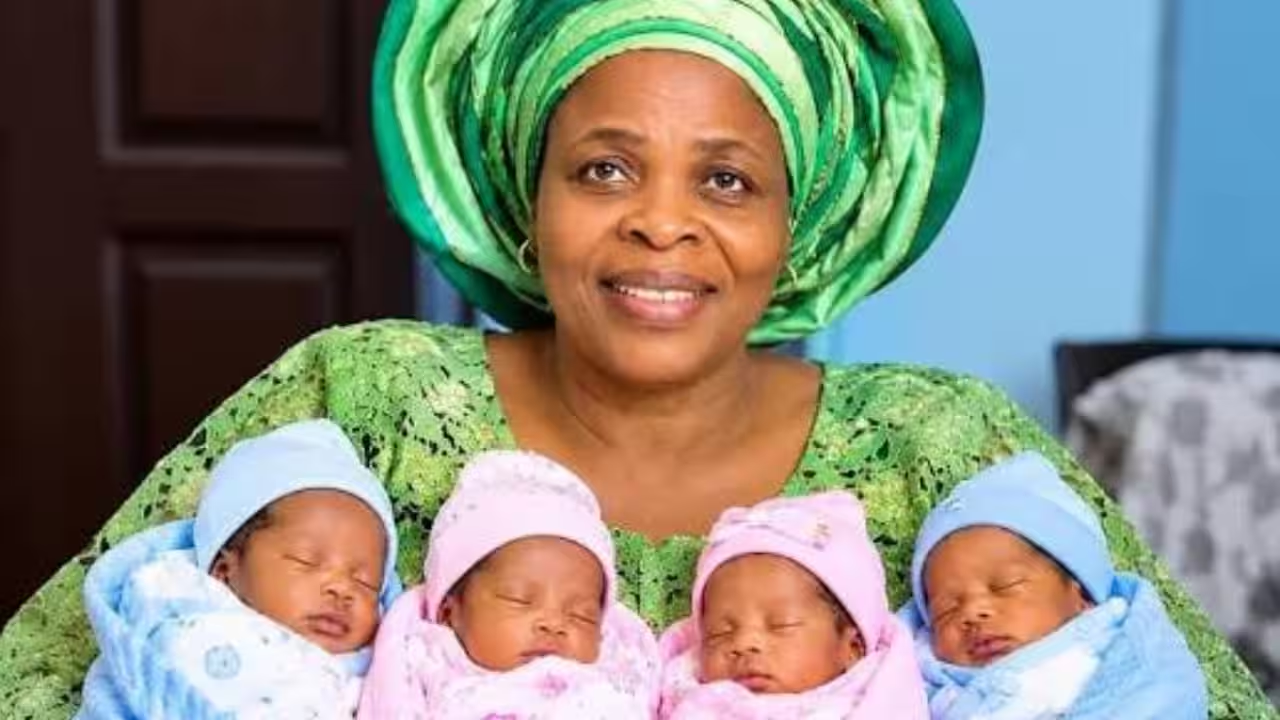
For a lot of women, there’s a ticking clock attached to marriage and motherhood: it’s a sense that if you don’t follow the schedule everyone expects, you’re falling behind. That’s why Olusola Olonade’s story lands with such force. She turned her own life’s timeline upside down, getting married at 48 and, just as she was about to turn 50, becoming a mother for the first time — not to one baby, but to four.“I gave birth at the age of 50, but I didn’t expect four children at once,” she told BBC Africa. She sounded both stunned and amused by what had transpired. Her journey hasn’t just captured the attention of people online for the sheer novelty of quadruplets. It’s resonated because it’s about asking for more out of life when everyone else assumes your window of opportunity has closed. Her story winds through the worlds of faith, modern fertility medicine, the unpredictability of biology, and an unwavering belief that life can still surprise you, even in your fifties.Olusola delivered her quadruplets — two girls, two boys — on March 6, 2026, about three weeks shy of her 50th birthday. This wasn’t some improbable accident, either; she conceived through IVF, a procedure that involves fertilising the egg outside the body before transferring the embryo back into the uterus. If her journey to marriage had been long, her wait for motherhood felt turbocharged. When she and her husband decided they wanted children, she pushed forward. “I’ve waited for a husband, I don’t want to wait for children,” she remembers thinking. And she didn’t.Olusola Olonade: Who is she?By her own account, Olonade (born Olusola Adeniji) never spent much time worrying she would remain childless. She had faith in God’s promise, in her husband’s family history (which she’d researched carefully), and, crucially, in the science she trusted to help her. She also knew there were no guarantees; she’d seen women younger than her try IVF multiple times, only to be left disappointed. She knew this could’ve ended differently, maybe with an empty nursery rather than four squirming babies.But instead, her path turned almost comically unexpected. At her first ultrasound, the doctor said twins. Later, someone else spotted triplets. On another visit, quadruplets. At that point, she joked she wouldn’t be coming in for any more scans: what if they found a fifth? The confusion didn’t just make for a good story. It captured something real about pregnancy, especially one brought about by fertility treatments. Multiple embryos, split-second readings, constantly shifting counts — it really can turn into a guessing game. Through it all, Olonade’s amazement kept rising. By the time she went into labour, she clung to hope that her four would all make it to birth safely.Finally, on March 6, she made it: two boys and two girls. She marked the occasion, not just privately but in the company of her community, offering thanks at church, holding her four babies, her faith and her happiness out for everyone to see. The joy was unmistakable, but so was a sense of groundedness. She knows how rare this outcome is. IVF is remarkable, yes, but it’s not a guarantee. She’s said so herself: sometimes, it just doesn’t work, even after multiple tries.What are the risks of pregnancy with quadruplets at 50?As for the medical side of things, quadruplet pregnancies are never simple, and having babies at 50 brings another layer of complexity. The risks run higher: preterm labour, low birth weights, complications for the mother, a greater need for medical intervention, and constant monitoring along the way. None of that was lost on Olonade’s doctors: more scans, more specialists, and preparations for whatever might happen. She hasn’t disclosed the details of her babies’ births, like their weights or whether they spent time in neonatal care, but she’s said the delivery was safe. For her and her husband, that’s clearly the headline.Notably, the American College of Obstetricians and Gynecologists (ACOG) agrees that IVF can result in multiple pregnancies, particularly when more than one embryo is transferred. It also explains that the likelihood of multiple pregnancy can be higher among older women. The Society for Maternal-Fetal Medicine recommends careful monitoring of pregnancies achieved through IVF because of the additional risks that may be involved.Olonade’s story is not just about the birth, though. It’s also about what comes after, about building a life that’s equal parts chaos and deep gratitude. Olonade describes her husband as someone who steps in fully, even pulling night shifts with the babies so she can rest. He sees her as the answer to a prayer for peace and companionship. Their late-in-life marriage, now bolstered by the chaos of four young children, seems to have helped them find the kind of partnership they both wanted.Olusola Olonade’s life now: ‘I want to live to become a great-grandmother’You get the sense from Olonade that she’s looking far beyond the early months of diapers and feedings. She talks openly about her wish, not just to see her children grow, but to watch them become parents themselves, maybe even to become a great-grandmother. There’s a defiance in the way she describes her hopes. She points to other women who, through sheer resilience, have lived to see generation after generation. Why not me, she seems to say.That’s a big part of why Olonade’s story lingers for so many people. She’s not just defying the logic of biology; she’s defying the expectations society presses down on women: about age, fertility, marriage, and what’s “supposed” to be possible after a certain point. She’s proof that the journey to family can wind in unpredictable directions, that there are second acts (and third, and fourth), and that sometimes, when you stop believing the timeline matters, life brings you something you never expected, or, in Olusola’s case, four somethings at once!You use AI every day. Now get your AI Quotient. Take the AIQ testGet the latest Lifestyle News and more. Download the TOI app.
Topics in this story
Gathered from external sources. Rights to this text belong to whoever originally published it.