New York men cut 4 trees on neighbour’s land after being warned about property line, then face $35,000 court award
A property-line dispute in New York escalated into a court battle after two men entered a neighbour’s land and removed trees and vegetation despite being
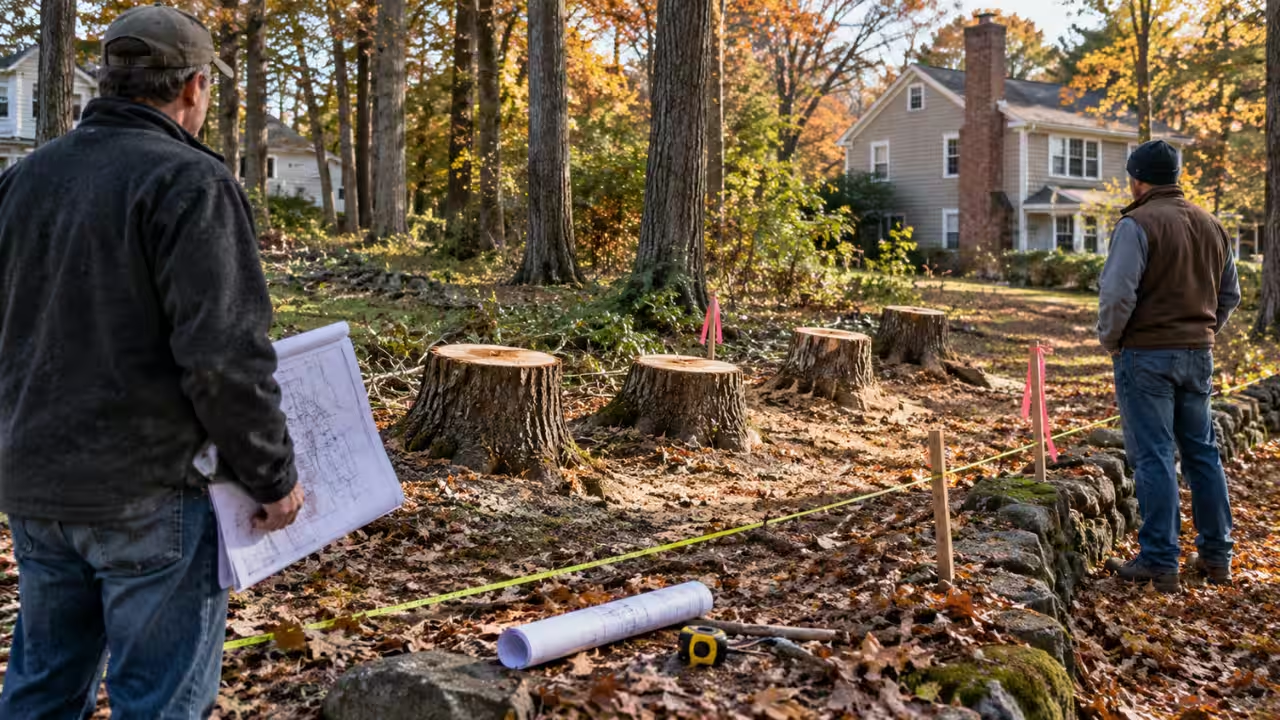
A property-line dispute in New York escalated into a court battle after two men entered a neighbour’s land and removed trees and vegetation despite being shown a survey identifying the disputed boundary. Nicholas Howard and Micah Geraghty were involved in the October 2021 incident in Columbia County, where four trees on Elaine Storms’ property were removed. Storms had previously shown the men a survey indicating where she believed the property line stood, and another neighbour later confirmed the same boundary. Despite that, the men returned about two weeks later and partially cleared the area. A jury initially awarded $55,000 in punitive damages, but the amount was later reduced and ultimately restored in part by an appeals court.New York's property-line dispute escalatesThe dispute began after Howard purchased property next to Storms’ land in June 2021. By October, the parties were arguing over the location of the boundary between the properties. During a heated disagreement on October 11, Storms showed Howard and Geraghty a survey that placed the property line where she said it was. The men later spoke with another neighbour, who also confirmed the boundary.According to the evidence described by the Appellate Division, the men nevertheless returned roughly two weeks later. They used equipment to partially clear a lot they still incorrectly believed belonged to Howard, without first taking steps to independently establish the correct property line. The clearing resulted in the removal of trees and vegetation from Storms’ property.Four trees were removedStorms subsequently sued, alleging trespass, damage to real property under New York’s Real Property Actions and Proceedings Law and seeking to establish ownership of the disputed portion of land.At trial, the jury found that Howard and Geraghty had entered Storms’ property without permission. It also specifically found that four trees had been cut, removed, injured or destroyed without Storms’ permission, or that the defendants had caused this to happen.The jury awarded $3,000 against each defendant under the state law relating to damage to trees, with the money intended to cover restoration costs. The court record said the restoration estimate presented at trial was $14,330, potentially rising to $20,330 if additional drainage work was required.Storms said the damage went beyond the treesThe case involved more than the loss of four trees. Storms testified that the clearing affected drainage on her property and removed tree cover and vegetation that had provided privacy.She presented evidence that estimated the property’s value had fallen from $335,000 to $285,000 following the defendants’ actions. She also said the incident caused her stress and aggravation.However, despite finding that Storms had suffered actual damage from the trespass, the jury awarded $0 in compensatory damages on the trespass claim. Instead, it found that the defendants’ conduct was wanton and reckless or malicious and awarded punitive damages of $40,000 against Geraghty and $15,000 against Howard.Judge cuts $55,000 punitive award to just $6The case then took an unusual turn. Because the jury had awarded no compensatory damages for the trespass claim, the trial court modified the verdict by awarding $1 in nominal damages against each defendant.It then reduced the punitive damages from $40,000 against Geraghty and $15,000 against Howard to just $3 against each man. The court concluded that the original punitive awards were excessive under constitutional due-process standards because they were vastly greater than the nominal compensatory damages.That left the defendants with a combined judgment of $8,008, including other damages connected to the tree-removal claim.Appeals court restores $35,000Storms appealed, arguing that reducing the punitive damages to $3 each effectively stripped the punishment of any meaningful effect.On May 14, 2026, New York’s Appellate Division, Third Department agreed that the original $55,000 punitive award was excessive, but it also concluded that the trial court had gone too far in reducing the amount to what it described as a token sum.The appeals court noted that the defendants had been given information about the property boundary before returning to clear the land. It also said their actions involved aggravating circumstances, including failing to make further efforts to establish the boundary and intentionally interfering with Storms’ property rights.The court ultimately set punitive damages at $25,000 against Geraghty and $10,000 against Howard, for a combined $35,000.Court says $3 each would not deter future misconductThe appeals court explained that punitive damages are intended not only to punish wrongful conduct but also to deter similar behaviour in the future. It said requiring each defendant to pay only $3 would not meaningfully accomplish either purpose.The court also pointed to New York’s tree-protection law, which permits statutory damages for the unauthorised cutting or destruction of trees. Under the relevant provision, the statute allows damages based on the tree’s value or a specified amount per tree, along with compensation for permanent and substantial damage to land or improvements.Final rulingThe Appellate Division therefore modified the judgments, increasing the punitive damages to $25,000 against Geraghty and $10,000 against Howard while otherwise affirming the judgments.The case is notable because a dispute involving just four trees produced a complicated legal battle over property boundaries, trespass, punitive damages and constitutional limits on civil penalties. The final $35,000 punitive award was substantially lower than the jury’s original $55,000 award, but far higher than the $6 imposed by the trial court.You use AI every day. Now get your AI Quotient. Take the AIQ test.
Topics in this story
Gathered from external sources. Rights to this text belong to whoever originally published it.