Museum of Chelmsford taxidermy bear helps tackle wildlife crime
Hayden Leigh, a forensic science graduate, is studying the hair of Boris the bear.
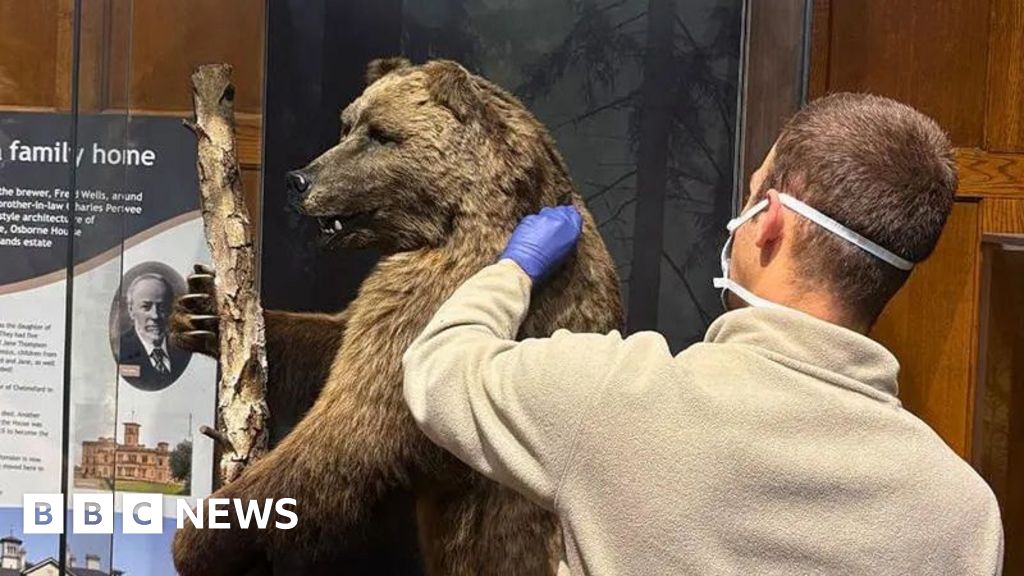
A student has been using hair from a 120-year-old museum exhibit to help find new ways of solving wildlife crime.
The taxidermy bear, known as Boris, is a popular feature at the Museum of Chelmsford and is regarded as its unofficial mascot.
Hayden Leigh, a forensic science graduate at the University of Staffordshire, is using samples taken from his hair to help protect modern-day brown bears from illegal poaching.
His PhD research involves analysing Boris's fur to compare how its characteristics could improve identification of animal hairs during investigations.
Boris arrived at the museum in 1932 amongst a large collection of taxidermy bequeathed by a local game hunter.
Leigh said in the wild the animals were mostly found in places like Romania and Bulgaria as well as Russia.
He said he had been using a microscope to analyse the cuticles, and different layers of the bear's fur as well as its DNA.
Leigh had previously approached about 30 zoos and museums for help with the project before the Museum of Chelmsford said they would lend a hand.
"There's been hundreds of studies done on dog hairs and cat hairs and general domestic animals, and I thought, well, let's make a wider impact than on the wider wildlife crime investigations," he said.
By developing more a cost-effective and reliable alternative to DNA analysis, the aim is to help tackle the illegal poaching and trafficking of wildlife.
"Taxidermy samples from museums can play a valuable role in the research of animal hair within a forensic context, Leigh added.
"They are often far more accessible than obtaining hair from live animals.
"In my project, I examined Boris's hair at a microscopic level, assessing the characteristics of the hairs and investigating whether there was any variation across different areas of the body."
Having access to a preserved specimen had also meant an opportunity to examine authentic animal hair in a controlled and ethical way, he said, without needing to disturb a live animal.
Councillor Jennie Lardge, cabinet member for culture and leisure at Chelmsford City Council, acknowledged that taxidermy was often considered a controversial part of museum collections, but said it was "wonderful" that Boris' legacy would be to help protect other animals from illegal hunting.
"It highlights the scientific value of historic taxidermy collections in museums in 2026, and we are delighted that the Museum of Chelmsford has been able to support this important project," she said.
Follow BBC Stoke & Staffordshire on BBC Sounds , Facebook , X and Instagram .
Tiny wild cat settles in at custom enclosure
Heathland plan to support two rare species of ant
Barn loft transformed to support bat colony
Topics in this story
Gathered from external sources. Rights to this text belong to whoever originally published it.