Drumcree dispute: More talks taking place at Hillsborough
Northern Ireland Secretary Sir Chris Bryant is holding further talks with community leaders over the controversial Drumcree march.
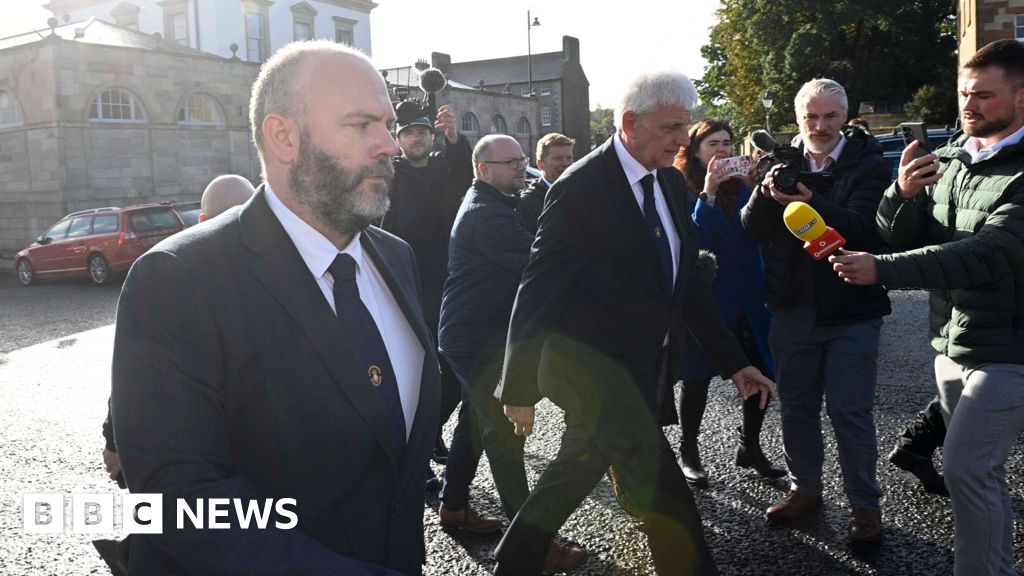
Northern Ireland Secretary Sir Chris Bryant is holding further talks with community leaders on Wednesday over the controversial Drumcree march.
It comes after lawyers for the Garvaghy Road Residents Coalition issued a fresh legal bid to try to prevent the march from going ahead.
Members of the Orange Order are still waiting to begin their permitted parade, which was due to take place on Sunday, and walk down the mainly-nationalist Garvaghy Road in Portadown.
The residents' appeal will be the latest challenge to the march, which was given the go ahead after three separate legal hearings over the course of 13 hours late on Saturday and into the early hours of Sunday morning.
Wednesday's talks at Hillsborough Castle took place in an upstairs room which, under normal circumstances, is used as a sitting room.
The Garvaghy Road Residents' Coalition and the Portadown Orange Order waited in separate rooms before going upstairs for talks.
What is the Garvaghy Road dispute all about?
Parading, policing and power sharing collide amid Drumcree dispute
Drumcree parade resolution not going to be easy - NI secretary
Senior members from the Orange Order, including Portadown District Master Nigel Dawson and Deputy District Master Alastair Power, met the secretary of state.
They were accompanied by loyalist activist Jamie Bryson, who has acted as an adviser for the lodge.
Speaking after their meeting, Dawson said the contents of the meetings remained "confidential".
But he added that the secretary of state had been left "in no doubt" that the Orange Order's position continued to be that he and the chief constable must apply the law to allow the march to take place.
Bryson was asked about what had happened and said while he did not want to speak for the Orange Order, "if the law is not applied how can the executive possibly survive?"
It is understood Bryson has not been part of the discussions with Sir Chris and has been waiting in a separate room.
Members of the Garvaghy Road Residents' Coalition, including Breandán Mac Cionnaith, also arrived to Hillsborough Castle on Wednesday morning.
Mac Cionnaith said little on the way in, and did not respond to a suggestion that he'd told residents last night that mediation was "dead in the water" .
When asked what his message would be to Sir Chris, he replied: "I think you know that."
The discussions are a form of proximity talks, with the two sides not meeting face-to-face but both being under the same roof.
Wednesday's discussions are the third day in a row that Hillsborough talks have taken place.
Dozens of protesters remain at the Garvaghy Road on Wednesday.
Paul and Charlie told BBC News NI that they have camped out for nearly 24 hours.
They said they were relieved to see the sun come out today after the "wild" weather overnight that saw the protest site battered by wind and rain.
Members of the Orange Order left Drumcree Church overnight - the first time since the standoff began. It's understood they left on health and safety reasons due to the adverse weather.
However, a small crowd returned this morning, where they continue to wait for news from the talks at Hillsborough.
There was another attempt by Portadown District Lodge to walk the route at 22:10 BST on Tuesday.
Accompanied by DUP MP Carla Lockhart, Power asked the police if they could facilitate their parade. The answer was no.
The Drumcree parade, which in the 1990s sparked some of the most serious disorder in Northern Ireland's history, was due to go ahead on Sunday for the first time in almost 30 years after a series of legal challenges.
Since 1998, the Orange Order had been banned from completing its Drumcree march - and until this year had been repeatedly refused permission to finish the route by the Parades Commission, which was set up to adjudicate disputes.
The Orange Order is a Protestant pro-British organisation, while the area where it wants to walk - specifically along the Garvaghy Road - is largely Catholic and predominantly inhabited by pro-Irish nationalists.
Both the Orange Order and members of the Garvaghy Road Residents' Coalition also met Northern Ireland Secretary Sir Chris Bryant at Hillsborough Castle on Tuesday.
Speaking on his way into the talks, Breandán Mac Cionnaith, from the Garvaghy Road Residents' Coalition, said "reroute the sectarian parade, that's it".
Speaking after a separate meeting with the secretary of state, Portadown District Master Nigel Dawson said the talks had been "positive and constructive".
Later, hundreds of people attended a meeting beside St John the Baptist Church on the Garvaghy Road for an update on the talks process.
Speaking to the media outside the hall, Mac Cionnaith said the only person the residents had left to meet was PSNI Chief Constable Jon Boutcher.
He said he will be waiting for Boutcher to let him know when the meeting would happen, adding: "Or is he going to hide behind a wall of uniforms of police in riot gear?"
Meanwhile, the Portadown district master told hundreds of supporters at an outdoor rally in the town that unionist leaders needed to keep pressure on the secretary of state and chief constable and that the law must be "respected and applied".
Nigel Dawson said: "Tonight, my position, our position, is very, very clear. The chief constable, who is responsible for ensuring the law is complied in this country, must apply the law.
"He must respect the High Court judgement and he must deliver us safely and securely back to Carleton Street Orange Hall via the Garvaghy Road because that's what the Parade's Commission said and that is what a High Court has said.
Sinn Féin have called on the Irish government to intervene in the dispute.
The Orange Order, the most prominent of the loyal orders associated with Protestants in Northern Ireland, holds thousands of parades every year and the vast majority pass off without incident.
However, many Catholics see the marches as sectarian and object to them passing through, or close to, Catholic or nationalist areas.
The Garvaghy Road had been part of the Drumcree route, but by the mid 1990s nationalist residents protested against the parade. The row sparked some of the most serious public disorder in Northern Ireland's history and was linked to several murders.
The Drumcree dispute was one of Northern Ireland's most serious parading disputes during the 1990s, when stand-offs over attempts by the Orange Order to march along the Garvaghy Road were accompanied by riots, roadblocks and killings.
When the Orange Order was prevented by police from walking down the route in July 1995, there was a tense stand-off. It was the same for the next three years.
Violence related to the dispute resulted in riots, roadblocks and murders across Northern Ireland.
In 1998, the newly-established Parades Commission ruled that the Orange Order should not march down the road - a decision upheld for the last 28 years.
The row reemerged last month after a court case in which a ruling by the Parades Commission was overturned, and a fresh application was lodged.
On Friday, the commission decided the march could go ahead with restrictions in place. However that decision was challenged in several Belfast courts on Saturday, before finally being given the go ahead just hours before it was due to take place .
Police block Orange Order from controversial parade route
Protesters disperse after blocking contentious Orange Order parade
Orange Order march row goes to heart of ongoing divisions in Northern Ireland
Topics in this story
Gathered from external sources. Rights to this text belong to whoever originally published it.