US passport rules may change: Parents could need to prove citizenship status for children
US News: The US state department may require parents to provide proof of their own citizenship or immigration status when applying for passports for their chil.
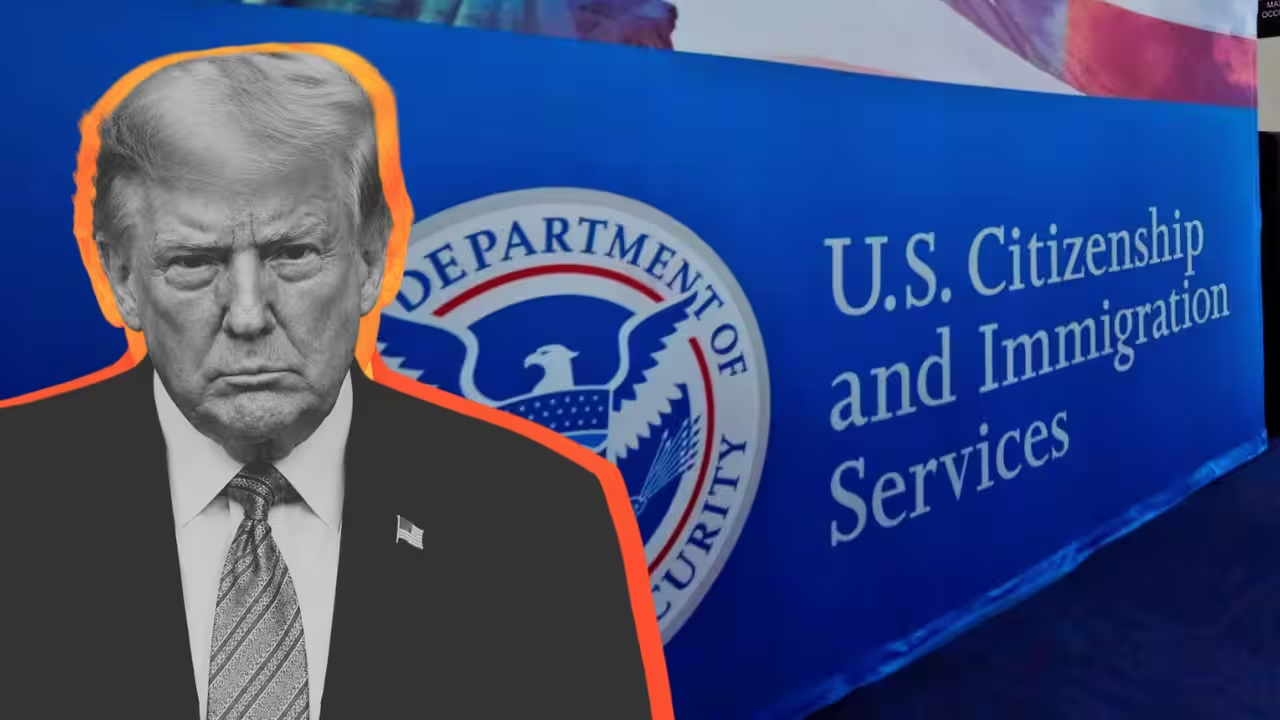
The US state department may require parents to provide proof of their own citizenship or immigration status when applying for passports for their children. The latest draft is proposed amid US President Donald Trump's push to restrict birthright citizenship.According to a report by Reuters, the draft guidance outlines how the department could implement Trump’s August 6 executive order targeting so-called “birth tourism”. This targets foreign nationals travelling to the US to give birth so their children can obtain American citizenship. The proposal would require parents or legal guardians to submit documents proving their citizenship or immigration status as part of their child’s passport application.“The Department will require parental information and evidence of parental citizenship or immigration status as part of its determination whether the applicant is subject to EO 14418,” the state department draft guidance reads, referring to the executive order.Under the proposed rules, parents could be asked to provide evidence such as a valid US passport or birth certificate to establish citizenship, or documents including an I-94 form or permanent residency card to establish immigration status. The information would be used to determine whether the child is eligible for US citizenship under the order.Currently, parents applying for a passport for a child born in the US are required to establish their relationship with the child and provide photo identification. Although the application asks whether a parent is a US citizen, supporting proof of the parent’s citizenship is not generally required as part of that process.The proposal comes as Trump intensifies his efforts to narrow the circumstances in which children born in the US can automatically acquire citizenship. His administration has argued that existing rules have encouraged birth tourism and other forms of what it considers abuse of the citizenship system.In a statement, state department spokesman Tommy Pigott said, “President Trump has been unequivocal that this administration will protect the meaning and value of American citizenship, full stop, and that includes making sure our passport adjudication process fully reflects that standard."Trump's first executive order on birthright citizenship sought to limit automatic citizenship to children born in the US who had at least one parent who was an American citizen or a lawful permanent resident, commonly known as a green card holder.The US Supreme Court later ruled that the order was unlawful, with a 6-3 majority finding that it violated the Citizenship Clause of the 14th Amendment to the US Constitution.Trump's August 6 order is narrower and specifically targets categories including children whose parents are foreign government employees, are allegedly involved in fraud or a commercial transaction to obtain citizenship, or are classified as an “alien enemy”. The order could still face legal challenges.Lawyers representing babies who could be denied citizenship under Trump's earlier order have already filed class-action lawsuits seeking to stop the administration's latest directive. One such case is before US District Judge Deborah Boardman in Greenbelt, Maryland.At a hearing on Friday, Boardman expressed scepticism about what she described as Trump's unprecedented order and allowed the plaintiffs to amend their lawsuit so that she could consider whether to block its implementation.Justice Department lawyers have argued that a restraining order would be inappropriate and that the legal challenge is premature because federal agencies had not yet issued public guidance on how the executive order would be enforced.Catch the latest World News and Live updates. Download the TOI app.
Topics in this story
Gathered from external sources. Rights to this text belong to whoever originally published it.