In 2009–12, South Carolina turned 285 abandoned crab traps into oyster-reef bases; oysters grew within 7 months on experimental reefs
Discover how South Carolina is repurposing abandoned crab traps into effective oyster-reef bases, enhancing coastal ecosystems and preventing habitat loss in just months.
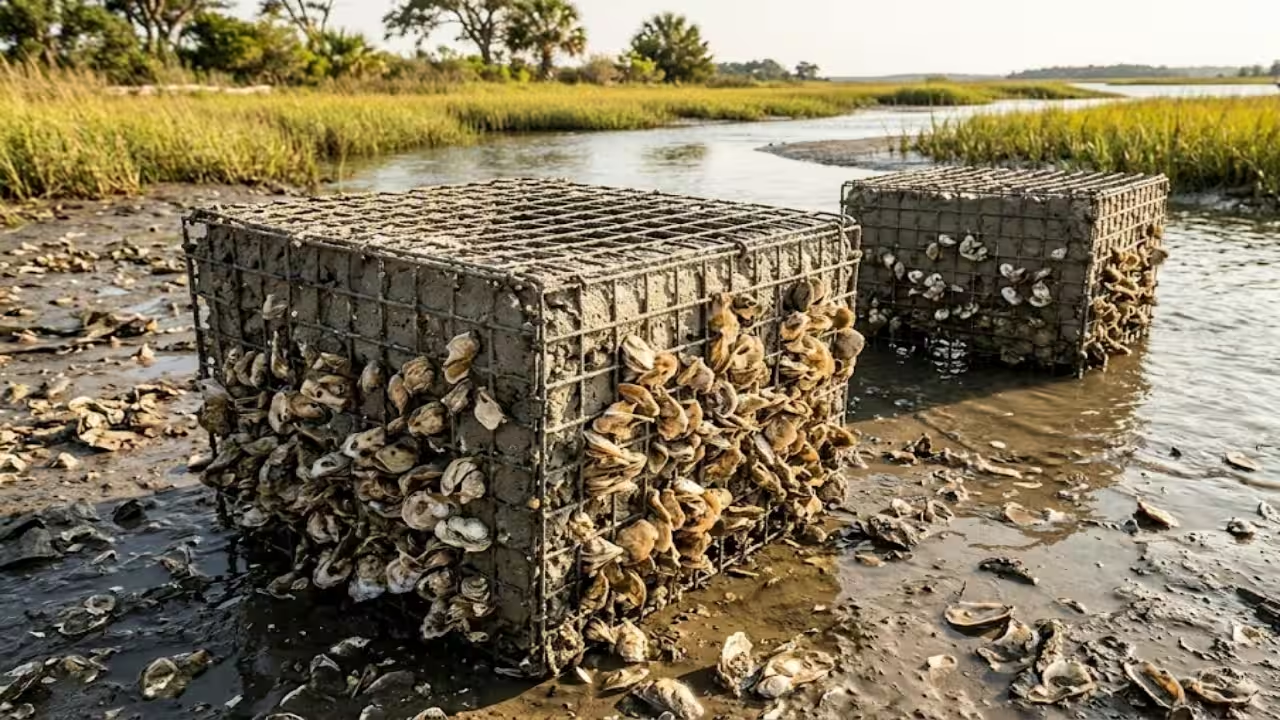
If you walk along the beach of a South Carolina creek during low tide, you might notice the debris the water leaves behind. Tattered rope, broken dock planks, plastic bottles, and even a cube of rusty wire that was formerly used as blue crab bait. Crabbers often lose their traps. Storms push the wires out of place, boat propellers shatter them, and some are just left to sink. The problem is that, long after crabbers stop tracking it, a neglected trap still catches crabs, turtles and other animals that cannot escape.Between 2009 and 2012, government experts tested a few hundred of them. The Department of Natural Resources in South Carolina did not dump the retrieved traps. Instead, they sealed the vents, covered the wire with concrete and repurposed the traps as the basis for oyster reefs. Supported by a plan sponsored by NOAA and the Southeast Aquatic Resources Partnership, or SARP, the initiative had deployed 285 modified traps in coastal waters by December 2012. It is a technique that can work on soft, muddy ground where typical reef development is difficult. The study is forthright about its tradeoffs.A problem that keeps fishingBlue crab fishing is a big business for the state, with landings valued at over $6 million a year, according to S.C. Sea Grant. Storms, heavy tides, boat propellers and ordinary wear can tear the lines, and traps shift or vanish. They keep catching creatures, a behaviour called ghost fishing, even after settling into a marsh or channel. According to the South Carolina Department of Natural Resources’ terrapin studies page, more than a third of the hundreds of abandoned traps removed each year contain trapped animals.The oyster side of this narrative begins with a materials concern. Crushed oyster shell is the typical building block used in reef repair work, however it can be costly to purchase and inefficient in swampy areas. There’s a lot of soft mud in the state’s tidal creeks and not the hard surfaces young oysters need to settle on, SARP adds. A solid hand-wire basket offers the larvae something to grab onto.NOAA says the project aims to keep reefs healthy and reduce coastline erosion and habitat loss.The results of the testsA 2014 thesis by A. D. Kreutzer, cited in a 2019 PeerJ study, found that concrete-dipped crab traps drew more oysters than untreated ones, likely because the concrete adds a rough surface and may mimic the chemical cues oysters give off. So traps are not always an alternative to shell. They are a fallback where shell falls short.Mud was the more beneficial discovery. In a separate investigation, traps with recycled oyster shell previously seeded with live spat were deployed on firm and soft sand for nine months. They never became clogged, even in soft dirt. In the traps, juvenile oysters averaged about 26 mm on hard ground and 31 mm on mud, with survival rates of 38.5% and 34.6%. The author discovered that repurposed traps, particularly cement-coated ones, could facilitate oyster restoration in many locations where existing shell methods aren’t feasible.The field images provide a similar story. SARP’s project page shows an experimental reef at Dawho Cut where traps were set on 5 April 2011 and photographed on 10 November that year, around seven months later. The second demonstration reef identified as having high oyster recruitment and growth on the coated traps is Bears Bluff on Wadmalaw Island.Where it is todayShellfish biologists with the department stated they have been recycling obsolete and donated crab traps as reef material since 2011. More recently, a NOAA-funded effort has aimed to find and remove abandoned traps and recycle the recovered wire into new oyster habitat. Other coasts have had their own studies. A 22-month field experiment published in PeerJ compared concrete structures with crab traps on degraded oyster bars in northwestern Florida.Oysters settled faster on the concrete in the first year, but both proved viable. Both did best at lower intertidal elevations. That is also why placement matters. Most of the South Carolina results come from monitoring periods of nine months or less, so it remains to be seen how these reefs will fare across several seasons. In practice, for now, it is simple. Wire that once sat in the water killing wildlife is hauled out and put to work, giving oysters a place to begin.You use AI every day. Now get your AI Quotient. Take the AIQ test.
Topics in this story
Gathered from external sources. Rights to this text belong to whoever originally published it.